The Triathlete's 4th Discipline: A Guide to Mastering Logistics
By Sarah — translated from an article by Charly Caubaut Published on 09/06/2026 at 08h31 Reading time : 9 minutes
Hello there, fellow triathlete!
We often talk about the three disciplines: swimming, cycling, running. We spend hours, months, even years perfecting our crawl, optimizing our position on the bike, lengthening our stride. But there's a hidden discipline, a silent event that can turn your race into a dream or a nightmare: logistics. Yes, you read that right. I call it the 4th discipline. It's everything that happens before the starting "BEEP" and after crossing the finish line. It's the art of forgetting nothing, planning for everything, and staying calm when everyone around you seems to be running around like crazy. Having experienced missed starts because of an alarm that didn't go off and chaotic transitions over a misplaced pair of goggles, I can assure you: mastering your logistics means giving yourself peace of mind and precious minutes on the clock.
It's not the most glamorous part of triathlon, I'll grant you that. It doesn't make for pretty Instagram photos. But it's the foundation of your performance. Well-oiled logistics mean a clear mind, 100% focused on the effort. In this guide, I'm going to share all my tips, my field-tested checklists, and those famous "practical tips" that make the difference between a stressed-out triathlete and one who's ready to battle it out. So, are you ready to train for this 4th discipline? Let's go!
Advance preparation: the race begins a month before
The secret to successful race-day logistics is anticipation. The more you prepare things in advance, the fewer decisions you'll have to make and the less stress you'll have to manage when the pressure mounts. Think of this phase as your logistics training camp.
D-30: The ultimate checklist, far beyond just equipment
Everyone knows about the gear checklist. But logistics go further. A month before the event, you need a clear vision of all the organizational aspects. This is the time to create your own "race folder."
- Registration and documents: Check that your registration is confirmed. Print the confirmation, your medical certificate or license, and a form of ID. Put everything in a plastic sleeve that you can just grab and go. I even recommend scanning these documents and having them on your phone or in the cloud. You can never be too careful.
- Race regulations: Read them. The whole thing. Yes, it's long, but it's a goldmine of information: cut-off times, type of nutrition at aid stations, specifics of the transition area, penalties... Knowing the rules means avoiding unpleasant surprises.
- Travel planning: If the race isn't close to home, now is the time to book. Train, plane, car? Think about transporting your bike! Some airlines are more "bike-friendly" than others. If you're driving, do you have room for all your gear and your teammates' stuff?
- Accommodation: Choose a place not too far from the start to avoid the stress of the journey on race morning. A bonus? A place that allows bikes inside and offers an early breakfast (or a kitchen to prepare it yourself).
This first step takes a huge mental load off your shoulders. Once it's done, it's done. You can focus on your physical training.
Planning travel and accommodation: the tips that change everything
Traveling with a bike is an adventure in itself. If you're flying, invest in a good hard or semi-rigid bike case. Practice disassembling and reassembling your bike several times before you leave to get comfortable with it. Don't forget the necessary tools! A practical tip: slightly deflate your tires, but not completely, to avoid issues with pressure in the cargo hold.
For accommodation, I have a slight preference for Airbnb-style rentals with a kitchen. This allows you to have complete control over your pre-race nutrition, without depending on restaurant hours and menus. In the evening, you can prepare your favorite pasta dish, and in the morning, your usual breakfast. This is a significant psychological comfort. Also, check the distance to the transition area. Being able to walk or bike there in the morning is a luxury that eliminates parking stress.
Course reconnaissance: your best strategic weapon
Knowing the terrain gives you a huge advantage. If you can visit the location a few weeks before, that's ideal. But if it's not possible, don't panic, technology is your friend.
- Virtual reconnaissance: Dive into the maps. Organizers often provide elevation profiles and GPX tracks. Load them onto your watch or GPS computer. Use Google Street View to visualize sharp turns on the bike course, changes in road surface, and especially the entrance and exit of the transition area. Identify difficult hills on the run course to know where to manage your effort.
- Physical reconnaissance (if possible): If you're on-site the day before, do the swim if the water is accessible to get your bearings (the sun, a building, a tree...). Drive the bike course or, even better, ride a small portion of it to feel the gradients of the hills and the technicality of the descents. Check out the run course with a light jog. The goal isn't to do a workout, but to memorize key points.
Knowing what to expect transforms the unknown into a familiar playground. On race day, you won't just endure the course; you'll dominate it.
Bike mechanics: the final check-up you can't miss
Your bike is your most faithful ally; don't neglect it. A week before the race is the perfect time for a final, complete check-up. If you're not a mechanical expert, take it to your bike shop. Ask them to check the brakes, the drivetrain (gears), the tightness of all components, and the tire pressure. This is also the time to put on your race wheels if you have them. After this check-up, go for a short 30-minute ride to make sure everything is working perfectly. Don't make any major changes after this! The worst mistake would be to change your saddle or position the day before the race.
Race week (D-7 to D-1): the art of setting up
During the final week, physical training decreases (this is tapering), but logistical preparation intensifies. Every action should be thought out to get you to the starting line in the best possible condition.
Preparing your transition bags: the foolproof method
Organizing your transition gear is crucial. This is where precious seconds can be gained or lost. I recommend preparing three separate bags, even if the race organization doesn't require it. This helps you visualize each step.
- Bag 1 (Pre-race): Everything you need before the start. Floor pump, tools, pre-race nutrition, sunscreen, warm clothing to avoid getting cold.
- Bag 2 (Transition 1 - T1: Swim > Bike): Helmet, cycling glasses, race belt, cycling shoes (if you don't leave them on the pedals), nutrition for the bike. A small towel to dry your feet can be a great practical tip!
- Bag 3 (Transition 2 - T2: Bike > Run): Running shoes with speed laces, cap or visor, sunglasses (if different from your cycling ones), nutrition for the run.
For the main equipment, here is a reminder that you can refine. This is such a vast topic that we have written a complete guide: Triathlon: The Complete Equipment Checklist to Succeed in Your Race. Feel free to consult it to make sure you don't forget anything.
Once your bags are ready, do a mental rehearsal. Close your eyes and visualize yourself going through your transition. Getting out of the water, running to your bike, taking off your wetsuit... Every movement should become automatic.
The race briefing: decoding crucial information
The briefing, whether online or in person the day before, is MANDATORY. Organizers provide last-minute information: water temperature (which determines if wetsuits are allowed), course changes, danger zones, number of laps to complete... Pay attention, take notes. This is also the time to ask questions if anything is unclear. Never skip the briefing thinking, "I already know everything." Every race is different.
The day before the race: rituals, nutrition, and sleep
The day before is a sacred day. The watchword: calm. Avoid walking around the race expo for hours. Pick up your race bib, do your reconnaissance if you haven't already, and then go rest. Prepare all your things for the next morning: the trisuit you'll wear, your breakfast, your water bottles.
For dinner, stick to what you know. This is not the time to try the exotic local restaurant. A meal rich in complex carbohydrates (pasta, rice, quinoa) with a source of lean protein is ideal. Drink plenty of water throughout the day. And finally, sleep. You'll probably be a bit nervous, which is normal. Don't pressure yourself to get exactly 8 hours of sleep. Even if you only sleep 5 or 6 hours, if you've rested well the previous nights, you'll be fine. The important thing is to stay lying down and calm. Set two alarms, just in case. It's a simple trick that saved me once!
Race day: from dawn to the starting line
This is it, the big day! Your logistical preparation is about to pay off. The goal is to arrive at the start with maximum energy, without having wasted it on unnecessary stress.
The champion's wake-up: routine and breakfast
Wake up at least 3 hours before the start. This is the time needed for your body to wake up and for digestion to take place. Don't change anything in your habits. Eat the breakfast you've tested and approved in training. For me, it's a sports cake with coffee. For others, it might be whole-wheat toast with honey. The important thing is that it's easy to digest and gives you the necessary energy. While you eat, visualize your race one last time, the sequences, the transitions. Think positive!
Arriving on site: timing and scouting
Don't arrive too early or too late. Generally, 1.5 to 2 hours before your start is good timing. This gives you time to park without stress, pick up your race bib if you haven't already, and head to the transition area. Once there, your first instinct should be to locate the strategic points. Where is the swim start? The exit? The entrance and exit of the transition area? The start line? The finish line? Do a full tour of the site so everything is clear in your mind.
Setting up in the transition area: the art of organization
Your spot in the transition area is your base camp. Organization is the key to speed and serenity. Here's my method, a practical tip tested and approved hundreds of times:
- Set up the bike: Rack your bike in the designated spot. Make sure it's stable. Shift to the right gear for the start (an easy gear to get going).
- Inflate the tires: This is the last thing to do before leaving the area. Inflate to the pressure you normally use. Don't forget to remove your pump adapter!
- Set up nutrition: Place your gels and bars on your bike's frame or in your bento box. Fill your bottles and place them in the bottle cages.
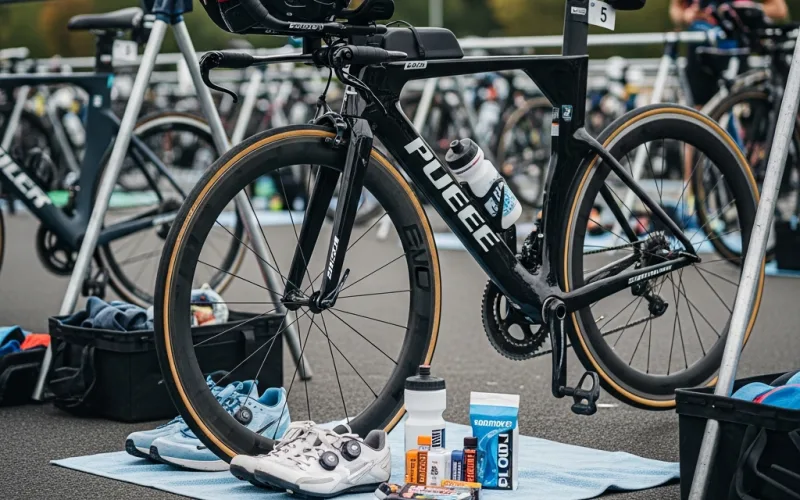
- Organize your gear on the ground: Use a small, brightly colored towel to mark your space and find your spot easily. Place your items in the order you'll use them. For T1: helmet open, placed on the aerobars or handlebars, with your glasses inside. For T2: running shoes, laces open, with maybe a little talc inside to put them on faster.
- Scout the path: Once everything is set up, go through the path mentally and physically. Start from the swim exit, run to your bike. Count the number of rows. Find a visual cue (a tree, a sign, a tent) to orient yourself. Do the same for the path from your spot to the bike exit, then from the bike entrance to your spot, and finally from your spot to the run exit. Do it several times until it's second nature.
⌚ XL Microfiber Towel 110 x 175 cm
🧾 A well-organized towel is the foundation of a successful transition. This microfiber model is perfect: it's large to clearly mark your space, ultra-absorbent to dry your feet in a flash, and dries very quickly after the race. It's a small detail that provides enormous comfort.
- Size: XL (110 x 175 cm) for a clear transition space.
- Material: Microfiber for quick absorption and drying.
🎯 Ideal for: The triathlete who wants to optimize every second of their transition with simple but effective gear.
🛒 Discover XL Microfiber Towel 110 x 175 cm on DECATHLONThe warm-up: linking the three disciplines
Once you're out of the transition area (which usually closes 15-20 minutes before the start), it's time to warm up. Start with a light 10-minute jog to wake up the body, followed by some drills (high knees, butt kicks) and 2-3 progressive accelerations. Then, put on your wetsuit. If a swim warm-up is allowed, take advantage of it! Swim for 5 to 10 minutes, do a few sprints to get your heart rate up and get your face used to the water temperature. This helps reduce the shock of the start. Keep an eye on the time to get to the starting corral on time, calm and ready.
After the race: logistical recovery
The finish line is crossed, the euphoria is there, but the 4th discipline isn't quite over. Good post-race management will allow you to fully savor your achievement and already prepare for the next one.
Collecting your gear: don't forget anything in the rush
After you've refueled and shared your first impressions with your loved ones, you'll need to go back to the transition area to collect your things. Don't rush. Take the time to pack everything up calmly. Do one last check of your spot to make sure you haven't forgotten anything: GPS computer, bottles, towel... It's amazing how many things can be left behind in the excitement of the moment!
The hot debrief: what worked, what didn't
On the way home or that evening, take 15 minutes to debrief your race, and especially, your logistics. What worked perfectly? What caused you stress? Did you forget anything? Were your transitions smooth? Write everything down in a notebook or on your phone. This feedback is precious for your future races. It's by analyzing these small mistakes that you become an expert in the 4th discipline.
Storing and cleaning your gear: for the next adventure
Back home, don't just leave your sports bag in a corner. The final stage of logistics is to take care of your gear. Rinse your wetsuit and trisuit immediately with fresh water and let them dry in the shade. Clean your bike, especially the drivetrain. Recharge your watch and GPS computer. By doing this right away, you ensure your equipment will be in perfect condition for the next outing and the next race. It's a sign of respect for your gear and for yourself.
Practical tips and pro tricks to go further
To finish, here are a few more tips, the fruit of many years on the circuit, to turn you into a true organizational pro.
Managing the unexpected: Plan B, C, and D
Triathlon is an outdoor sport, and the unexpected is part of the game. The key is not to avoid the unexpected, but to know how to react to it.
- Changing weather: Always have clothing for all conditions in your bag. Arm warmers, a windbreaker, and thin gloves can save you if the weather turns cold. A poncho is also an excellent ally for waiting before the start in the rain without getting cold.
- Flat tire: Know how to fix a flat tire with your eyes closed. Practice at home. On race day, have at least one new inner tube, tire levers, and a CO2 cartridge or a mini-pump on your bike.
- Lost nutrition: If you lose a gel, don't panic. Use the race's aid stations. That's why you read the regulations and know what they offer!
⌚ EKOI Racing MTB Forest Poncho
🧾 The wait before the start can be long and sometimes wet. This poncho is the ultimate practical tip for staying dry and warm without being weighed down. Easy to throw on over your clothes, it effectively protects you from rain and wind. It's a small investment for great comfort and an arrival at the starting line in optimal conditions.
- Protection: Effective against rain and wind.
- Practicality: Loose-fitting, easy to put on and take off quickly.
🎯 Ideal for: Triathletes who want to face all weather conditions and stay focused on their race, not the cold or rain.
🛒 Discover EKOI Racing MTB Forest Poncho on Ekoi - Product ReferenceThe importance of supporters: logistical and moral support
If you're lucky enough to have loved ones coming to cheer you on, they can be invaluable logistical help. Entrust them with your post-race bag with dry clothes for the finish. Give them strategic viewing spots so they can see you several times and give you encouragement (which is worth more than all the gels in the world!). Brief them before the race so they know where to position themselves and what you expect from them. Their support is an incredible force.
Classic beginner mistakes (and how to avoid them)
- Trying new gear on race day: Golden rule: NEVER. Whether it's shoes, a trisuit, or a new gel, everything must be tested and approved in training.
- Pinning your bib incorrectly: Use a race belt. It's faster and more comfortable. Remember to wear it on your back for the bike and on your front for the run.
- Forgetting sunscreen: Even on a cloudy day, you can get a serious sunburn during a triathlon. Apply it generously before you start.
- Starting too fast: The adrenaline of the start is a trap. Stick to your race plan, manage your effort. A triathlon is a test of management, not a 100m sprint.
As you've understood, logistics isn't a chore, but a true discipline that is worked on and perfected, just like swimming, cycling, or running. By dedicating time and attention to it, you're not just preparing for a race; you're preparing for success. You're putting all the chances on your side so that on race day, only your performance and the pleasure of the effort matter. It's a mindset, an approach that will serve you in all your sporting challenges.
Now, you have all the tools to become a master of logistics.
It's your turn to play!
Answers to your questions about triathlon logistics
What is the biggest logistical mistake to avoid before a triathlon?
The biggest mistake is undoubtedly testing new equipment or new nutrition on race day. Everything, absolutely everything, must have been tested and validated during your training sessions. New shoes that cause blisters or a gel that gives you stomach problems can ruin months of preparation. The day before and on race day, stick to what works!
How should you organize your spot in the transition area to not waste time?
The key is method and simplicity. Use a brightly colored towel to clearly mark your space. Place your items in the order you will use them: for T1 (bike), have your helmet open on the handlebars with your glasses inside, and your race belt next to it. For T2 (run), have your running shoes open, with your cap and gels placed inside. The fewer items there are, the less risk of getting tangled up. And most importantly, walk the path from the swim exit and the bike entrance several times to memorize your spot.
Should you arrive very early at the race venue?
You need to find the right balance. Arriving 1.5 to 2 hours before the start is generally a good compromise. This gives you enough time to park without stress, use the restroom, calmly set up your gear in the transition area, scout the location, and warm up without rushing. Arriving too early can lead to unnecessary waiting and fatigue, while arriving too late is the best way to start your race with a huge dose of stress.
How do you manage logistics when traveling for a triathlon?
Traveling for a race requires maximum anticipation. Book transportation and accommodation well in advance, favoring "bike-friendly" options. Use a quality bike travel case and practice assembling/disassembling it. Make a specific "travel" checklist that includes your tools, documents, and nutrition (as you might not find your usual products on site). Plan to arrive at least two days before the race to have time to settle in, recover from the journey, and do a course reconnaissance.