Power Hiking in Trail Running: The Art of Walking to Go Faster
By Sarah — translated from an article by Charly Caubaut Published on 16/06/2026 at 08h31 Reading time : 9 minutes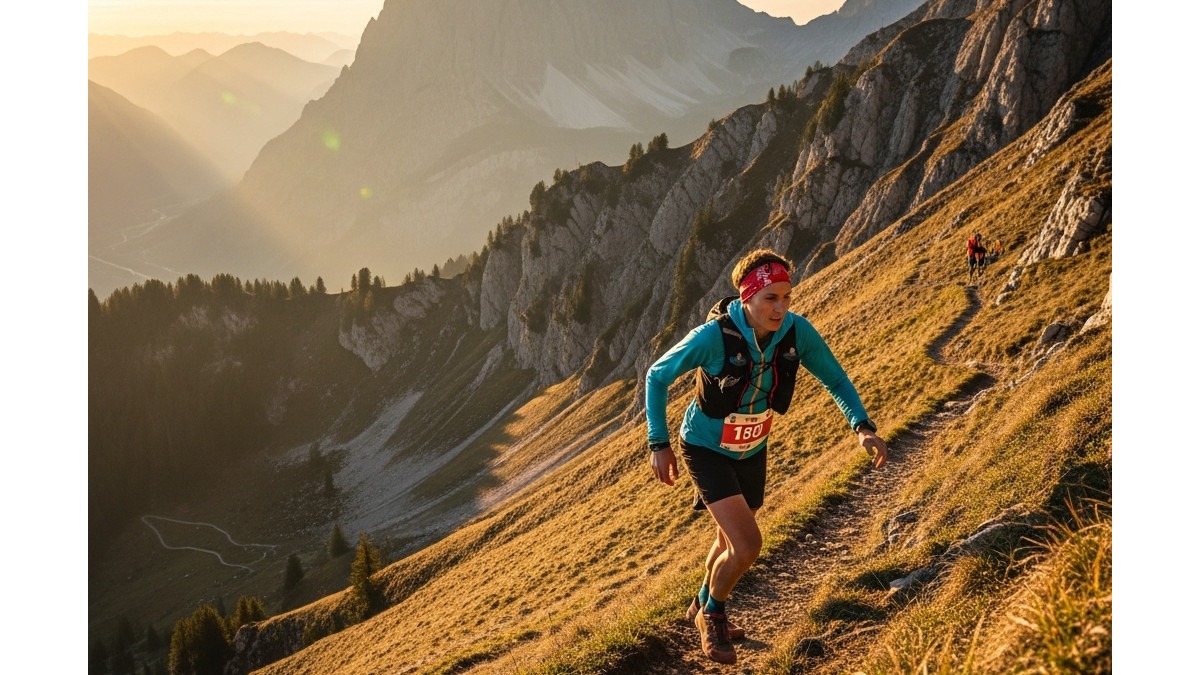
Walking is Cheating? Let Me Tell You a Story...
We've all asked ourselves the question, haven't we? Stuck at the bottom of a wall that seems to touch the sky, short of breath, thighs on fire, that little voice whispering: "Go on, walk a bit, no one's watching." For years, like many runners, I believed that walking in a trail race was an admission of weakness. A sign that I hadn't trained enough. Until the day, on a particularly demanding ultra in the Alps, I saw the race leaders... walking. But not just any kind of walking. They moved with a power, determination, and efficiency that left me speechless. It wasn't a recovery walk. It was a weapon. That day, I discovered power hiking.
Hi, it's Charly! A former triathlete, I've spent thousands of hours on trails and roads, testing gear, refining my technique, and above all, learning from my mistakes. And the biggest mistake was underestimating the power of walking in trail running. Today, I want to share with you what has become one of the pillars of my performance and enjoyment in the mountains. Forget your ego, forget the prejudices. Power hiking isn't about giving up on running; it's about choosing intelligence to go further, higher, and often... faster. So, lace up your shoes, we're off to discover this subtle art that will transform your mountain outings. Ready?
What is Power Hiking? Much More Than a Simple Walk!
If you're picturing power hiking as a Sunday stroll in the woods, you're sorely mistaken. It's the complete opposite. It's an active, intense, and incredibly effective progression technique, specially designed for the steep terrain that we trail runners love so much.
Definition: The Art of Active and Intentional Walking
Power hiking is a fast, dynamic walking technique used on steep climbs in trail running. The goal is not to rest, but to maintain a high rate of forward progression while expending less energy than running. It's a deliberate, engaged movement where every part of the body contributes: the legs, of course, but also the core, the arms, and even the mind. It's the difference between enduring the slope and attacking it with strategy.
Why Walk When You Can Run? The Science of Energy Conservation
This is the heart of the matter. Why would a top-level athlete, capable of running at crazy paces on flat ground, choose to walk? The answer is simple: efficiency. Biomechanical studies, like those conducted in the past on human locomotion, have shown that beyond a certain gradient, the energy cost of running exceeds that of walking. In concrete terms, to maintain the same speed on a very steep slope, your body will burn far more calories and oxygen by running than by walking efficiently.
There is a threshold, a tipping point unique to each runner, where the running stride becomes an inefficient jump against gravity. By switching to power hiking, you reduce the impact on the ground, engage your muscles differently (hello, glutes!), and most importantly, keep your heart rate in a more sustainable zone. You conserve your energy for the more runnable sections and the descents. It's pure effort management, the key to success over long distances.
The Pros Do It, So Why Not You?
If you still have doubts, look at the elites. Legends like Kilian Jornet, François D’Haene, or Courtney Dauwalter are absolute masters of power hiking. Watch them in races: on the toughest climbs of UTMB or the Hardrock 100, they don't run. They walk. But with a cadence and power that allows them to leave 99% of the runners who are exhausting themselves trying to jog in the dust. They understood that trail running isn't a pure speed race, but a chess match against the mountain, the distance, and yourself. Power hiking is their masterstroke. If it's good enough for them, believe me, it's good enough for us!
When Should You Unleash the Power Hiking Weapon?
Knowing how to walk is good. Knowing WHEN to walk is even better. Power hiking isn't a silver bullet to be used haphazardly. It's a strategic tool to be deployed at the right moment. Here are the situations where you should unhesitatingly put away your running stride and bring out your warrior walk.
Factor #1: The Gradient
This is the most obvious criterion. The steeper the slope, the more advantageous power hiking becomes. There's no universal magic percentage, as it depends on your fitness, your technique, and the length of the climb. However, most trail runners agree that above a 15-20% gradient, walking becomes mechanically and energetically more efficient than running. The best indicator? Your own body. If you feel like you have to contort yourself to run, that your stride shortens to the point of becoming a costly shuffle, and your heart is racing without any real increase in speed... it's time to walk.
Duration of the Effort: Managing Your Energy Capital on an Ultra
On a short 10 or 20 km trail, you might be able to get away with running everything (and even then!). But as soon as you tackle longer distances – marathon, 80 km, and let alone an ultra – power hiking becomes not an option, but a necessity. Every running stride generates an impact that fatigues your muscles and joints. Walking on the steepest hills, even at the beginning of the race when you feel fresh, is like putting money in the bank. You save your muscle fibers, limit the damage, and preserve that precious glycogen you'll desperately need after hours of effort. Think long-term: every hill walked is an investment to finish strong.
Technical Terrain: Stability and Safety First
The mountains aren't an athletics track. Trails full of roots, unstable scree fields, muddy and slippery sections... In these conditions, trying to run at all costs is not only inefficient but also dangerous. Power hiking allows you to plant your foot more securely and with more control. You can better choose your footing, maintain your balance, and drastically reduce the risk of a fall or a twisted ankle. Safety always comes first, and a sprained ankle is a guaranteed race-ender.
Altitude: When Oxygen Becomes Scarce
As soon as you go above 2000 or 2500 meters (6500-8200 feet), the scarcity of oxygen becomes noticeable. Your body struggles to supply your muscles, and the slightest effort pushes you into the red. In this context, power hiking is your best friend. It allows you to keep moving at a good pace while keeping your effort at an aerobic intensity, thus limiting shortness of breath and mountain sickness. At altitude, humility and intelligence always pay off.
The Perfect Power Hiker Technique: My Practical Gems
Now that we've covered the why and when, let's move on to the how. Because power hiking is a real technique that needs to be practiced. Forget slouching, head down. We're aiming for power and efficiency. Here are my practical gems, tested and approved over hundreds of kilometers of elevation gain.
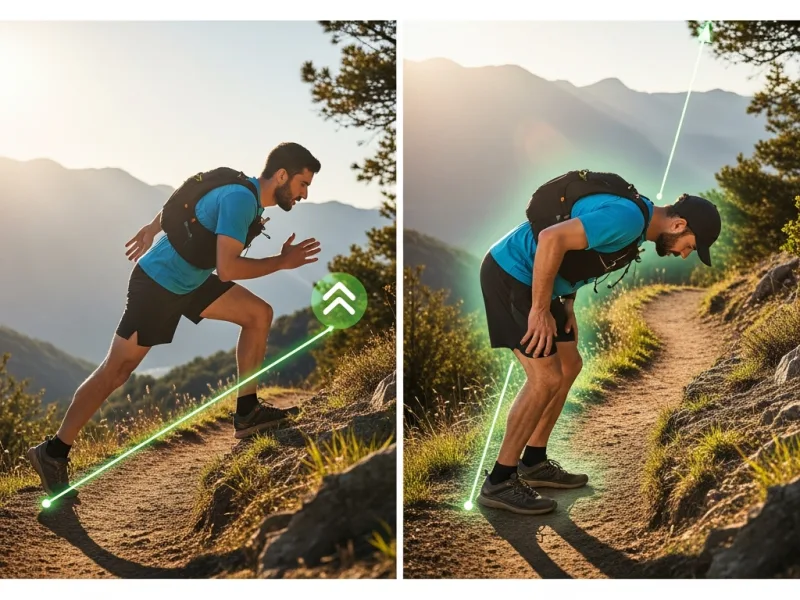
Posture: The Secret Is in the Hips
Everything starts from the body's core. The most common mistake is to bend in half at the waist, which compresses the diaphragm and prevents proper breathing. Instead, you should:
- Lean forward from the hips, not from your back. Imagine a hinge at your pelvis.
- Keep your back as straight as possible. Think about lengthening your spine, as if a string is pulling the top of your head towards the sky.
- Engage your abs. A braced core ensures the transfer of power between the upper and lower body and protects your lower back.
This posture opens up your chest for full breathing and allows your powerful glute muscles to kick in.
Footwork: Cadence and Power
In power hiking, we're not looking for stride length, but for efficiency. You need to find the right balance between cadence and power.
- Take shorter, quicker steps than in a normal walk. This helps maintain a good cadence and makes each step less taxing.
- Land with a flat foot as much as possible to maximize contact surface and stability.
- Focus on the push-off. The movement should come from behind. Push hard off your supporting leg by consciously contracting your calf and especially your glute. That's your main engine!
The Art of Using Your Arms (With and Without Poles)
Your arms aren't just there for balance! They are an additional source of propulsion. There are two schools of thought, depending on whether you use poles or not.
Without Poles: Hands on Thighs
This is the simplest and most instinctive technique. When the slope gets really steep, place your hands just above your knees, fingers pointing inwards. With each step, actively push on your thigh to help the leg move up. It's like adding the strength of your arms to your quadriceps. This technique takes a huge load off the legs, and you can even alternate (right hand on left thigh and vice versa) to create a natural rocking motion.
With Poles: Your Best Allies in the Mountains
Ah, poles... once you've tried them, it's hard to go back! They turn your walk into a full-body activity, making you feel like you have four-wheel drive.
- The basic technique (alternating): This is the most natural. You move the right pole forward with the left foot, and vice versa. Push firmly on the pole to propel yourself forward and upward. The pole should be planted slightly behind your supporting foot for an effective push.
- The double pole push: In very steep sections or to get over an obstacle, you can plant both poles in front of you at the same time and hoist yourself up using the strength of your arms, back, and chest. It's a real power boost.
- The correct adjustment: Make sure your poles are the right length. For uphills, you tend to shorten them a bit for a better push. Your elbow should form an angle of about 90 degrees or slightly less.
Gaze and Breathing: Aim High and Breathe Low
Two final details that are anything but minor. First, lift your head! Don't stare at your feet. Look 5 to 10 meters ahead to anticipate the terrain, choose the best line, and maintain an open posture. Mentally, seeing the path ahead is much more motivating than only seeing the immediate difficulty. Second, breathe. Synchronize your breathing with your steps. For example, inhale for two steps, exhale for two steps. Find your rhythm. Aim for deep, diaphragmatic breathing rather than short, choppy chest breathing. This improves oxygenation and helps you stay calm and focused.
How to Specifically Train for Power Hiking?
Power hiking isn't innate. Like swimming or cycling, it's a skill that develops with practice. You can't expect to be efficient on race day if you've never worked on it in training. So, let's get to work!
Incorporate Dedicated Sessions into Your Plan
Don't just walk when you're tired. Schedule actual power hiking sessions. Find a good hill near you, long and steep if possible, and do a series of repeats. The goal is to work on the technique at a controlled heart rate (zone 2-3), but also to do more intense intervals where you push up to your threshold (zone 4). For example:
- Endurance session: 4 to 6 repeats of 10 minutes of continuous power hiking uphill, focusing on posture and breathing. Recover on the downhill.
- Threshold session: 5 repeats of 5 minutes of power hiking uphill at an intensity where you can barely speak.
These sessions will not only improve your technique but also specifically strengthen the muscles involved. To go further on this topic, I suggest you take a look at our guide to mastering technical climbs in trail running, which is an excellent complement.
Strength Training: Building a Powerful Engine
To be a good power hiker, you need strength. A targeted strength training program will work wonders. You don't need to spend hours at the gym; 2 sessions of 20-30 minutes per week can be enough. Focus on:
- The posterior chain: Squats, lunges, straight-leg deadlifts, hip thrusts. These are your main engines: the glutes and hamstrings.
- Calves: Calf raises.
- Core work: Planks (front, side), mountain climbers. For optimal power transfer.
- Upper body (if you use poles): Rows, push-ups, dips. To have power in your arms and back.
Base Endurance in Hike-Run Mode
The long weekend outing is the perfect playground for practice. Instead of forcing yourself to run everything, adopt a hike-run strategy: run on the flats and easy descents, and switch to power hiking as soon as the slope gets steep. This is the perfect simulation of race conditions. You'll learn to manage the transitions between walking and running, which are crucial for not breaking your rhythm.
Treadmill Work: Controlling Intensity and Gradient
Do you live in a city or a flat region? Don't panic! The treadmill is a fantastic tool. You can adjust the gradient and speed with surgical precision. Set the treadmill to an incline of 15% or more and walk at a good pace. It's a mentally tough but incredibly effective exercise for strengthening the right muscles and cardiovascular system. You can replicate your hill sessions indoors, without worrying about the weather or daylight.
The Gear That Makes a Difference for the Power Hiker
While technique is king, the right gear can give you that extra edge that makes the effort easier and improves efficiency. Unsurprisingly, we'll talk about three key elements.
Poles: Choosing Your Companions in Hardship
This is the number one accessory for the power hiker. Choosing your poles wisely is essential. Here are the criteria to look at:
- Single-piece or foldable/telescopic? Single-piece poles are lighter and more robust, but less practical to carry. Foldable poles (most often in 3 sections) are the choice of the majority of trail runners because they are easy to store on a pack.
- Carbon or aluminum? Carbon is lighter and absorbs vibrations better, but it's more expensive and more fragile. Aluminum is a bit heavier but very durable and more affordable.
- The grip and the strap: A cork or foam grip is more comfortable than plastic. The strap (or gauntlet) is crucial: it should allow for a good grip and an effective push without having to squeeze the handle constantly.
Shoes: Grip and Stability Are King
On a steep climb, your entire body weight rests on a small surface area. A good pair of trail running shoes is therefore non-negotiable. Above all, look for a sole with excellent grip (deep, well-spaced lugs) to avoid slipping backward with each push. Good foot support is also important for stability on technical terrain.
Hydration Pack: Accessibility Is Key
When you're in the middle of a hard climb, the last thing you want to do is stop to take off your pack and search for a flask or a bar. Your pack should be your cockpit. Make sure your hydration, nutrition, and pole storage (if you opt for foldable ones) are easily accessible without stopping. A quiver or attachments on the shoulder straps are very practical systems for poles.
⌚ EKOI Perf Seamless Arm Warmers
🧾 During long mountain climbs, the weather can change quickly. These arm warmers are perfect for adapting: you put them on when a cool wind picks up at the summit and easily take them off on the descent without having to stop. A lightweight and versatile accessory, ideal for temperature management in trail running.
- Thermoregulation: Keeps your arms warm without overheating.
- Seamless: Optimal comfort, without chafing during effort.
🎯 Ideal for: Trail runners and cyclists looking for a modular solution to handle temperature changes on long outings with elevation gain.
🛒 Discover EKOI Perf Seamless Arm Warmers on EkoiCommon Mistakes to Avoid in Power Hiking
We learn a lot by doing, but we can save time by avoiding others' mistakes! I made quite a few in my early days, so here's a little summary for you.
Hunching Over: The Diaphragm Killer
I've said it before, but I'll say it again because it's the number one mistake. When fatigue sets in, we tend to collapse, to round our back. It's a reflex. Fight it! Straighten up, open your shoulders, think 'proud and tall.' Your breathing and your lower back will thank you.
Taking Strides That Are Too Long: Guaranteed Exhaustion
We feel like taking long steps will make us go faster. It's an illusion. Long strides uphill are very costly in terms of energy, they heavily tax the quadriceps and break your rhythm. It's better to have a higher step cadence with shorter strides. Think 'spinning' like cyclists in the mountains.
Planting Poles Too Far Forward: A Brake on Your Progress
If you plant your poles too far in front of your feet, you'll be pulling yourself forward instead of pushing yourself up. It's counterproductive. The pole should land level with your heel, or even slightly behind, so that the main movement is a push backward, which propels you forward.
Waiting Until You're Exhausted to Start Walking
The worst strategy of all! If you wait until you're in the red, with your legs screaming and your heart rate at 180 bpm, to decide to walk, it's already too late. The walk then becomes a forced recovery, not an effective progression strategy. Power hiking must be proactive. Anticipate the difficulty of the slope and switch to walking mode BEFORE you're in agony. That's the sign of a smart and experienced trail runner.
There you have it, you now have all the tools to transform the way you climb. Power hiking is not an easy way out; it's a demanding technique that requires practice and strength. But I guarantee you, once mastered, it will give you an incredible advantage on all terrains. It will allow you to manage your effort, stay sharp, and above all, have even more fun on your mountain adventures. So, don't be ashamed to walk anymore. On the contrary, be proud of it, do it with power and intention.
Now it's your turn!
Your Questions About Power Hiking
At what gradient should you start walking in trail running?
There's no absolute rule, as it depends on your fitness level and the race distance. However, most experts and experienced runners agree that a gradient above 15% is a good indicator. The key is to switch to walking before you're completely exhausted, when you feel that running is becoming less efficient and more energy-intensive than walking quickly.
Is power hiking with poles really more effective?
Yes, without a doubt. Using poles turns power hiking into a full-body exercise. They help distribute the effort between the legs and the upper body (arms, shoulders, back), which relieves the lower limb muscles and reduces overall fatigue. Additionally, they improve stability and propulsion, making you faster and more energy-efficient overall on long climbs.
How can I train for power hiking without mountains nearby?
It's a common challenge, but entirely surmountable! Use a treadmill set to its maximum incline (15% or more). Stadium steps, stairs in a tall building, or even bleachers are also excellent tools. You can also look for bridges, multi-story car parks, or short hills and do repeats on them. Targeted strength training (glutes, quads, calves) is also crucial for developing the necessary power.
Won't walking in a trail race ruin my final time?
On the contrary, it's one of the best strategies to improve it, especially over long distances! By walking efficiently and strategically on steep hills, you save precious energy. This energy will be available to run faster and longer on flat or downhill sections, especially at the end of the race where many runners bonk because they've exhausted themselves on the climbs. It's a calculation of overall efficiency.