Fear of the 'Washing Machine': Conquering Swim Start Anxiety in Triathlon
By Sarah — translated from an article by Charly Caubaut Published on 28/04/2026 at 08h30 Reading time : 10 minutes
Fear of the 'Washing Machine': The Ultimate Guide to Finally Enjoying Your Triathlon Start
Hey, fellow triathlete! Charly here. Today, we're going to talk about a topic that makes 9 out of 10 triathletes clench their jaws, from the absolute beginner to the seasoned Ironman finisher: that infamous, dreaded, cursed **'washing machine'** of the swim start. You know what I'm talking about, right? That moment when the starting gun fires and the body of water, so calm just seconds before, turns into a churning mess of arms, legs, splashes, and contact... that isn't always gentle. 😅
Your heart races, your breath catches, you feel like you're losing control... believe me, I know it all too well. I've spent years on the circuit, and I've been through my share of starts. Some were euphoric, where everything just flowed, and others where I felt like I drank half the lake and fought for every single breath. That knot in your stomach before you jump in the water is normal. It's a human reaction to a situation perceived as dangerous. But the good news is, it's not a life sentence. Far from it!
In this guide, we're not just going to tell you to "take a deep breath." We're going to dissect this phenomenon together, understand why it throws us into a tizzy, and most importantly, give you concrete tools, field-tested tips, and strategies you can apply in training starting tomorrow. My goal? For you to turn this ordeal into a mere formality, or even a moment of controlled excitement. So, pull on your tri-suit, adjust your goggles, and let's dive into the heart of the matter to tame the beast. Let's go!
Understanding the "Washing Machine" to Better Outsmart It
Before looking for solutions, we need to make a diagnosis. Understanding what's really happening in that aquatic chaos is the first step to de-dramatizing it and regaining control. It's a bit like looking at a map before heading out on a hike: it helps you not get lost along the way.
Anatomy of a Mass Start: Autopsy of Chaos
Imagine hundreds (sometimes thousands) of people, full of adrenaline, launching themselves at the same time into a relatively small space with a common goal: to reach the first buoy as quickly as possible. What does that actually look like?
- Constant Churn: The water is literally churned up. The waves no longer come just from the wind, but from the movements of all the swimmers around you. The water is murky, full of bubbles, making visibility almost zero.
- Physical Contact: It's inevitable. An arm brushing your hip, a foot tapping your shoulder, someone trying to swim over you... Most of the time, it's completely unintentional. Every swimmer is just trying to find their path, just like you.
- Loss of Bearings: Between the choppy water, lack of visibility, and ambient noise, it's very easy to feel disoriented. That perfect swim line you imagined? It's often put to a tough test in the first 200 meters.
- Maximum Intensity: Everyone starts fast, very fast. Your heart rate skyrockets, and if you're not careful, you can find yourself in the red zone before you've even found your cruising pace.
This explosive cocktail is what we call the "washing machine." It's intense, it's messy, but it's not a lawless zone. It's a phase of the race with its own set of rules that you have to learn to master.
The Roots of Anxiety: Why Is It So Terrifying?
Now, let's ask ourselves why this situation generates so much stress. It's not just a matter of "not liking contact." The reasons are deeper and touch on both our psychology and our physiology.
From a psychological perspective:
- Loss of Control: This is the number one factor. As endurance athletes, we love to control everything: our pace, our heart rate, our nutrition... But at the start, a large part of that control is out of our hands. We depend on the actions of others, the weather, the density of the pack. This powerlessness is a major source of anxiety.
- Fear of the Unknown and the Unexpected: What's going to happen? Will I lose my goggles? Am I going to get swum over? Will I take a bad hit? Our brain hates uncertainty and tends to imagine the worst-case scenarios.
- Performance Pressure: We all have a goal in mind. The fear of messing up the start, losing precious time, and jeopardizing the entire race can be paralyzing.
From a physiological perspective:
Faced with what our brain interprets as a threat, our body reacts instinctively. This is the famous "fight or flight" response. Adrenaline is released, the heart rate increases, and breathing becomes short and rapid. In the water, this reaction is particularly problematic. Panting is a swimmer's enemy. It leads to a feeling of breathlessness, even suffocation, which can quickly escalate into a panic attack. It's a vicious cycle: physical stress fuels mental stress, and vice versa.
I remember one of my first triathlons. I was overconfident and positioned myself on the front line. When the gun went off, I was overwhelmed. I took a kick to the goggles, and they filled with water. Panic. I had to stop, empty my goggles on the side, and watch everyone pass me. That experience taught me one thing: respect the start. And above all, that good preparation isn't just physical; it's also, and most importantly, mental and strategic.
Before the Race: Forging a Mind of Steel
The battle against the "washing machine" isn't won on race day, but weeks, even months, beforehand. It's about fundamentally working on your mindset. It's your most powerful weapon, the one that will allow you to stay clear-headed when everything is churning around you.
Visualization: Swim the Race Before You Swim It
This is one of my favorite **golden nuggets**, used by all great athletes. Visualization isn't magical thinking. It's mental training that involves creating an experience in your mind as vividly as possible. The brain doesn't always distinguish between a real experience and an intensely imagined one. By familiarizing yourself with the start scenario, you "de-stress" it.
How to practice?
- Find a quiet place: Take 10 to 15 minutes, a few times a week, in a place where you won't be disturbed. Sit or lie down comfortably.
- Relax: Take a few deep breaths to relax.
- Create the movie of your ideal start: Imagine the scene with all your senses. You're on the beach or the pontoon. Feel the sand under your feet, the fresh air on your skin. Hear the buzz of the other athletes, the announcer's voice. See the colors of the swim caps, the shimmer of the water.
- The key moment: Visualize the starting gun. The entry into the water. Feel the water on your face. Visualize yourself swimming calmly, with long, controlled strokes, even if it's choppy around you. Your breathing is deep and steady. You are focused on your effort.
- Incorporate the unexpected: This is where the magic happens. Don't just visualize the perfect start. Also, imagine "difficult" scenarios and your calm, controlled reaction. What happens if someone bumps into you? You shift slightly and keep going. If you swallow some water? You cough, exhale sharply, and resume your breathing. By preparing your brain for these situations, you will no longer be caught off guard. You will already have a response plan.
Breathing Techniques: Your Anchor in the Storm
Your breath is the bridge between your body and your mind. If you control your breathing, you control your stress level. Anxiety causes shallow, rapid chest breathing. What you need is slow, deep, abdominal breathing.
Box Breathing:
- Inhale through your nose for 4 seconds.
- Hold your breath for 4 seconds.
- Exhale slowly through your mouth for 4 seconds.
- Hold your breath (lungs empty) for 4 seconds.
- Repeat this cycle several times.
Practice this exercise every day, and especially in the minutes before the start. It's an incredibly powerful tool for calming your nervous system. You can do it while waiting in the starting pen; no one will notice, but for you, it will make all the difference.
Set Process Goals, Not Just Outcome Goals
A major source of stress comes from fixating on a time or ranking goal ("I MUST get out of the water in under 30 minutes"). The problem is, you don't control all the variables. However, you do control your actions.
Shift your focus to **process goals** for the swim portion:
- "My goal for the first 200 meters is to stay calm and focus on exhaling completely in the water."
- "My goal is to lift my head to sight the buoy every 6 to 8 strokes."
- "My goal is to find feet to draft off once the pack stretches out."
These goals are 100% within your control. By focusing on them, you stay in the action rather than in anxious anticipation of the result. And guess what? By achieving these small goals, you put yourself in the best position to achieve your outcome goal!
In Training: Simulate to Dominate
You can't expect to be comfortable in chaos if you always train alone in a perfectly calm lane. The key is to integrate race condition simulations into your training routine, whether in the pool or in open water.
Group Training: The Best Simulation
If you're lucky enough to be in a club or have training partners, take full advantage of it! It's the easiest and most effective way to recreate the density of a start.
A few drills to implement:
- Swimming 3 or 4 to a lane: Forget comfort. Get several people in the same lane and swim at the same time. Yes, there will be bumping and getting in each other's way. That's the point! Learn to stay calm, adjust your line, and not get distracted by contact.
- The "washing machine" start: For a set of sprints (50m or 100m), everyone starts from the same T-mark at the same time. The first to the wall wins... the right to rest. This drill recreates the intensity and scramble of the start.
- Drafting drills with contact: Swim in a single file line, very close to each other. The person behind should intentionally touch the feet of the person in front. Then, try swimming side-by-side, brushing shoulders. The idea is to normalize physical contact so that it's no longer a source of surprise or panic on race day.
Drills to Keep Your Cool and Your Course
In addition to group simulation, certain individual drills are golden for building your confidence and skills in a hostile environment.
- Water Polo Drill (or head-up swimming): Swim freestyle while keeping your head completely out of the water for distances of 25m. It's physically demanding, but it's the best way to strengthen your neck muscles and get used to looking far ahead, even when it's choppy.
- Sighting: Integrate systematic sighting into your sets. Every 6, 8, or 10 strokes, lift your eyes just enough above the surface to look ahead without disrupting your swim rhythm. Do it even in the pool, aiming for the clock at the end of the lane. It should become a reflex.
- Hypoxic swimming: Do sets where you vary your breathing frequency. Swim a 50m breathing every 3 strokes, then another every 5 strokes, then every 7 strokes (if possible). This trains your body to handle a slight oxygen deficit and teaches you not to panic when you miss a breath.
The Essential Open Water Training
As soon as the water temperature allows, you need to get out of the pool. Open water is a completely different environment that requires specific adaptation.
- Temperature Acclimatization: Entering colder water can cause a thermal shock that takes your breath away. Training regularly in open water allows your body to get used to it and reduces this gasping reaction.
- Swimming without lines: In a pool, you're guided by the lines on the bottom. In a lake or the sea, there's nothing. This is where your sighting training really pays off. You must learn to navigate, lift your head, aim for a fixed point, and correct your course.
- Testing your gear in real conditions: This is the time to swim in your triathlon wetsuit, check the seal and comfort of your race goggles. No nasty surprises on the day of the event!
Race Day Strategies: The Battle Plan for a Controlled Start
This is it, the big day. You've done the mental and physical work. Now, it's time to execute the plan. Here is the checklist for a calm and effective start.
The Warm-up: More Than Just Getting Going
I still see too many triathletes who skip or rush the swim warm-up. Big mistake! It's a crucial moment to prepare your body and mind.
If the organization allows it (which is almost always the case), **get in the water 10 to 15 minutes before the start.**
- Acclimatization: The first thing to do is let water into your wetsuit and get used to the temperature. Put your head under the water several times, exhale forcefully through your nose. This prevents thermal shock.
- Muscle activation: Swim a few hundred meters very easily to wake up your muscles. Focus on technique and range of motion.
- A few accelerations: Do 3 or 4 accelerations of 15-20 seconds. The goal is not to get tired, but to raise your heart rate a little so it doesn't skyrocket at the starting gun.
- Sighting: Use this time to spot the first buoy, but also landmarks on the shore (a tall tree, a building) that could help you navigate.
Coming out of this warm-up puts you in an optimal state of readiness. You are calm, your body is ready, and you've already gotten your bearings in the environment.
Positioning on the Start Line: A Crucial Golden Nugget
Where should you position yourself? This is THE strategic question. There's no right or wrong answer, only an answer adapted to YOUR level and YOUR mindset on the day.
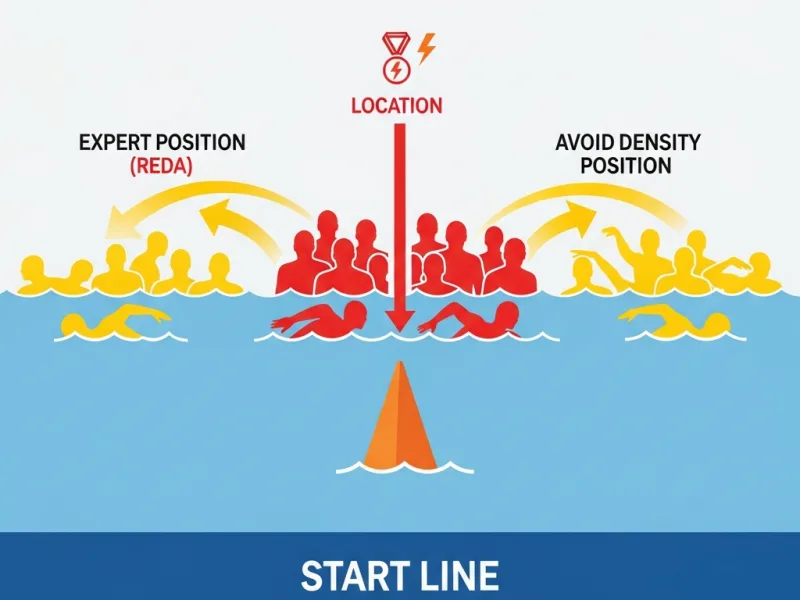
- Front and center: This is the expert zone, for very strong swimmers aiming for the lead pack. The line to the buoy is more direct, but it's also where the "washing machine" is most violent. Avoid it if you're not 100% confident.
- On the sides: My recommendation for the vast majority of triathletes. By positioning yourself on an edge (left or right), you avoid the heart of the melee. You might swim an extra 10 or 20 meters, but you'll have space to settle into your stroke peacefully. The gain in serenity is well worth this small detour. Look at the course map: if the first buoy is on the right, position yourself on the right, and vice versa.
- At the back: If this is your first triathlon or if your anxiety is really high, there is absolutely no shame in starting behind everyone else. Let the wave go, wait 5 to 10 seconds, and then start in already calmer water. You'll lose a little time, it's true, but you'll ensure you have a good, panic-free swim. It's an excellent strategy for building confidence.
The First Few Minutes: Survive, Then Swim
The gun goes off. Breathe. Your only goal for the first 200 meters is not speed, but to **find your rhythm**.
- Don't hold your breath: The classic mistake is to hold your breath under the effect of stress and effort. Force yourself to exhale completely and loudly underwater. This empties your lungs, releases CO2, and naturally calls for the next inhale.
- Don't fight the wave: Don't try to fight for every inch. In the beginning, the goal is to find a little personal space. Swim defensively, with your arms slightly more bent to protect your face.
- Find a cruising pace: After 100 or 200 meters, the pack naturally starts to stretch out. This is when you can start to lengthen your stroke, focus on your technique, and look for feet to follow to take advantage of the draft.
Once the chaos of the start is over, it's time to implement a strategy. This is where our 6 tips for a smart triathlon swim come in, to turn these initial efforts into a solid foundation for the rest of your race.
Equipment: Your Allies for Confidence
Good gear won't magically make you swim faster, but it can greatly contribute to your safety and self-confidence. And when it comes to managing anxiety, confidence is king.
The Wetsuit: More Than a Second Skin
Unless you're swimming in the South Seas, you'll be wearing a wetsuit. It's your best friend for several reasons:
- Buoyancy: This is its number one advantage. It makes you more buoyant, especially in the legs. This feeling of support is extremely reassuring. You know that even if you're tired or panicked, you'll float.
- Thermal Protection: It protects you from the cold, preventing thermal shock and energy loss.
- Hydrodynamics: It compresses you and makes you sleeker in the water.
Golden nugget: The most important thing is to have a wetsuit that fits perfectly. If it's too tight, it can compress your chest and restrict your breathing, which can be a panic trigger. Take the time to try it on and train with it before the race.
Swim Goggles: Your Window to the World
Having good visibility is fundamental to feeling in control. Don't neglect your choice of goggles.
- Field of Vision: Opt for goggles with a wide, panoramic field of vision, like a "mask" style. This helps you better perceive what's happening on the sides without having to turn your head completely.
- Anti-fog Coating: Essential. There's nothing worse than swimming blind. An old-timer's trick: just before the start, a little saliva on the inside, rub it in, and rinse. Works every time!
- Lens Tint: Adapt the color to the weather. Smoked or mirrored lenses for bright sunny days, clear or lightly tinted lenses for overcast weather. Having the right tint reduces eye fatigue and stress.
Ultimate golden nugget: Always put your swim cap OVER your goggle strap. This way, even if you take a hit, there's very little chance they'll be knocked off.
From Fear to Performance: Changing Your Perspective
The final step, and perhaps the most important, is a change in mindset. It's about no longer seeing the swim start as an ordeal to be endured, but as an integral and even exciting part of the triathlon adventure.
Accepting Chaos as Part of the Game
A mass start triathlon will never be a zen experience. That's a fact. Once you accept that, you stop fighting against the very nature of the event and start working with it. Chaos is no longer your enemy; it's just the playing field. Your challenge is to navigate through it with intelligence and calm. It's a skill, just like cycling or running. And like any skill, it can be developed and improved with practice.
Analyzing Your Experiences: The Post-Race Debrief
After each race, take the time to debrief your swim. Not just to judge yourself, but to learn. What went well? Was my positioning good? Did I manage to stay calm? What could be improved? Did I panic at any point? Why?
Keeping a small race journal is an excellent idea. Note your feelings, your successes, and your areas for improvement. Every race, even the toughest ones, becomes a learning experience that will make you stronger and more confident for the next one. You'll see that over time, the "successes" column will grow longer and fear will give way to experience.
Overcoming the fear of the washing machine is a process. There will be ups and downs. But with targeted preparation, a clear strategy, and a healthy dose of self-compassion, I guarantee you can transform this moment of anxiety into a demonstration of your mental strength. You have all the tools now.
So, the next time you're on that starting line, heart pounding, remember all this work. Take a deep breath, smile, and tell yourself that you are ready. You are more than a survivor; you are a triathlete.
Now it's your turn!
Answers to your questions about fear of the triathlon start
Is it normal to still be afraid after several triathlons?
Absolutely. Fear of the start is a very common reaction that can persist even in experienced athletes. Every race is different: the number of participants, the water conditions, your own expectations... It's completely normal to feel some apprehension before you dive in. The goal isn't necessarily to eliminate fear completely, but to learn to manage it with mental and strategic tools so that it no longer paralyzes you and simply becomes a signal that you're ready for action.
What should I do if I really panic during the start?
If a real panic attack occurs (shortness of breath, racing heart), the first thing to do is get to safety. Stop swimming, roll onto your back to float and rest, or grab onto a safety kayak if one is nearby. No one will judge you. Then, focus on your breathing: exhale slowly and deeply to calm your nervous system. Once you're calm again, you can decide to start again slowly or, if necessary, signal to the safety crew that you are withdrawing. Your health comes first.
Will swimming on the sides make me lose a lot of time?
It's a legitimate concern, but the time lost is often overestimated. On a 1500m course, swimming an extra 10 to 20 meters only amounts to a few seconds. Compare those few lost seconds to the time you could lose if you panic, have to stop, or swim inefficiently in the middle of the scramble. For the vast majority of triathletes, the gain in peace of mind and the ability to establish a proper stroke far outweigh the extra distance. It's a strategic choice that pays off handsomely.
Should I train specifically for physical contact?
Yes, that's an excellent idea. The goal isn't to learn how to fight, but to desensitize yourself to contact so that it's no longer a source of surprise or panic. Simple drills in a club or with partners, like swimming three to a lane, intentionally touching feet while drafting, or doing group starts over short distances, are very effective. This helps to normalize contact and teaches you to stay focused on your own swimming despite external disturbances.