The Triathlete's Ego: Ally or Enemy of Your Progress?
By Sarah — translated from an article by Charly Caubaut Published on 11/04/2026 at 08h31 Reading time : 9 minutes
The Triathlete's Ego: Ally or Enemy of Your Progress?
Hey there, triple-discipline enthusiast! Today, we're going to talk about a somewhat taboo subject, an invisible traveling companion that sometimes weighs more than a steel bike: our ego. Ah, the ego... that thing that pushes us to get up at 5 a.m. for a freezing swim session, but can also make us crash and burn during the marathon of an Ironman. I've spent years on the roads and in the pools, and believe me, I've seen brilliant athletes sabotage themselves because of it. And yes, I plead guilty, it has played tricks on me too!
I still remember a local triathlon a few years ago. I was in shape, maybe too confident. On the starting line, I spotted a guy from my club, a good runner I absolutely wanted to "drop" on the bike. My race plan? Thrown out the window. My ego took the handlebars. I rode well above my pace, heart rate in the red, just to get away from him. The result? Monumental cramps from the very beginning of the run, a walk to the finish line, and my rival of the day overtaking me with a friendly pat on the shoulder. A true lesson in humility!
This experience, and many others, taught me something essential: the ego is neither good nor bad. It's an energy. A raw force. The real question is: how do we channel it? Do you let it lead you straight into the wall of overtraining and frustration, or do you learn to tame it to make it your best ally towards performance and, above all, pleasure? That's what we're going to break down together. Get ready, we're diving behind the scenes of our triathlete mindset.
Understanding the Triathlete's Ego: More Than Just a Matter of Pride
Before we go any further, let's agree on what we're talking about. Far from complicated psychological concepts, the athlete's ego is the representation you have of your own value as an athlete. It's that little voice in your head that comments on your performances, compares you to others, and influences your decisions, both on the bike and in life.
What is ego, concretely, in our sport?
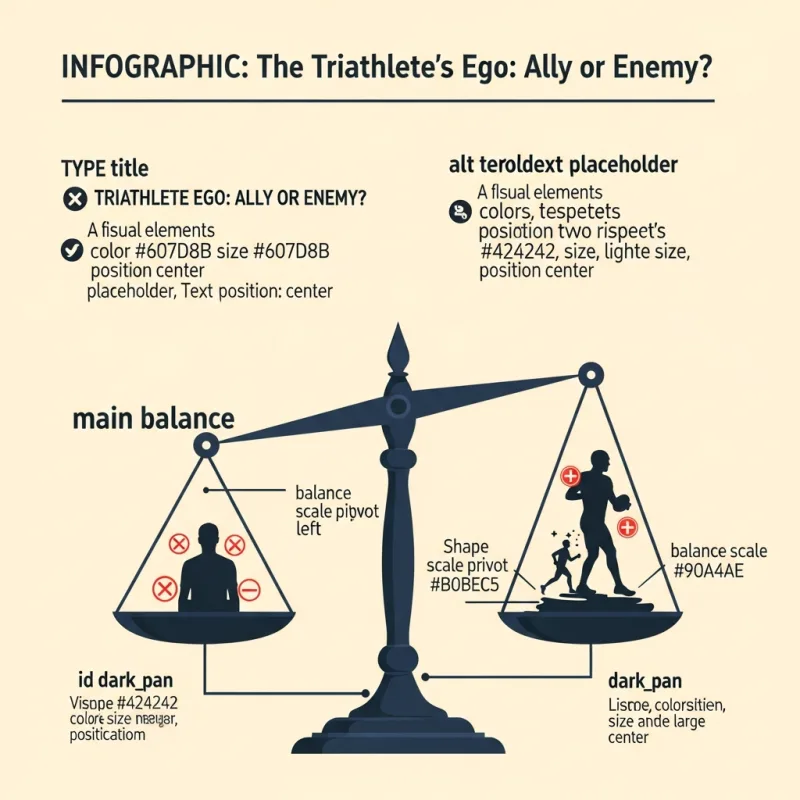
Imagine your ego as a slider with two extremes. On one side, you have the healthy ego. It's your engine. It feeds on the confidence you build in training, the ambition that makes you aim for audacious goals, the pride of crossing a finish line. It's the one that tells you: "Yes, you can do it, you've worked for this." It is inward-looking, based on your own abilities and personal progress.
On the other side, there's the oversized ego, or fragile ego. This one is outward-looking. It has a pathological need for validation. It feeds on Strava kudos, the opinions of others, the ranking. It's riddled with fear: fear of failure, fear of not being as good, fear of judgment. It's the one that whispers: "Don't show you're tired," "He absolutely must not pass you," "If you don't have the latest trendy bike, you're nobody." See the difference? One builds you up, the other consumes you.
Why is triathlon such a fertile playground for the ego?
It's no accident that the ego flourishes so much in our discipline. Triathlon is a perfect cocktail to set it ablaze:
- The triple discipline: Three sports means three times as many opportunities to compare, to judge, to find a weak point for the ego to press on. "I'm a good swimmer, but a poor runner," and just like that, the complex sets in.
- The "always more" culture: We start with a sprint distance, then a standard, a middle... The Ironman is often seen as the Holy Grail. This escalation of distance and difficulty is a source of immense pride, but it can also become a never-ending race to prove one's worth.
- The omnipresence of numbers: Our sport is quantifiable to the extreme. Watts, pace per 100m, heart rate, average speed, times... Everything is measurable, and therefore, comparable. Every workout becomes a potential evaluation, a grade that the ego will rush to analyze.
- The social and material dimension: Triathlon is a sport where equipment is visible, expensive, and a status symbol. The time-trial bike, carbon wheels, the latest wetsuit... The ego loves to adorn itself with these attributes to mask insecurities or simply to "show" its belonging to the tribe.
In short, our passion is a magnificent field of adventure, but also a magnifying glass for our strengths and flaws. Learning to look at ourselves in it with lucidity is the first step to keeping the adventure beautiful.
When Your Ego Becomes Your Worst Enemy: The 5 Pitfalls to Avoid
A poorly managed ego is like riding with the handbrake on. You push hard, you get exhausted, and you don't move forward as you should. Worse, you risk overheating and breaking down. I've identified 5 classic pitfalls that we've all fallen into at least once. Recognizing them is the first step to defusing them.
Pitfall #1: Constant Comparison, the Modern Athlete's Poison
This is THE plague of our generation. With platforms like Strava or Instagram, we have real-time access to the workouts of people all over the world. Your neighbor just knocked out a 10k in 40 minutes? Your colleague biked 150 km with 3000m of elevation gain? Immediately, the little voice of the ego activates: "And you? Your little 45-minute base endurance session is ridiculous in comparison...".
The problem is that we're comparing apples and oranges. We don't know the context: their training plan, their fatigue, their goals... We only see the showcase, the raw performance. This constant comparison has devastating effects:
- It kills the joy: Your workout, which was supposed to be a moment of relaxation, becomes a source of frustration.
- It skews your training: You might be tempted to modify your session to "do better" than the other person, disregarding your own plan.
- It undermines your confidence: By constantly comparing yourself to athletes who are not at the same stage as you, you end up believing you're no good.
My first practical tip for you: customize your feed. On Strava, only follow people who inspire you positively. Better yet, use it for what it should be: your personal logbook. The only comparison that matters is with yourself, yesterday.
Pitfall #2: Refusing to Listen to Your Body (and Flirting with Injury)
The ego hates signs of weakness. Fatigue, a small ache, a lack of motivation... To the ego, these are excuses. It pushes you to always do more, to ignore the warning signals your body is sending. "Come on, just one more set." "Don't stop, others will think you're spent." "A rest day? That's for the weak!"
This internal dialogue is the royal road to overtraining. This topic is so crucial that I've dedicated a full article to it. If you feel constantly tired, irritable, and your performance is stagnating, I really invite you to read this guide on overtraining, a risk for the ambitious triathlete. The ego is often the main culprit in this downward spiral.
I have a painful memory of a marathon preparation where an Achilles tendon pain appeared. My ego refused to admit it. I continued to follow the plan, gritting my teeth. I ended up partially tearing the tendon. Result: three months of complete rest. For wanting to "win" a few sessions, I lost my entire season. The lesson was harsh, but life-saving. Listening to your body is not a weakness; it's the greatest proof of intelligence for an endurance athlete.
Pitfall #3: The Fear of Failure and Judgment
This one is more subtle. The fearful ego doesn't make noise; it prevents you from acting. It's the one that dissuades you from signing up for that first triathlon because you're afraid of finishing last. It's the one that stops you from joining a swim club because "everyone swims better than me." It's the one that makes you choose an easy race over a challenge that would truly help you progress, but where you risk not reaching your goal.
This fear of judgment and failure is a major brake on progress. Sport is about exploring your limits. And to explore, you have to accept getting a little lost, falling, not succeeding on the first try. An athlete who never experiences failure is an athlete who takes no risks and stagnates in their comfort zone. Every "failed" race is a goldmine of information for the future. Every session where you are "dropped" by someone stronger is an opportunity to learn. You must dare to be a beginner, at any age and at any level.
Pitfall #4: The Obsession with Gear as a Cover-Up
Ah, gear... my specialty! And I'll be the first to tell you that good, suitable, and well-adjusted equipment changes your life. But beware of the ego trap. Some triathletes spend fortunes on the latest aero bike, the most advanced power meters, the most expensive wetsuit... thinking it will compensate for the missed training hours.
The ego loves gear because it's an external sign of status. "Look at my bike, I'm a serious triathlete." But a €10,000 bike doesn't pedal by itself. I've seen guys with war machines get passed by enthusiasts on 10-year-old aluminum bikes, but who had thousands of kilometers in their legs. The scene is always a bit comical and puts things in perspective. The priority is the engine, which is you. Invest first in consistency, discipline, and self-knowledge. The gear will come later, as a reward and a tool to optimize your potential, not to create it.
Pitfall #5: Poor Race Management, or the Art of Self-Sabotage
On race day, the ego is in overdrive. The adrenaline, the crowd, the other competitors... everything is there to provoke it. And that's when it can make you commit the worst strategic mistakes:
- The kamikaze start: You leave the transition area feeling invincible. You see a group, or a competitor you're targeting, and you put yourself in the red to follow them, completely forgetting your pacing plan.
- The denial of failure: You start getting stomach cramps, but you refuse to slow down at the aid station to hydrate and fuel properly. The ego tells you you'll lose time, when in fact it's the best way to end up walking.
- The final sprint... 10 km from the finish: You feel good halfway through the run and you accelerate, exhilarated by the competitors you're passing. You forget that the race is still long and you pay for it dearly a few kilometers later.
Race discipline is a fundamental quality. It requires silencing your ego and trusting your training and your plan. Your best practical tip here: use your GPS watch not to look at your instantaneous speed, but to confirm that you are in your target zones (heart rate, pace, power). Run your race, not someone else's.
Turning Your Ego into an Ally: The Smart Triathlete's Manual
Now that we've clearly identified the enemy, let's see how to turn it into a teammate. Because yes, this energy, this ambition, this pride, if channeled correctly, can take you very far. It's not about killing your ego, but about educating it.
Cultivating a "Healthy" Ego: The Art of Self-Confidence
The key is to shift the source of your ego. Instead of feeding it with external elements (comparisons, gear, raw results), feed it from within. That is true self-confidence. It doesn't come from the arrogance of thinking you're better than others, but from the deep-seated certainty of having done the necessary work.
How do you build it?
- Set SMART goals: Specific, Measurable, Achievable, Relevant, and Time-bound. Every small goal achieved is a brick that builds the wall of your confidence.
- Keep a training journal: Note not only your numerical performance but also your feelings and successes. Reread it before a race to remember how far you've come.
- Practice visualization: Before a competition, visualize yourself succeeding, managing a difficult moment, crossing the finish line with a smile. Your brain doesn't distinguish between a real experience and an intensely imagined one.
- Adopt positive self-talk: Stop putting yourself down. Talk to yourself as you would to your best friend. Be your own biggest supporter.
Humility, the Superpower of the Progressing Triathlete
It may seem paradoxical, but to have a healthy ego, you need a good dose of humility. Humility isn't thinking you're worthless. It's having the lucidity to know your strengths and weaknesses, and to accept that you always have more to learn.
A humble triathlete is a progressing triathlete, because:
- They are not afraid to ask for help: They consult a coach to optimize their training, ask for technical advice from a better swimmer, discuss strategy with more experienced athletes.
- They accept constructive criticism: If their coach tells them their running technique needs work, they don't take it as a personal attack, but as an opportunity to improve.
- They learn from their mistakes: After a disappointing race, they don't look for excuses. They coolly analyze what went wrong so as not to repeat it.
Humility is the key that opens the door to continuous progress. Arrogance double-locks it.
Using the Ego as a Motivational Engine
Once your ego is well-educated, you can use its firepower wisely. That desire to be good, to surpass yourself, is an extraordinary fuel!
That little boost to go for that KOM/QOM on Strava during a specific session? That's your ego giving it to you. The pride of wearing your club's colors and giving it your all for the team in a relay? That's it again. The desire to beat your personal record over a distance? Still the ego.
The secret is to let it express itself within a controlled framework. Transform its energy into discipline: "I want to be good, so I will follow my plan to the letter, sleep well, eat well." Use it to push you through the tough moments of an interval session, not to take foolish risks on a long ride. Make it your training partner, the one who whispers "let's go!" in the morning, not the one who constantly screams "be better than everyone else!".
The Power of the "Process" Over the Obsession with the Result
This is perhaps the most important practical tip I can give you. To tame your ego, stop focusing solely on the end result (the time, the ranking) and fall in love with the process.
Triathlon is not just the finish line. It's every arm stroke in the water at sunrise, every bike ride where you discover new landscapes, every stride in the forest, every technical discussion with your friends, every healthy meal you prepare. The process is 99% of your life as a triathlete.
When you focus on the process, you shift the source of your satisfaction. Your goal is no longer just to "finish an Ironman," but to "have a great long session this Sunday." It's more concrete, more immediate, and much less anxiety-inducing. Progress and results then become a natural consequence of a well-managed process, rather than an obsession that eats away at your pleasure. Set process goals (e.g., "succeed in swimming 3 times a week for a month," "do all my active recovery sessions") and celebrate these daily victories. Your ego will be satisfied, and your long-term performance will thank you for it.
Concrete Strategies to Tame the Beast Daily
Alright, Charly, but how do we do this in practice? Here's a simple, three-step routine to integrate this ego management into your daily practice.
Before Training: Mental Preparation
Five minutes before you put on your sneakers or get on your bike, take a moment. Breathe deeply and clearly define the intention of your session. Is it a recovery ride? An intense interval session? A technical workout? Simply naming the objective puts you in the right mindset. If it's a "cool" session, you give your brain permission not to seek performance. Turn off Strava and Instagram notifications. Your session is a moment for you, not for the gallery.
During Training: Staying Tuned In
During the effort, try to shift your focus from the numbers (speed, watts) to your sensations. How is your breathing? Are your legs heavy or light? Do you feel tension anywhere? This is the dialogue with your body. If you're training in a group and the pace picks up beyond what was planned for you, have the humility and confidence to say: "Guys, great pace, but I'm sticking to my plan. Have fun, I'll catch up with you later!". It's not an admission of weakness, it's a proof of maturity. Your ego might protest for 30 seconds, but your body will thank you for weeks.
After Training: The Compassionate Analysis
Back home, the debriefing is crucial. Yes, you can sync your watch and look at your data. But do it with an analyst's eye, not a judge's. Instead of just looking at the time, ask yourself: "Did I stick to my plan? Were my feelings consistent with the numbers? What did I learn today?". If the session was difficult, don't beat yourself up. Note it down, and try to understand why (fatigue, stress, nutrition?). Every session, successful or not, is a piece of information. Don't let your ego turn it into a value judgment on you as a person.
By integrating these small routines, you will gradually regain control. You will strengthen your ability to dissociate your performance from your personal worth. And that's when sport becomes an incredible source of fulfillment.
Conclusion: Make Your Ego Your Best Teammate
We've covered a lot of ground, haven't we? From its most insidious manifestations to how to transform it into a strength, you now have all the cards in hand to better understand that very special traveling companion that is your ego.
Remember this: triathlon is a magnificent adventure, a personal journey before it's a competition against others. Your greatest adversary, the one who can make you go off the rails, but also your most powerful ally, the one who can make you move mountains, is the same person: yourself. Learning to manage your internal dialogue, to channel your ambition, and to cultivate humility is probably the skill that will make you progress the most, far more than any pair of carbon wheels.
Don't try to eliminate your ego. Seek to understand it, to reassure it, and to give it the right direction. Make it understand that the real victory is not about beating others, but about becoming a better version of yourself every day, with every training session, at every race.
So, are you ready to start this discussion with yourself and make your ego your best teammate?
It's your turn to play!
Answers to Your Questions About Ego in Triathlon
How do I know if my ego is hindering my progress?
If you're constantly comparing yourself, ignoring fatigue to "never give up," if the fear of judgment prevents you from trying new things, or if you base your self-worth solely on your race times, your ego is likely a hindrance. The main sign is a loss of enjoyment in your practice.
Is wanting to be the best a bad thing?
Absolutely not! Ambition is a powerful motivator. The problem isn't wanting to be the best, but how you go about it. If this quest comes at the expense of your health, your enjoyment, and involves belittling others, the ego is toxic. If it pushes you to train intelligently and with discipline, it's a healthy ego.
How to handle the pressure of Strava and social media?
It's a real challenge. One trick is to change your perspective: use Strava as your personal training log, not as a permanent leaderboard. Celebrate your own progress, hide the activities of athletes who make you feel insecure, and don't hesitate to make some sessions "private" to focus solely on your sensations.
Is the ego different in amateur and professional triathletes?
The manifestations differ, but the core is the same. For a pro, the ego is linked to career, sponsors, results; it's a professional tool they must master. For an amateur, it's often linked to identity, self-image, and comparison within their community. Both must learn to channel it to perform sustainably.