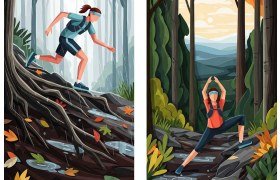
Vestibular Training: The Secret to 'Reading' Terrain in Trail Running
By Sarah — translated from an article by Charly Caubaut Published on 18/08/2026 at 08h31 Reading time : 11 minutes
Trail Running is More Than Just Legs!
Hey there, trail enthusiast! We've all been there. You know, that tricky, technical descent where every root seems to want to trip you up and every rock rolls under your sole. Your cardio is good, your thighs are burning just right, but a little voice in your head is holding you back. The fear of falling, the hesitation that breaks your rhythm... You feel like you're enduring the terrain rather than dancing with it. What if I told you that the key to unlocking that fluidity isn't in a new squat program, but... inside your skull?
Yes, you read that right! For years, like many, I believed that to be a good trail runner, you needed legs of steel and a marathoner's heart. That's true, but it's incomplete. After thousands of kilometers on the most varied trails, from muddy forest singletracks to dizzying alpine ridges, I've realized that the best among us share a secret, a sixth sense: an almost supernatural ability to "read" the terrain and react to it instinctively. This superpower has a name: a perfectly honed vestibular system.
The vestibular system is your internal gyroscope, located in your inner ear. It manages your balance, your spatial orientation, and allows you to stay stable when everything is moving around (and under) you. In trail running, it's simply your best ally. The problem? Almost all of us neglect it. We spend hours strengthening our calves, but not a single minute training this essential sensor.
In this article, we're going to dive together into the heart of this fascinating system. I'll show you why it's the cornerstone of your performance and safety in trail running. And most importantly, I'll share a concrete action plan with tested and approved exercises, "practical gems" that you can integrate into your routine starting tomorrow. Get ready to never look at a technical descent the same way again. Let's go!
What is the Vestibular System and Why is it Your Best Ally in Trail Running?
Before jumping into the exercises, it's important to understand the basics. No boring medical lecture, I promise! Imagine I'm opening the hood of your own internal machinery to show you a key part you didn't know you had. By understanding the "why," the "how" makes perfect sense.
Your Internal GPS, How Does it Work?
The vestibular system is a small masterpiece of bio-engineering nestled in your inner ear. It is composed of two types of sensors:
- The semicircular canals: Think of three small rings filled with fluid, oriented in the three dimensions of space (up/down, left/right, forward/backward). When you turn your head, the fluid moves, and microscopic hairs detect this rotation. This is what allows you to know you're turning your head even with your eyes closed. In trail running, this is crucial when you quickly scan the terrain from left to right to choose your path.
- The otoliths (utricle and saccule): These are tiny crystals resting on a gelatinous membrane. They are sensitive to gravity and linear accelerations (forward/backward, up/down). When you accelerate on a descent or jump over an obstacle, they are the ones informing your brain. They are your personal accelerometer and plumb line.
This information travels at incredible speed to your brain, which combines it with what your eyes see (the visual system) and what your muscles and joints feel (proprioception). This trio – vestibular, visual, proprioceptive – is the holy trinity of balance. The vestibular system is the conductor that allows this entire ensemble to play the same tune in perfect harmony. It is what, for example, stabilizes your gaze (a reflex called the vestibulo-ocular reflex) so that the world doesn't become a blurry mess when you're running on a bumpy trail.
When Your "GPS" is Out of Whack: The Consequences on the Trails
Now imagine this internal GPS lacks training. It becomes less precise, slower to react. On flat ground, in daily life, it often goes unnoticed. But on a trail, chaos ensues:
- Hesitation and loss of fluidity: Your brain doesn't receive reliable information about your head's position. It panics and forces you to slow down, to plant your feet heavily, to tense up. The infamous feeling of being "clumsy" on descents.
- Increased risk of falls: An ankle twists on an unstable rock. Normally, your vestibular system detects the abnormal tilt and commands a muscular correction in a few milliseconds. If it's slow, by the time the correction arrives, you're already on the ground.
- Excessive dependence on vision: You become unable to run confidently if the light diminishes (undergrowth, dusk). Your eyes are overworked, you look at your feet instead of anticipating the trail 5 meters ahead, which is a classic mistake. We also talk about this in the article on perceptual training, as the two skills are intimately linked.
- Dizziness and nausea: On switchbacks or very technical trails, a conflict between visual information (everything is moving) and vestibular information (not used to these movements) can create a sensation of motion sickness.
I personally experienced this during a race. A long and technical descent, I was in great physical shape, but I couldn't let go of the brakes. Every step was a conscious, exhausting decision. My friends were pulling away from me effortlessly. That day, I understood that my legs could get me to the summit, but it was my balance that would allow me to get back down fast and well.
The Direct Link Between a Good Vestibular System and Trail Performance
Training your vestibular system isn't a gimmick. It's a direct investment in your performance, safety, and enjoyment.
- Agility and reactivity: You become capable of making ultra-fast, unconscious adjustments. Your foot lands in the exact right spot, with the right amount of pressure, without you even thinking about it. You switch from "I'm thinking about where to place my feet" mode to "I'm flying over obstacles" mode.
- Confidence and commitment: When your brain trusts your balance, it lets you take more calculated risks. You no longer hesitate before a small jump or on a section of unstable rocks. This confidence translates into speed and a huge saving of mental energy.
- Running economy: A stable runner is an efficient runner. Less tension, fewer parasitic micro-corrections from muscles, less untimely braking. The energy saved is energy available to go further or faster.
- Injury prevention: It's mathematical. Better balance means fewer falls, fewer ankle or knee sprains. It's the assurance of being able to continue training over the long term.
In short, a well-trained vestibular system allows you to unlock the full potential of your physical preparation. It's the software that enables your hardware (your body) to operate at 100% of its capabilities on the demanding terrain of trail running.
Diagnosing Your Weaknesses: Are You "Vestibularly" Ready for the Trails?
Now that you know how crucial this system is, let's get practical. Before you jump into complex exercises, let's do a fun little check-up. No lab needed, just you, a bit of space, and honesty. These tests will help you become aware of your strengths and, more importantly, the areas where you can improve. Think of it as the first step on your journey to feline-like balance!
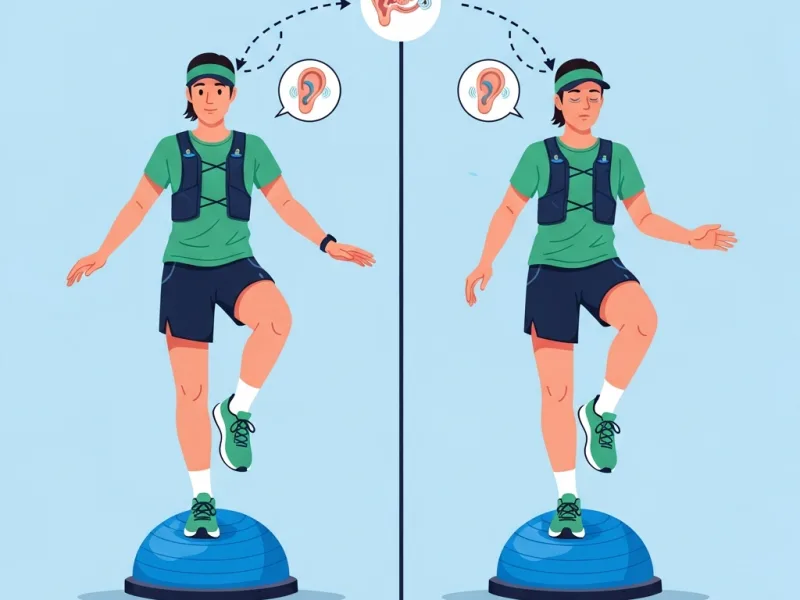
Test 1: Single-Leg Balance (Eyes Open, then Closed)
This is the basic, most revealing test. It measures your ability to maintain balance by cutting off one of the three sources of information: vision.
- Protocol: Stand barefoot on a hard floor. Lift one leg, knee bent at 90 degrees, and hold the position. Start a timer. Stay as stable as possible. Stop the timer as soon as you have to put your foot down or your supporting foot moves to catch yourself. Do this on each leg.
- Step 2: Now, do the exact same thing, but with your eyes closed. Be prepared, the difference can be... surprising! Have someone assist you or stand near a wall to avoid falling.
- What it reveals: An athlete should easily hold for more than 30 seconds with eyes open. The crucial point is the comparison. If your time plummets with your eyes closed (e.g., from 60s to 5s), it means you have a huge dependency on your vision for balance. Your vestibular system and proprioception aren't taking over effectively. This is golden information: you know exactly what to work on!
Test 2: The Tandem Walk (The Tightrope Walker Test)
This test assesses your dynamic balance, which is your ability to stay stable while in motion—the very heart of trail running.
- Protocol: Draw or imagine a straight 5-meter line on the ground. Walk on it by placing the heel of one foot just in front of the toes of the other, like a tightrope walker. Take 10 steps forward.
- Variations to make it harder:
- Do the same thing walking backward.
- Do it forward, but with your eyes closed (be careful!).
- Do it forward, eyes open, but turning your head from left to right with each step.
- What it reveals: If you constantly have to step off the line, use your arms for balance, or place a foot beside the line, your dynamic balance can be improved. The variations with eyes closed or head movements test your vestibular system's ability to take control when vision is disrupted or when the brain has to manage multiple tasks at once. If you feel very unstable or nauseous when turning your head, it's a clear sign that your vestibular system isn't used to being challenged while in motion.
Test 3: Head Rotations While Marching in Place
This test specifically targets your vestibular system's tolerance to head movements, which you do constantly in trail running to scan the environment.
- Protocol: Stand with your feet shoulder-width apart. Start marching in place at a moderate pace.
- Step 2: While continuing to march in place, turn your head from left to right, as if saying "no," for 30 seconds. Try to keep a steady rhythm.
- Step 3: After a short break, do the same thing, but this time nodding your head up and down, as if saying "yes," for 30 seconds.
- What it reveals: Note any feeling of dizziness, imbalance, or difficulty maintaining a stable march. If these head movements disorient you, it means your brain is having trouble dissociating head movements from body movements. In trail running, this translates to an inability to look to the side to see another runner or admire the scenery without risking a stumble.
Analyzing Your Results: No Panic, Just Paths for Improvement!
The purpose of these tests isn't to judge you, but to give you a starting point. Did you wobble on the first test? That's great! Did you almost fall on the second? Perfect! Did you feel a bit queasy on the third? Excellent! Why? Because you have just identified with surgical precision the areas you need to work on. You're no longer flying blind. You now know that your journey to better agility will start by strengthening your stability without the help of your eyes, or by getting your brain used to head movements. Every difficulty encountered here is a promise of progress on the trails. So, are you ready to turn these weaknesses into strengths?
The Action Plan: Concrete Exercises to Strengthen Your Balance
Let's get to the part you've been waiting for! Enough theory, time to break a sweat. Here is a progression of exercises, from the foundations to the most trail-specific movements. I recommend mastering each phase before moving on to the next. Consistency is key: 5 minutes every other day is better than an hour once a month. Integrate these practical gems into your routine and you'll be amazed by the results.
Phase 1: The Foundations – Static Stability
The goal here is to build a solid base. We teach the body to balance without moving, focusing on vestibular and proprioceptive signals, especially by reducing the aid of vision.
Exercise 1: The Progressive Flamingo
- Why it's effective: This is the "training" version of the single-leg test. It forces your nervous system to refine the micro-adjustments in your ankles and hips to maintain balance.
- How to do it:
- Stand on one leg, the other bent. Fix your gaze on a point in front of you. Hold for 30 to 60 seconds.
- Once this is easy, move to the next step.
- Variations for progression:
- Level 2: Do the same thing with your eyes closed. Start with sets of 10-15 seconds. You'll feel your ankle muscles working like never before!
- Level 3: Do the exercise (eyes open at first) on an unstable surface: a cushion, a sofa, a folded towel, or ideally, a Bosu ball or balance board.
- Level 4 (the ultimate combo): Do the exercise on an unstable surface AND with your eyes closed. This is the expert level!
- Charly's tip: Don't tense up! Breathe calmly. The goal isn't to be a marble statue, but to feel the oscillations and correct them with fluidity. Accept the imbalance to better master it.
Phase 2: Movement – Integrating Dynamic Imbalance
Now that the base is there, let's add movement. The goal is to teach your brain to maintain balance WHILE the body is moving and the head is changing orientation.
Exercise 2: Lunges with Head Rotation
- Why it's effective: This exercise combines a basic strength movement (the lunge) with vestibular stimulation (head rotation). It simulates having to look to the side while moving forward on the trail.
- How to do it:
- Start in a standing position. Take a big step forward into a lunge.
- Once stable in the low position, slowly turn your head to the left, then to the right.
- Return to the starting position and switch legs. Do 8 to 12 reps per leg.
- Variations for progression:
- Level 2: Do the same thing, but nodding your head up and down.
- Level 3: Instead of doing the head rotations in a static position, do them during the descending and ascending phase of the lunge. This is much more difficult as you have to manage balance and coordination at the same time.
- Charly's tip: Quality over speed. Use slow, controlled movements. If you feel dizzy, slow down or reduce the range of motion of your head. It's a sign that your system is working!
Phase 3: Trail Specificity – Simulating the Terrain
Here we are! We're now going to simulate the specific conditions you encounter in trail running. The goal is to make balance reactions automatic and specific to the demands of our sport.
Exercise 3: Targeted Single-Leg Hops
- Why it's effective: It trains foot placement precision, rapid stabilization after impact, and eye-foot coordination, all of which are essential for navigating a rock field or a root-filled trail.
- How to do it:
- Place several markers on the floor (sheets of paper, flat cushions, cones).
- Standing on one leg, hop to land precisely on a target.
- Upon landing, stabilize as quickly as possible on the landing leg. Hold for 2-3 seconds before hopping to the next target.
- Variations for progression:
- Level 2: Vary the distances and angles between the targets (forward, sideways, diagonal hops).
- Level 3: Do the exercise on a slight slope or on grass to increase instability.
- Level 4: Just before you jump, briefly close your eyes and try to land on the memorized target. This forces your body to rely on proprioception and momentum rather than last-second vision.
- Charly's tip: Aim for a light, quiet landing. A loud "thud" means you're absorbing the impact poorly. A soft landing shows that your muscles are absorbing and controlling the movement. This is the perfect complement to good perceptual training, where you learn to see the terrain before your feet even touch it. Your shoes are also an ally: having good grip and support helps you trust your footing for this type of exercise.
⌚ Men's trail running shoes, Kiprun Kipsummit, grey orange
🧾 To put these exercises into practice and transfer your new skills to the trails, a reliable shoe is your best partner. The Kiprun Kipsummit is designed for technical terrain, where your balance is challenged the most.
- Grip: Its 5 mm lugs give you the confidence to focus on your balance without fear of slipping.
- Stability: Its structure offers good foot support, which aids proprioception and secures your ankles during dynamic exercises or on unstable trails.
🎯 Ideal for: Trail runners of all levels who want a versatile and secure shoe to venture onto demanding terrain and progress with confidence.
🛒 Discover Kiprun Kipsummit on DECATHLONPractical Gem: The "Fixed Gaze" or Gaze Stabilization
This is a slightly different but fundamental exercise. It trains the vestibulo-ocular reflex (VOR), the magic that allows your eyes to stay stable when your head moves. In trail running, this is what allows you to read the terrain even when you're being shaken in all directions.
- How to do it: Extend your arm in front of you, thumb up. Stare at your thumb.
- Movement 1: While keeping your gaze fixed on your thumb, turn your head from left to right, faster and faster, for 30 seconds. Your thumb should remain in focus.
- Movement 2: Do the same thing, nodding your head up and down.
- Why it's effective: You're training your brain to dissociate head and eye movements. A stable vision means reliable information for the brain, which reduces hesitation and improves anticipation on the trails. It's an exercise you can do anywhere, even at the office!
Integrating it into Your Training Routine: When and How?
Great, you now have a well-stocked toolbox. But like any tool, you need to know when and how to use it to be effective. The idea is not to add two hours of training to your already busy week, but to intelligently integrate these exercises for maximum benefit.
As a Warm-up: 5 Minutes to Activate Your GPS
Before each run, especially if it's going to be technical, take 5 minutes to wake up your vestibular system. It's like turning on your GPS and waiting for it to find the satellites before you start driving. This prepares your brain to be more reactive from the very first meters.
Typical Activation Routine (5 minutes):
- 1 minute of flamingo pose (30s per leg), eyes open.
- 1 minute of tandem walk for 10 steps, forward and then backward.
- 1 minute of marching in place with head rotations (30s left/right, 30s up/down).
- 2 sets of 30s of the "fixed gaze" exercise.
It's quick, requires no equipment, and radically changes how you'll approach the first technical difficulties of your run.
In a Dedicated Session: One 15-20 Minute Session Per Week
Once or twice a week, ideally on rest days or after an easy run, dedicate a slightly longer and more complete session to balance work. This is where you'll really build your skills and progress through the exercise variations.
Example of a 20-minute session:
- Warm-up (3 min): The activation routine above.
- Static Block (5 min): Work on the "progressive flamingo." Do 3 sets per leg, trying to push your limits: on an unstable surface, with eyes closed... Challenge yourself!
- Dynamic Block (7 min): Combine lunges with head rotations (3 sets of 10 per leg) and targeted hops (3 sets of 8 hops). Focus on quality and control.
- Cool-down (5 min): Finish with gentle stretches and a few minutes of the fixed gaze exercise to strengthen the eye-brain connection.
During Your Runs: Turn Every Run into an Opportunity
The terrain is your best gym! Don't confine your vestibular training to your home. Use your runs, especially the easier ones, to practice your new skills in a real-world context.
- On flat and easy sections: Take the opportunity to turn your head, look at the scenery, and scan your surroundings. Get your brain used to receiving changing visual information while running.
- On moderate descents: Consciously try to lift your gaze, not to stare at your feet. Trust your peripheral vision and your balance to handle the immediate terrain.
- Play with the terrain: Deliberately aim for the small, unstable rock (safely!), hop from one side of the trail to the other, run a few meters on the grassy and uneven shoulder. Every little variation is a micro-dose of training for your vestibular system.
By adopting these habits, you turn every kilometer into an opportunity to become a more agile and confident trail runner. Training then becomes a permanent game with the terrain.
Beyond Balance: The Unexpected Benefits of Vestibular Training
We've talked a lot about agility, speed on descents, and fall prevention. But the benefits of a sharp vestibular system go far beyond that. By committing to this type of training, you will unlock advantages you might not have expected.
Reduce Motion Sickness (and Sickness from Winding Trails)
If you're the type to get nauseous on mountain roads on your way to a race, or even on very winding forest trails, good news! Motion sickness often comes from a conflict between what your eyes see (it's moving) and what your inner ear feels. By accustoming your vestibular system to varied and controlled movements, you increase its tolerance. Your brain learns to better interpret these contradictory signals, which can significantly reduce, or even eliminate, these unpleasant sensations. No more pre-race stress related to the drive!
Improve Your Proprioception and Body Awareness
The vestibular system never works alone. It's in constant conversation with proprioception, the sense that allows you to know where your limbs are in space without having to look at them. By stimulating your vestibular system, you force this collaboration. You become more aware of your body, your posture, the position of your feet. This increased body awareness is a major asset, not only for performance but also for detecting the first signs of fatigue or poor posture before it causes an injury.
Gain Mental Clarity During Long Efforts
This is an often-underestimated benefit, especially for ultra-trail runners. A brain that doesn't have to constantly allocate massive resources simply to maintain balance is a more available brain. This saving of mental load translates into greater clarity over long distances. You'll be better able to manage your nutrition, monitor your pace, and make the right strategic decisions (when to push, when to hold back) even after hours of effort. When fatigue sets in, automated balance is a formidable weapon for staying efficient and avoiding the costly mistakes that can happen in an ultra.
In short, vestibular training is a bit like optimizing your body's operating system. Not only does the "trail running" application run better, but the whole system becomes more stable, more efficient, and more resilient. It's a global investment in your quality of life as an athlete.
The path to mastering your balance is a marathon, not a sprint. But every session, every exercise, every small victory against imbalance is one more step towards the smoother, safer, and faster trail runner you want to become. It's not magic; it's applied neurophysiology, accessible to everyone. So, don't let your potential be held back by a simple hesitation.
It's your turn to play!
Your Questions About Vestibular Training in Trail Running
How often should I do these exercises?
Consistency is more important than volume. Ideally, integrate a 5-minute activation routine before each trail run. In addition, a longer, dedicated session of 15 to 20 minutes, once or twice a week, is perfect for in-depth progress and working on more complex exercises.
Can these exercises make me dizzy?
Initially, it's possible to feel a slight sensation of dizziness or disorientation, especially with exercises involving head movements. This is a normal sign that your vestibular system is being challenged. If this happens, slow down, reduce the range of motion, and take breaks. These sensations diminish quickly with practice.
How long will it take to see progress on the trails?
Neurological adaptations can be very rapid. You might feel better stability and greater confidence after just 2 to 3 weeks of regular training. However, for these skills to become truly automatic under race conditions and fatigue, you should count on 2 to 3 months of consistent practice.
Does vestibular training replace strength training?
Absolutely not. It should be seen as an essential complement. Strength training (legs, core) gives you strength and power; it's the "engine." Vestibular training is the "guidance system" that allows you to use that strength precisely and effectively on the terrain. One without the other is incomplete for a high-performing trail runner.