Trail Running: Micro-Dosing Your Training for Maximum Performance
By Sarah — translated from an article by Charly Caubaut Published on 07/07/2026 at 08h31 Reading time : 9 minutes
Stop the "always more" mindset! What if the key to your trail running progress was to train... for less time?
Hey, trail friend! Charly here. If, like me, you've spent years believing that the only way to the top was through hours and hours of training, long runs that left you drained for the rest of the weekend, then this article is for you. We all have that friend who proudly posts their 150 km week on Strava, and we think, "damn, I'm not doing enough." I experienced this race for volume in triathlon, and I saw it again in trail running. It's a spiral that often leads to two things: frustration and injury.
But over the miles, through discussions with pros, coaches, and most importantly, by listening to my own body, I discovered an approach that changed everything. A philosophy that advocates for intelligence over brutality, quality over quantity. It's called micro-dosing. Far from being a magic formula, it's a profound reorganization of how you think about training. The idea? Replace some of your long, monotonous runs with a multitude of small, ultra-targeted sessions—short but intense. It's a bit like the eternal debate, do you have to run more to improve more? Micro-dosing whispers in our ear that the answer is "not necessarily." Ready to explore this path? Hold on tight, we're off on an adventure!
Micro-Dosing: The Art of Precision to Skyrocket Your Performance
Before diving into the practical details, let's lay the groundwork. Micro-dosing isn't disguised laziness or an excuse to stay on the couch. It's the complete opposite. It's a demanding method that requires discipline and concentration, but its benefits are absolutely stunning. It's the art of giving your body the right stimulus, at the right time, and allowing it time to adapt, over and over again.
Definition: Less Volume, More Impact
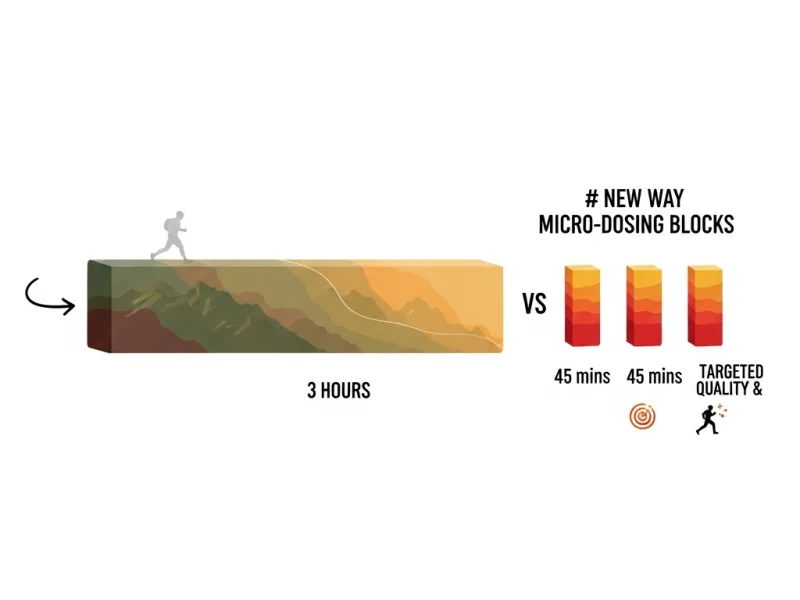
Imagine your annual training as a large wall to be built. The traditional approach is to try to lay huge stone blocks from time to time (your long, intense runs). It's exhausting, risky, and if you misplace a single block, the whole wall can become unstable. Micro-dosing is like building that same wall with smaller bricks, but laying a few every day. Each brick is perfectly fitted, the mortar has time to set, and the final wall is infinitely stronger.
In practical terms, micro-dosing involves breaking down your training load into multiple short sessions (from 15 to 45 minutes) spread throughout the week. Instead of doing 3 runs of 1.5 hours, you might do 5 or 6 sessions of 30 minutes, plus a slightly longer run on the weekend. Each micro-session has a single, specific goal: working on your climbing strength, improving your downhill technique, boosting your VO2 max, strengthening your ankles... No more "junk" miles where you're just running to add volume. Every minute spent training has a purpose.
Why It Works: The Science Behind Frequency
This method didn't just appear out of thin air. It's based on solid physiological principles. Here are a few practical gems to understand why it's so effective:
- Adaptation Through Repetition: Your body learns and adapts through the repetition of stimuli. By sending it small training signals very frequently, you maintain a near-constant state of adaptation. The neuromuscular system becomes more efficient, your movements more economical, and your muscles learn to recruit fibers better. This is the "Grease the Groove" principle: the more you repeat a movement correctly, the easier and more natural it becomes.
- Hormonal Management: Very long and intense training sessions cause a spike in cortisol, the stress hormone. In high and chronic doses, cortisol is catabolic (it breaks down muscle tissue) and can lead to overtraining. Short sessions limit this stress response. You stimulate your body without exhausting it. The result: better recovery, a better mood, and healthier progress.
- Mental Freshness: It's not often discussed, but mental fatigue is a key factor in quitting or stagnating. Motivating yourself for a 3-hour run in the rain is tough. Motivating yourself for 20 minutes of hill repeats on your lunch break? That's much more manageable! Micro-dosing keeps the flame and the joy of running alive by making each session accessible and rewarding.
Who Is It For? From Beginners to Ultra-Trail Runners
That's the beauty of this approach: it's universal and adaptable to all profiles. Don't think it's a "soft" method for beginners. Some of the world's best athletes use it to fine-tune their preparation.
- The Beginner: It's the perfect gateway into trail running. Micro-dosing allows you to build a solid foundation, getting tendons and joints used to the effort without the traumatic shock of long distances. It's the best way to progress without getting injured.
- The Time-Crunched Athlete: Juggling work, family, and a social life? Micro-dosing is your ally. Finding a 30-minute slot is infinitely easier than blocking out 2 hours. You can fit in a strength session in the morning when you wake up, a hill session at lunchtime, and a few technical drills in the evening.
- The Experienced Trail Runner: Do you feel like you're stagnating? Struggling to break through a plateau? Micro-dosing will allow you to work on your weaknesses with surgical precision. By isolating each component of performance (strength, speed, endurance, technique), you can strengthen it specifically, which is often impossible during a long run where all factors are mixed.
- The Ultra Enthusiast: Counter-intuitive? Not at all! Preparing for an ultra means preparing your body to resist muscle breakdown and fatigue. Muscle strengthening is key. Micro-sessions of strength training 3 to 4 times a week will have a much greater impact on your resilience than a single big weekly session. Of course, you'll still need to keep your long runs, but they will be focused on effort management, nutrition, and mental game, because the "engine" will have been built by the micro-sessions.
The Three Foundational Pillars of Your New Training Routine
For micro-dosing to work, it's not enough to just run for less time. It must be based on three inseparable pillars. If one of them collapses, the whole system loses its effectiveness. Think of a three-legged stool: remove one leg, and it falls over.
Pillar 1: Quality Before Quantity
This is the core of the reactor. Every micro-session must have an intention. When you head out for your 25 minutes, you must know exactly why you're going. Is it to improve your cadence? Your climbing power? Your downhill agility?
A quality session is:
- A short but effective warm-up: 5-7 minutes of joint mobilization and temperature raising.
- An ultra-focused main set: If it's a hill session, you ONLY do that. No chit-chat, no downtime. You are there to work. For example, 8 repetitions of a 45-second hill, with recovery on the way down. That's it. But during those 8 repetitions, you are 100% focused on your technique, your posture, your push-off.
- A cool-down: 3-5 minutes of walking or very slow jogging to bring your heart rate down.
Intensity isn't always synonymous with speed. A low-speed downhill technique session, where you concentrate on your foot placement and balance, is a very high-quality session. Quality is the concentration you put into every movement.
Pillar 2: Frequency as the Engine of Progress
This is the magic of the compound effect. A single 20-minute session won't change anything. But 5 sessions of 20 minutes a week, for a month, then two, then six... that's where the transformation happens. Frequency is the hammer that shapes your body. Each small session is a hammer blow that reinforces the adaptation.
By regularly stimulating your cardiovascular system, muscles, and tendons, you teach them to become more resilient, more efficient, stronger. The rest between sessions is short, but since the sessions themselves are short, the fatigue generated is low. Your body has just enough time to slightly overcompensate before the next stimulus. It's a virtuous cycle of constant progress, without the deep fatigue troughs of traditional training.
Pillar 3: Recovery, Your Secret Weapon
This is the most often neglected pillar, and yet, without it, the other two are useless. It's during recovery that your body adapts and improves. Micro-dosing has a huge advantage: since the sessions are short, recovery is much faster.
However, more frequency also means more vigilance on overall recovery:
- Sleep: It's non-negotiable. Aim for 7 to 9 hours a night. This is when your body releases growth hormones and repairs muscular micro-tears.
- Nutrition: A diet rich in protein for rebuilding, carbohydrates for energy, and good fats for hormonal functions is essential. Hydrate yourself! Even if the sessions are short, water loss is real.
- Listening to your body: The main danger of micro-dosing is falling into the trap of "it's short, so I can go all out every day." Wrong. Learn to distinguish "good" fatigue (muscular, local) from "bad" fatigue (general, nervous). If you wake up exhausted, replace your VO2 max micro-session with 20 minutes of mobility or yoga. That's also part of smart training.
Your Step-by-Step Action Plan to Integrate Micro-Dosing
Okay Charly, the theory is great, but how do we do it in practice? Don't worry, I'll walk you through it. Here's a simple method to get started without overthinking it.
Step 1: Audit Your Schedule and Identify Time Slots
Take a piece of paper or open a spreadsheet. For a typical week, note all your commitments (work, family, etc.). Now, look for the "gaps." That 45-minute slot on your lunch break? The half-hour in the morning before everyone wakes up? The 20 minutes in the evening while dinner is cooking? You'll be surprised at how much available time you have. The goal is to find 3 to 5 slots of 20 to 45 minutes in your week.
Step 2: Define Clear Micro-Goals
What's the one weakness that frustrates you the most right now?
- "I get dropped on every climb." -> Goal: Improve my climbing power.
- "I'm useless on descents, I lose all the places I gained on the way up." -> Goal: Gain confidence and agility on descents.
- "I have no 'engine,' I get out of breath quickly on the flats." -> Goal: Develop my VO2 max.
Choose ONE or TWO main goals to start. This will help you target your micro-sessions.
Step 3: Concrete Micro-Session Examples (My Practical Gems!)
Here are some ideas to pick from and adapt. The duration includes the warm-up and cool-down.
For climbing power (D+ Goal):
- The Classic (30 min): Find a hill that takes 1 to 2 minutes to climb. After a good warm-up, do 6 to 8 climbs at a sustained pace (8/10 on perceived effort). Focus on a short, dynamic stride, using your arms. Recovery is done by jogging or walking back down.
- The Hill Sprint (20 min): Find a very steep and short hill (30-45 seconds). Do 10 repetitions at near-maximum intensity. This is excellent for pure power and fast-twitch fiber recruitment.
For downhill technique:
- The Technical Rep (25 min): Choose a technical but not overly dangerous descent. Go up it slowly and come down focusing on a single aspect each time: your gaze (look far ahead), relaxing your upper body, your foot strike (light, on the forefoot/midfoot), changing direction. Do 4-5 passes. The goal isn't speed, but fluidity.
For speed (VO2 Max Goal):
- The 30/30 (25 min): After a 10-min warm-up, alternate 30 seconds of fast (but controlled) running with 30 seconds of recovery jogging. Do 10 to 12 repetitions. This is a great classic, incredibly effective.
- Urban Fartleks (30 min): No track needed! During a run, accelerate from one lamppost to the next, then recover for two. Sprint to the next bench, then walk for 30 seconds. Be creative! It's fun and breaks the routine.
For overall strength:
- The Trail Runner's Circuit (15 min): No equipment needed. Chain these 4 exercises for 15 minutes as a circuit: 40s of effort / 20s of rest. 1) Forward lunges. 2) Plank. 3) Step-ups on a chair (one leg at a time). 4) Push-ups (on your knees if needed). Do 3 to 4 rounds.
How to Structure a Typical Micro-Dosing Week?
Here's an example for a trail runner preparing for a 30-50 km race who has an office job.
- Monday (Morning - 20 min): The Trail Runner's Strength Circuit.
- Tuesday (Lunchtime - 35 min): "The Classic" hill session.
- Wednesday: Complete rest or 20 min of stretching/mobility.
- Thursday (Lunchtime - 30 min): "30/30" VO2 max session.
- Friday (Evening - 20 min): Downhill technique session or proprioception work (balancing on one leg, etc.).
- Saturday: Long run (1.5 to 2.5 hours) on trails, at an easy pace, integrating active hiking on climbs. This is the session to work on endurance, test gear, and nutrition.
- Sunday: Rest or active recovery (biking, swimming, family walk).
You see the idea? We have a quality and varied training load, without ever feeling overwhelmed. The total volume isn't huge, but the impact on your progress will be much greater than with three uninspired one-hour jogs.
Smart Gear for Short but Intense Sessions
One of the great advantages of micro-dosing is that it doesn't require a lot of logistics. For a 30-minute session, you don't need your 12-liter ultra pack! However, having the right gear on hand is key to not wasting time and staying motivated. The idea is to eliminate all barriers to practice.
The Essentials at Your Fingertips
Prepare a "micro-bag" for training, always ready in a corner of your entryway or in the trunk of your car. Inside, put: your trail shoes, an outfit suitable for the season, a GPS watch, and that's it! The goal: be able to change and be outside in less than 5 minutes.
For early morning or late evening sessions, a good headlamp is essential. Don't skimp on quality; it's your safety. For home strength sessions, a simple mat is enough to get started. You can add a few resistance bands for a few euros; it's an incredibly profitable investment for your performance.
And above all, be ready to face the elements. A micro-session cancelled due to a cold snap is a missed opportunity to improve. Having versatile accessories is a practical gem to ensure you never hesitate.
⌚ Merino Wool Trekking Neck Gaiter, MT500 Black
🧾 A simple but essential accessory. For an early morning micro-session when the air is crisp, this neck gaiter protects your throat and face without overheating you. Lightweight, breathable, it can turn into a beanie, a headband... It's the Swiss Army knife for the smart trail runner.
- Material: Merino wool, for natural thermoregulation and anti-odor properties.
- Versatility: Ideal for rapid weather changes during your outings.
🎯 Ideal for: Trail runners who want minimalist yet effective gear for their sessions in cool weather, in the morning, or at altitude.
🛒 Discover Merino Wool Trekking Neck Gaiter, MT500 Black on SIMONDLess Fatigue, More Fun: The Hidden Gains of Micro-Dosing
Beyond the race times and pure performance, micro-dosing will transform your relationship with the sport. And believe me, that's priceless.
Drastic Reduction in Injury Risk
This is the number one benefit. Less overall volume means less repetitive stress on your joints, tendons, and muscles. Moreover, since the sessions are short, you execute them with better movement quality. Fatigue doesn't degrade your stride, which is a major cause of injuries (IT band syndrome, tendonitis, etc.). By adding micro-sessions of strength training, you consolidate your entire body structure. You're not just running; you're building a trail runner's body, more robust and more resilient.
Renewed Mental and Physical Freshness
I talked with Claire, a trail running friend who juggles her job as a nurse and her two children. She told me: "Charly, micro-dosing saved my running. Before, I felt guilty for not doing my 3 weekly runs of 10-15 km. I was always tired. Now, I do 5 targeted sessions of 30-40 minutes and I've never been in better shape and, most importantly, so happy to put on my shoes. Every run is a pleasure, not a chore."
Her testimony sums it all up. Gone is the training "hangover." You finish your sessions with energy, not crawling. You have more juice for your work, your family, your other passions. Sport becomes a source of energy again, not a drain.
Faster and More Targeted Progress
By stopping mixing everything up, you progress faster. It's like mechanics: if your car has a brake problem, you don't change the engine. In trail running, it's the same. If you're weak on climbs, doing hours on the flat won't solve the problem. Micro-dosing allows you to make a precise diagnosis of your weak points and allocate specific resources to them. The progress is therefore more visible, faster, and incredibly motivating.
It's an approach that makes you an active participant in your progress. You are no longer just the executor of a generic training plan. You become your own coach, analyzing your needs and adjusting your sessions accordingly. It's an exciting journey towards better self-knowledge.
So, ready to give it a try? Start small. Replace just one of your usual runs with two micro-sessions this week. See how you feel. Listen to your body. Experiment. Trail running is an adventure, your training should be too. There's no single recipe, only principles to adapt to your life, your desires, your dreams of reaching the summit.
It's your turn to play!
Your Questions About Micro-Dosing Answered
Does micro-dosing completely replace long runs?
No, it complements and optimizes them. The idea is to keep one longer run (adapted to your goals) per week or every two weeks. However, this run becomes higher quality because the foundational work (strength, speed) has been done through the micro-sessions. You can then focus on fundamental endurance, pace management, in-race nutrition, and the mental aspect.
How long does it take to see results from micro-dosing?
The first benefits, like better daily energy and increased motivation, can be felt within the first few weeks. For measurable performance gains (for example, on your VO2 max or climbing speed), it generally takes between 4 and 6 weeks for the physiological adaptations to solidify. Consistency is key.
Is this method suitable for preparing for an ultra-trail?
Absolutely, and it's even a formidable tool. For an ultra, the ability to resist muscle fatigue is paramount. Micro-dosing allows you to accumulate a large volume of strength and quality work (elevation gain, technique) without the systemic fatigue generated by stringing together very long runs. This approach must, of course, be combined with "shock" weekends or specific long runs as the event approaches to accustom the body to the duration of the effort.
Should I do a micro-session every day?
Not necessarily. The goal is to increase the frequency of stimuli, but total rest remains a pillar of progress. Aiming for 4 to 6 sessions per week (including your long run) is an excellent starting point for most trail runners. The golden rule is to listen to your body: if you feel deep fatigue, grant yourself an extra rest day. That's also part of smart training.