Jelly Legs in Triathlon: The Science to Finally Tame the Transition
By Sarah — translated from an article by Charly Caubaut Published on 14/07/2026 at 08h30 Reading time : 8 minutes
Who hasn't experienced this feeling? You rack your bike, adrenaline pumping, and the moment you start to run... it's a disaster. Your legs, so powerful just a few seconds earlier, feel like they're made of jelly, lead, or some strange, heavy mixture that refuses to obey. We call it "jelly legs," the "triathlon shuffle," or simply, the struggle of the second transition (T2).
Hey, it's Charly! Having spent years on the triathlon circuit, from sprints to Ironman formats, I know this feeling inside and out. I've endured it, hated it, then learned to understand it, and finally, to tame it. It's not inevitable, nor is it a sign that you're not strong enough. It's a complex physiological reaction, a real challenge for your body. And the good news is that with the right knowledge and the right training, you can turn this critical moment into a smooth and efficient transition. In this article, we're going to dive into the heart of this phenomenon. We'll break down the science behind it, without complicated jargon, and I'll share all my practical tips, tested and approved in the field, so you too can finally run freely after the bike leg. Ready to turn lead into gold? Then, let's saddle up!
Why Do Your Legs Turn to Concrete in T2? The Scientific Explanation
Before looking for solutions, it's essential to understand what's really happening inside your machine. Because no, it's not "all in your head." It's a full-blown physiological storm hitting your body. Imagine asking a Formula 1 engine to behave like a tractor's in a split second. That's pretty much what you're asking your body to do. Let's break down the three main culprits together.
The Cardiovascular "Shock": When Your Heart Gets Lost
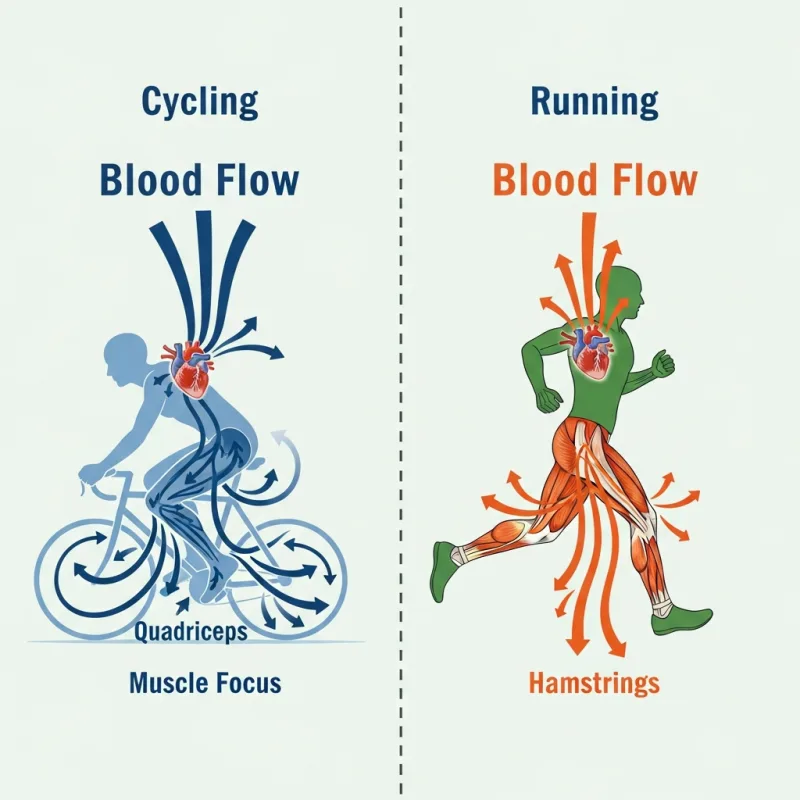
The first and most impactful culprit is your cardiovascular system. On the bike, your body is in a very specific configuration. You're in a seated, forward-leaning position, and the effort is mainly concentrated on the quadriceps and gluteal muscles. Your heart has gotten used to sending a massive blood flow to these areas to supply them with the necessary oxygen and nutrients. Venous return (the blood that flows back to the heart) is aided by this position and constant muscle contraction.
And then, suddenly, T2. You abruptly switch to an upright position. Gravity comes into play differently. The blood that was flowing massively to your thighs tends to "stagnate" (this is called blood pooling) in your lower limbs. At the same time, you're asking your body to supply a whole new group of muscles, which are a priority for running: the calves, hamstrings, and the stabilizing muscles of the foot and hip. Your heart has to react instantly: not only must it continue to beat at a high rate, but it also has to redirect liters of blood from one muscle group to another, all while fighting gravity to ensure good venous return. This abrupt redistribution creates a sort of temporary "void," a drop in blood pressure that can even cause dizziness in some people. Your legs, suddenly less irrigated and deprived of effective venous return, feel heavy, numb, and unable to respond. It's circulatory chaos!
The Neuromuscular Conflict: A Communication Breakdown Between Your Brain and Muscles
The second culprit is your nervous system. For hours (or tens of minutes, depending on the distance), your brain has been sending a very specific motor signal to your legs: pedaling. It's a circular, fluid motion where the power phase (mainly concentric) is king. Your brain has created a kind of "motor program" optimized for this task. It's on autopilot.
When you set foot on the ground, you ask it to switch instantly to a completely different program: running. This new program is based on impact, propulsion, and a complex alternation of eccentric (cushioning) and concentric (pushing) contractions. The muscle recruitment patterns are radically different. The muscles are not activated in the same order, with the same intensity, or for the same type of contraction.
The result? A complete system crash. Your brain is searching for the right program, and your muscles are receiving confusing orders. It's this latency, this neuromuscular recalibration time, that results in a disordered, inefficient stride and that feeling of no longer controlling your legs. You feel like you're running like a robot whose circuits have fried. It's normal: your operating system is rebooting.
Metabolic and Biomechanical Debt: The Baggage from the Bike
Finally, the third aspect is a direct legacy of the cycling effort. From a metabolic point of view, the intense effort on the bike has already depleted your glycogen stores and potentially created an accumulation of lactate. When you start running, your body has to manage this pre-existing fatigue while adapting to a new energy demand. The first few minutes of the run are often more intense than expected because the aerobic system struggles to keep up with the abrupt change, which can temporarily worsen muscle acidosis.
From a biomechanical point of view, your position on the bike, especially if it's very aggressive and aerodynamic, has consequences. Your hip flexors and hamstrings have been working in a reduced range of motion. They are in a "shortened" position. Switching to the upright posture and the large range of motion of a running stride requires a considerable adaptation effort. This residual tension in the posterior chain can limit your hip extension, reduce your stride efficiency, and contribute to that feeling of "locked" legs.
The Art of Training: Building Transition-Proof Legs
Now that we've made the diagnosis, let's move on to the treatment! Because yes, you can train your body to better handle this transition. The idea is not to eliminate the sensation completely (even the pros feel it!), but to minimize it, control it, and drastically reduce the time your body needs to find its running rhythm. And for that, training is your most powerful weapon.
Brick Sessions: Your Best Ally
If you only remember one thing from this article, let it be this: incorporate "brick" sessions (bike-run combinations) into your training plan. It's the ABC, the absolute foundation for preparing your body. But be careful, not all bricks are created equal. It's not just about jogging for 10 minutes after every bike ride. You have to think about them, structure them, so they are truly effective. Here are some practical gems to vary the fun and the benefits:
- The Base (or Acclimatization) Brick: After a base endurance bike ride, follow it up with 15 to 30 minutes of very easy running. The goal here is not performance, but simply to accustom your body to the change in posture and demands. It's the perfect session to start with or for recovery weeks.
- The Threshold (or Specific) Brick: This is the key session for race day. After a warm-up, do 30 to 60 minutes on the bike at your race pace (Half or Ironman), then immediately follow with 15 to 30 minutes of running at the same intensity. It's tough, it hurts, but it's incredibly effective for simulating race conditions and teaching your body to manage the effort over time.
- The Interval (or Explosive) Brick: For shorter formats (S or M) or to work on your speed. The principle is simple: you alternate intense effort intervals on the bike and run. For example: 4 x (10 minutes of cycling at VO2 max power + 5 minutes of fast running). The transition time should be as short as possible. These sessions teach your body to switch very quickly from one mode to another and to manage discomfort at high intensity.
- The "Multi-Brick" (or Leg-Buster) Session: My favorite for really shocking the system and forcing it to adapt! You repeat short combinations several times. Example: 5 x (15 minutes of cycling at race pace + 8 minutes of running at race pace). It's mentally and physically demanding, but it builds mental toughness and an extraordinary ability to adapt.
The key is consistency. Aim for one brick session per week, integrating it intelligently into your training cycle. Start gently and gradually increase the duration and intensity.
Cadence Work: The Practical Gem for an Efficient Stride
Here's a tip that changed my life as a triathlete. Cadence, whether on the bike or on the run, is a powerful lever to facilitate the transition. The idea is to create a bridge between the two disciplines.
On the bike: In the last 5 to 10 minutes of your cycling leg, focus on your pedaling cadence. Instead of pushing a big gear at 75-80 revolutions per minute (rpm), shift down one or two gears and increase your cadence to spin your legs around 90-100 rpm. This has two major advantages:
- It reduces the muscular load on your quadriceps, limiting fatigue and the feeling of "heavy legs."
- It prepares your neuromuscular system for a higher frequency of movement, closer to that of running (which is ideally around 180 steps per minute, or 90 per foot).
On the run: At the beginning of the run, don't think about speed or power. Think "quick, small steps." Focus on a high cadence, even if it means your stride is very short at first. This is the famous "triathlon shuffle." It's not very graceful, but it's incredibly effective for allowing your cardiovascular and neuromuscular systems to adapt smoothly. Once you feel your legs responding better, you can gradually lengthen your stride while maintaining a high cadence.
Targeted Strength Training: More Than Just a Gym Session
Triathlon is not just about cardio. A strong, stable body is a more resilient body, especially during transition phases. A well-designed strength program can do wonders for your jelly legs.
- Core Work Above All: A strong core and lower back are essential for maintaining good running posture, especially when fatigue sets in. The switch from the bent-over bike position to the upright running position is a shock to your torso. A stable core facilitates this transfer and prevents you from collapsing, which would waste precious energy. Planks, side planks, bird-dog... these exercises should be part of your routine.
- The Power of the Glutes: The glutes are the engines of running. Strong glutes will ensure a powerful and economical stride. Hip thrusts, lunges, and squats are your best friends.
- Plyometrics for Explosiveness: To get your muscles used to the impact of running, incorporate plyometric exercises: jump rope, box jumps, squat jumps... This will improve the elasticity of your muscles and tendons, making your stride more dynamic from the very first steps.
- Unilateral Work: Cycling is a bilateral movement, while running is a series of landings and push-offs on a single leg. You need to train for this specificity! Lunges (forward, reverse, lateral), pistol squats (if you can!), or single-leg deadlifts are excellent for developing the necessary strength and stability.
Race Day: Tips and Strategies for a Dream T2
Training is 90% of the work. But on race day, a good strategy can make all the difference. It's the small details, the practical gems, that, when put together, will allow you to have a much calmer transition.
The Last Kilometers on the Bike: Mental and Physical Preparation
The transition doesn't start when you put your foot down, but 5 to 10 minutes before. It's an active preparation phase. As I mentioned earlier, this is the ideal time to increase your pedaling cadence. Also, take the opportunity to sit up a bit on the saddle to slightly stretch your back and hip flexors. Visualize your transition: where is your spot, in what order will you remove your helmet, put on your shoes, etc. In terms of nutrition, this is the last moment to take a sip of water or an energy drink and a final gel if your plan calls for it. Starting the run well-hydrated is crucial, as dehydration terribly accentuates the feeling of heavy legs.
The Transition: From Speed to Efficiency
We're often obsessed with pure speed in the transition area. We want to save seconds. But haste is the enemy of efficiency. A successful transition is a calm and controlled one. A Faster Triathlon Transition is all about fluidity. Take the time to breathe deeply as you run to your spot. Perform your actions in the order you've rehearsed dozens of times in training. Putting on your running shoes, cap, sunglasses... it should be automatic. Don't sprint out of the transition area. You still have the entire run ahead of you.
The First 500 Meters of the Run: The Critical Phase
That's it, you're running. This is where it all happens. Accept the feeling. Don't panic if your legs feel weird. Tell yourself it's normal, that it will pass. Here is the roadmap for this first kilometer:
- Start deliberately slower than your target pace. Even 15 to 20 seconds slower per kilometer. The goal is not to set a record, but to allow your body to adapt. It's an investment: these few "lost" seconds at the beginning will save you minutes later.
- Focus on cadence, not stride length. Small, light, quick steps. Imagine you're running on eggshells.
- Relax your upper body. Tension is your enemy. Relax your shoulders, arms, and hands. A relaxed upper body promotes a more efficient stride.
- Breathe! Take deep breaths in and out to maximize oxygen delivery to your muscles and help relieve the stress of the transition.
You'll see that after 500 meters to 1 kilometer, as if by magic, the feeling of heaviness will dissipate, your stride will lengthen naturally, and you'll regain normal running sensations. You will have successfully navigated your transition!
Equipment, a False Friend?
A final word on equipment. While it doesn't solve the physiological problem, it can certainly help (or hinder!). A good bike fit is essential. A position that is too aggressive or poorly adjusted can cause muscle tension that you'll pay for dearly on the run. For shoes, elastic laces are a triathlete's classic. They not only save time but also ensure a uniform fit that doesn't compress the foot, promoting good blood circulation. Lastly, a comfortable trisuit that doesn't chafe or restrict your neck will help you stay more relaxed and breathe better. Comfort is a key element of endurance performance.
After the Finish Line: Learning and Improving
The race is over, but the work continues! Every triathlon is an opportunity to learn. Analyzing your sensations is a goldmine for your future training.
Keeping a Logbook: Data at the Service of Your Sensations
Get into the habit of noting your feelings after each brick session and each race. How did you feel in the last kilometers on the bike? What were the first 500 meters of the run like? How long did it take you to find your rhythm? Did you try to increase your cadence? What did you eat or drink beforehand? All this information, cross-referenced with your watch data (heart rate, pace, cadence), will help you identify what works for you.
Listening to Your Body: The Difference Between Pain and Discomfort
It's crucial to know the difference between the normal, temporary discomfort of the transition and real pain that could signal an emerging injury. Cramps, sharp pain in a joint, or a muscle that doesn't feel better after a few minutes should be a red flag. Don't be a hero; health always comes before performance.
Sharing Experiences: The Strength of the Community
Triathlon is an individual sport that is experienced collectively. Don't hesitate to discuss your feelings with other triathletes in your club or on forums. You'll realize you're not alone in this, and you can exchange tips, training plans, and experiences. It's this emulation that helps us all improve.
There you have it, you now have all the tools to understand and conquer the jelly legs phenomenon. It's not a magic formula, but a comprehensive approach that combines science, smart training, a refined race strategy, and a good dose of self-awareness. Don't get discouraged if your first attempts aren't perfect. Every transition is a new experience. Learn, adjust, and most importantly, enjoy the unique challenge that our sport offers.
Keep riding further!
Answers to your questions about jelly legs
How long does the "jelly legs" feeling last?
The duration varies greatly from one athlete to another and depends on training, race intensity, and distance. Generally, for a well-prepared triathlete, the major discomfort lasts between 400 meters and 1.5 kilometers. The goal of specific training is to reduce this duration to a minimum, ideally just a few minutes.
Should you do brick sessions after every bike ride?
No, it's neither necessary nor recommended. The body needs to train specifically for each discipline. Integrating one structured brick session per week is an excellent goal during race-specific preparation phases. Other bike rides can be followed by rest or another discipline later in the day, but not in immediate succession.
Can a bad bike position really cause this problem?
Absolutely. A position that is too aggressive, or a saddle that is too high or too low, can create excessive tension in the hamstrings, quadriceps, or hip flexors. This biomechanical stress makes the transition to a running posture much more difficult and painful, significantly worsening the feeling of heavy and inefficient legs.
Do professional triathletes feel this too?
Yes, all triathletes, even world champions, feel the effects of the transition. However, thanks to years of specific training, their bodies have adapted to minimize the impact and duration of this phase. They have automated the process so much that their neuromuscular and cardiovascular systems adapt in a matter of seconds, whereas an amateur might take several minutes.