Reverse Tapering: The Post-Race Strategy to Avoid Losing Everything
By Sarah — translated from an article by Charly Caubaut Published on 11/08/2026 at 08h31 Reading time : 9 minutes
Why is the Post-Race Period so Critical? The Finish Line Blues and Hidden Risks
You did it! You crossed that finish line. The euphoria, the tears of joy, the pride… For months, all your energy was focused on this goal. And now? A big void. This is what I call the 'finish line blues.' We go from a state of maximum excitement to a kind of limbo, without a clear purpose. Believe me, having experienced it after more than one long-distance triathlon, this feeling is as destabilizing as a crosswind on an 80 mm rim!
The biggest trap is falling into extremes. Either you tell yourself, 'Mission accomplished, now it's total rest!' and you let the bike gather dust for three weeks. Or, conversely, you're so addicted to the adrenaline that you put your running shoes back on two days later so you don't 'lose your fitness.' In both cases, you're heading straight for a wall.
The psychological pit: when the body goes quiet, the mind falters
The post-race period is first and foremost a mental affair. The decompression is brutal. The structure that the training plan provided disappears. No more sessions to check off, no more 'big' weekends to organize. This loss of bearings can be really difficult to manage. Some athletes even talk about a mini post-competition depression. It's normal! You've put your body and mind under enormous tension. The release must be done gently, not by cutting the engine all at once.
The physiological bill: an invisible but very real debt
Even if you feel like a superhero after a few days of rest, your body is a construction site. Just imagine the picture inside:
- Muscle micro-tears everywhere: Every stride, every pedal stroke has created microscopic damage in your fibers. It takes time and materials (proteins!) to rebuild it all.
- Depleted energy reserves: Your glycogen stores are at rock bottom. It's like trying to start a car without a drop of gasoline.
- A haywire hormonal system: Your cortisol level (the stress hormone) skyrocketed during the race. It takes time for everything to return to balance. A prolonged imbalance opens the door to overtraining.
- A weakened immune system: Right after intense effort, your body is more vulnerable to infections. This is the famous 'open window' where the slightest virus can knock you out.
Resuming too quickly is like building the second story of a house with cracked foundations. Sooner or later, it collapses. Tendinitis, stress fractures, recurring injuries... the list of risks is long. This is where the concept of 'reverse tapering' comes in, like a true insurance policy for your body and your future season.
"Reverse Tapering": Definition and Fundamental Principles
So, what is this famous 'reverse tapering'? The name may sound technical, but the idea is incredibly simple. Do you remember your taper before the race? That period when you gradually reduced your training volume to arrive fresh and full of energy at the starting line? Well, reverse tapering is the exact opposite. It's a gradual and controlled ramp-up of training after your goal event.
It's the mirror image of your taper. Instead of decreasing from 80% to 60%, then 40% of your volume, you'll start from almost zero and build back up to 25%, 40%, 60%, etc. It's a structured transition phase, a bridge between total recovery and resuming normal training. It's neither complete rest nor training. It's a distinct phase in your planning.
The four pillars of successful reverse tapering
For it to work, you have to follow a few golden rules. These are the guardrails that will keep you from derailing.
- Progression above all: This is the key word. Each week, the volume and intensity increase, but very slightly. The idea is to stimulate the body without ever rushing it. You gently reacquaint it with effort.
- Listening to your body as your compass: Forget your power meter and GPS watch for a while. Your best indicator is you. How do you feel when you wake up? Did you sleep well? Do you feel like moving? If your body screams 'stop,' you listen, even if the plan said '30 minutes on the bike.'
- Low intensity as a dogma: In the first few weeks, intensity is your enemy. We stick to fundamental endurance (Zone 1-2). The goal is to circulate blood, oxygenate the muscles, and reactivate the aerobic system without creating additional fatigue. Interval sessions can wait!
- Flexibility as the key principle: A reverse tapering plan is a guide, not a prison. One week, you might feel great and be able to do a little more. The next week, fatigue or a busy work schedule might force you to ease off. That's OK. The important thing is the overall upward trend over several weeks.
By adopting this method, you're not just recovering. You're capitalizing on the work you've done. You allow your body to intelligently supercompensate and build an even stronger foundation for your next challenges. It's a long-term investment, the secret of athletes who last.
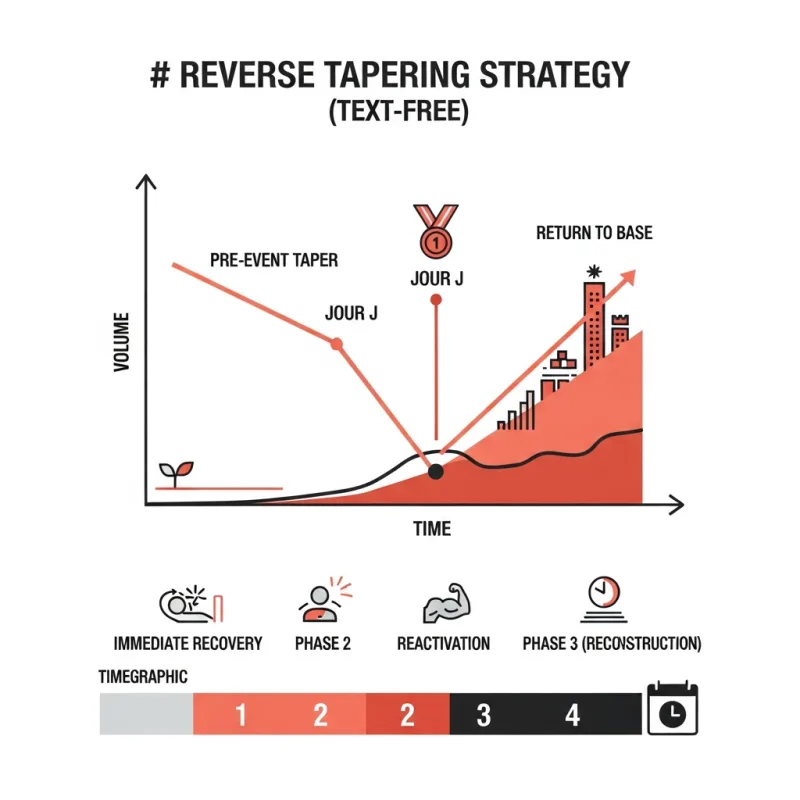
Building Your "Reverse Tapering" Plan: The Practical, Step-by-Step Guide
OK Charly, theory is all well and good, but what do we do in practice? Don't panic, I've prepared a detailed flight plan for you. It's a baseline that you'll obviously have to adapt to how you feel and the distance of your race. Think of it as a map, but you're the one behind the wheel.
Phase 1: Immediate Recovery (Day 0 to D+3)
The objective: Help the body kick-start the repair process. We're not talking about training, but care.
- Physical activity: The bare minimum. A slow 15-20 minute walk per day is ideal to activate blood circulation without stressing the muscles. Cycling? Forget it. Running? Don't even think about it. Swimming? Let the suit dry.
- Nutrition: This is crucial. Right after the race, refuel with a recovery drink. In the following days, focus on proteins to rebuild muscle fibers (white meats, fish, eggs, legumes) and good carbohydrates to replenish glycogen stores. Don't neglect fruits and vegetables for their vitamins and antioxidants that fight inflammation.
- Hydration: Drink water, again and again. Your body needs fluid to function and eliminate metabolic waste.
- Sleep: This is your best recovery tool. It's during the night that your body releases growth hormones that repair tissues. Aim for at least 8 hours a night, and if you can, a short nap never hurts.
- Practical gems: Compression socks can help reduce muscle soreness. A gentle massage (not a brutal one!) or using a massage gun on low intensity can also relieve tension.
Phase 2: Gentle Reactivation (Week 1, from D+4 to D+7)
The objective: Gently get the machine running again with low-impact activities.
- Total volume: About 25% to 30% of your average weekly volume before tapering.
- Intensity: Only in Zone 1/2. You should be able to breathe easily, capable of singing if you feel like it.
- Example week:
- Cycling: 2 rides of 30-45 minutes on flat terrain, spinning easily. The goal is to turn the legs without pushing.
- Swimming: 1 very easy 20-minute session, focusing on technique and the feeling of gliding. Use a pull-buoy to rest your legs.
- Running: ZERO. We're still waiting. Your joints and tendons will thank you.
- Other: Walking, gentle stretching, yoga.
Phase 3: Progressive Reconstruction (Week 2)
The objective: Slightly increase volume while maintaining very controlled intensity.
- Total volume: We move up to 40-50% of your cruising volume.
- Intensity: Still predominantly in Zone 2. You can include a few very short accelerations (30 seconds) at the end of a session, just to wake up the fast-twitch fibers, but without creating fatigue.
- Example week:
- Cycling: 2 or 3 rides, one of which can reach 1h to 1h15.
- Swimming: 2 sessions of 30-40 minutes, with some drills.
- Running: The big comeback! We start with 1 or 2 jogs of 15-20 minutes on a soft surface (grass, trail). If you feel any pain, stop and walk.
For these first post-race bike rides, the goal is pleasure, not performance. Make sure you are warm and comfortable so that the session remains a relaxing time. A good long-sleeved jersey can make all the difference in not getting cold and enjoying the ride.
⌚ EKOI Perf EXPLORE Khaki Long-Sleeved Jersey
🧾 Ideal for mid-season rides or cool mornings during the recovery period. It offers light thermal protection without overheating, perfect for low-intensity efforts.
- Technical fabric: Breathable and comfortable for optimal thermal regulation.
- Fitted cut: Close to the body without being compressive, for total freedom of movement.
🎯 Ideal for: Cyclists and triathletes looking for a versatile jersey for their recovery or fundamental endurance rides in cool weather.
🛒 Discover the EKOI Perf EXPLORE Khaki Long-Sleeved Jersey on Ekoi - Product ReferencePhase 4: Return to Base (Weeks 3 & 4)
The objective: Gradually return to a base training volume and reintroduce some intensity.
- Total volume: Aim for 60% to 75% of your maximum volume.
- Intensity: You can reintroduce threshold work (Zone 3/early Zone 4), but in short intervals. For example, 2x10 minutes at threshold during a bike ride. Still no VMA or PMA work.
- Example week (week 3):
- Cycling: 3 rides, including one long ride of 1h30-2h and one with some tempo.
- Swimming: 2 or 3 sessions, increasing the total distance.
- Running: 2 or 3 runs, including one of 30-40 minutes. Listen carefully to your body.
It's during this phase that you'll really feel the benefits of your patience. By having allowed your body to fully regenerate, you are ready to handle a load again. This is the basis of the principle of supercompensation in running: the principle of progression, but applied to recovery. You're not just getting back to your previous level; you're creating the conditions to surpass it.
Adapting "Reverse Tapering" to Your Race Distance
Obviously, you don't recover the same way from a 10k as you do from an Ironman. The duration and structure of your reverse taper must be proportional to the shockwave the race sent through your system. Here are some guidelines to help you customize your approach.
After a 10k or a Sprint triathlon
The effort is intense but relatively short. The muscular and systemic stress is much lower. Therefore, recovery is faster.
- Duration: One week is often enough.
- Typical plan: 2-3 days of complete rest or very active recovery (walking). Then you can go straight into a week that looks like Phase 3 of our general plan (volume at 40-50%, gentle resumption of running). By the end of this week, you should be able to resume almost normal training.
After a half-marathon or an Olympic distance triathlon (M distance)
Here, we're entering the realm of efforts that leave their mark. Muscle fatigue is significant, and energy reserves have been seriously depleted.
- Duration: Plan for a 2-week cycle.
- Typical plan: The first week will correspond perfectly to our Phase 2 (gentle reactivation). The second week will be a slightly more intense version of Phase 3 (reconstruction). You can increase the volume to 50-60% and do two runs. A return to normal training will happen in week 3.
After a marathon or a half-Ironman (70.3)
We are talking about a major trauma for the body here. I have immense respect for these distances. They require a recovery that is just as serious as the preparation. The most common mistake is to feel good after 4-5 days and want to start back too quickly.
- Duration: A full 3 to 4-week cycle is essential.
- Typical plan: Follow the detailed 4-phase plan we discussed earlier to the letter. Be particularly patient with running. A simple rule I like: no running for at least a week, then only one run in the second week. Cycling and swimming, being less impactful, will be your best friends for maintaining activity without stressing the joints.
After a full Ironman or an ultra-trail
This is the top of the pyramid. The effort is so long and intense that the damage is measured in weeks, if not months. The stress isn't just muscular; it's hormonal, nervous, immune... total.
- Duration: Between 4 and 6 weeks, without hesitation. Some pros take even longer.
- Typical plan: The 4-week plan is a bare minimum. Phase 1 can last 4 to 5 days. Running should not be resumed for 10 to 15 days, and then extremely gradually. Many athletes use this period to take a real break from one of the three sports, often running, for almost a month, focusing on very easy swimming and cycling. Listening to your body is more important than ever here. Fatigue can come in waves, weeks after the event.
Charly's "Practical Gems" for a Successful "Reverse Tapering"
Beyond the structured plan, there are a multitude of small details that can transform your recovery. It's these small attentions that, when added up, make a huge difference. Here are my favorites, tested and approved in the field!
Nutrition and hydration: your personal mechanics
Don't let your guard down about what you eat just because the race is over. Your body is in full reconstruction mode; it needs the best materials. Continue to prioritize quality proteins, complex carbohydrates, healthy fats (avocados, nuts, vegetable oils), and as many colorful vegetables as possible to load up on antioxidants. And keep drinking plenty of water throughout the day.
Sleep: your body's "reset" button
We've already said it, but it's so important I'll repeat it: sleep! It's free and it's the most powerful recovery tool that exists. If you have trouble falling asleep, try relaxation techniques, turn off screens an hour before bed, and make sure your room is cool, dark, and quiet.
Cross-training: the art of moving differently
Reverse tapering is the perfect time to mix things up. Are you a triathlete? Go for a hike in the forest. Are you a trail runner? Take advantage of the pool to unload your joints. Mountain biking, yoga, climbing... Moving differently helps maintain general fitness, work different muscle chains, and, above all, keep your spirits up and break the routine. It's excellent for your mind!
Strength training: repair and reinforce
After the first week of reactivation, you can reintroduce strength training, but in a smart way. Forget heavy loads. This is the time to focus on:
- Joint mobility: to regain range of motion.
- Core work: to strengthen your body's center, the foundation of all your movements.
- Stabilizer muscle work: (hips, ankles) to prevent future injuries.
- Light global strengthening exercises: to rebalance forces after months of repetitive movements.
The mental game: planning ahead without rushing
Take advantage of this quieter period to review your race and your season. What worked well? What could you improve? It's also a time to dream a little. Look at next year's race calendar, plan a cycling trip with friends, find a new goal that excites you. Having a perspective, even a distant one, helps you stay motivated during this transition phase.
Mistakes to Absolutely Avoid After Your Race
Sometimes, the best way to succeed is to know what NOT to do. I made most of these mistakes early in my career, so if my experience can save you some trouble, it's a win!
1. The Abrupt Stop: The "Couch Syndrome"
Going from 15 hours of training per week to zero is a shock to the body. Blood circulation slows, metabolism drops, and you can quickly feel lethargic and gain weight. Movement, even gentle, is essential to help the body drain and recover. Total rest should never exceed 2 or 3 days, unless injured.
2. The "Revenge" Comeback: Wanting to Train Too Hard, Too Soon
This is the opposite mistake. Either you're disappointed with your performance and want to get 'revenge' in training, or you feel invincible and think you can pick up where you left off. In either case, you're heading for disaster. Your body is fragile, even if it's not telling you yet. Respect its timeline.
3. Ignoring Your Body's Signals
A little pain in the Achilles tendon? Persistent abnormal fatigue? Poor quality sleep? These are red lights on your dashboard. Ignoring them is like continuing to drive with a flat tire: you'll end up damaging the rim. Be honest with yourself and don't hesitate to take an extra rest day if needed.
4. Neglecting "Repair" Nutrition
The race is over, so it's open season on beer, pizza, and ice cream, right? It's a well-deserved reward, but it shouldn't last a week. Your body is crying out for quality nutrients to repair itself. A poor diet at this time is like sending a team of masons to a construction site without bricks or cement. It just can't work.
Conclusion
As you've understood, the period following your goal event is just as important as the one preceding it. Reverse tapering is not a constraint; it's a smart athlete's strategy. It's the art of transforming your recovery into a solid foundation for your future successes. By respecting this transition phase, you're not just preventing injuries and overtraining. You are allowing your body to fully assimilate the thousands of kilometers you've covered, to regenerate deeply, and to come back stronger, more resilient, and with renewed motivation.
So, the next time you cross a finish line, savor the moment, be proud of yourself, but don't forget that the race doesn't end there. A new phase begins, quieter, more introspective, but absolutely essential. It's the secret to building a long and beautiful career as an endurance athlete.
Keep riding further!
Frequently Asked Questions about Reverse Tapering
How long should a reverse taper last?
The duration depends directly on the race distance. For a short event like a 10k or a Sprint triathlon, one week may be sufficient. For a half-marathon or Olympic distance, aim for two weeks. After a marathon or a 70.3, a three to four-week cycle is essential. Finally, for an Ironman or an ultra, plan for four to six weeks for a complete and safe recovery.
Can I do strength training during reverse tapering?
Yes, absolutely! But not right away. It's advisable to wait until the second week (reconstruction phase) to reintroduce strength training. In the beginning, focus on bodyweight exercises, core work, mobility, and very light weights. The goal is not to build strength, but to reinforce stabilizer muscles and correct imbalances.
What should I do if I feel pain when I resume training?
This is a clear warning sign: you must stop immediately. Pain (not to be confused with normal muscle soreness) means the tissue is not ready. Stop the session, rest, and analyze the situation. If the pain is mild, take one or two extra rest days before attempting a very short and easy session again. If the pain persists or is sharp, do not hesitate to consult a healthcare professional (sports doctor, physical therapist).
Will I lose all my fitness during this period?
No, this is a common but unfounded fear. On the contrary, reverse tapering is designed to preserve and even consolidate your gains. By allowing for complete recovery, you ensure optimal supercompensation. You will certainly lose the sharp peak fitness of the competition (which is normal and inevitable), but you will build a much more solid aerobic base and resilience. It's a strategic step back to leap forward and progress in the long term.