Aerobic Decoupling: The Indicator to Never Bonk in a Trail Race Again
By Sarah — translated from an article by Charly Caubaut Published on 05/05/2026 at 08h31 Reading time : 7 minutes
Hitting the wall, bonking, the crash... Call it what you want. We all know the feeling.
You start your trail race, your legs feel great, and your morale is sky-high. The first few kilometers fly by; you even overtake a few competitors on the first climb. You feel invincible. And then, without warning, the lights go out. Suddenly, your legs turn to concrete blocks, every stride becomes torture, and the finish line seems as far away as the moon. You finish on sheer willpower, walking, wondering what on earth just happened. Sound familiar, right?
I've been there dozens of times, whether in triathlons or on the trails. The frustration of feeling your body give up while your mind still wants to push forward. For years, I thought it was inevitable, just a lack of "base fitness" or poor race management. But the truth is, there's an indicator, a piece of data hidden in your GPS watch, that can predict and, more importantly, prevent this failure. It's like your personal early warning system. That indicator is aerobic decoupling.
Far from being a scientific term reserved for the pros, it's an incredibly powerful tool accessible to everyone. It's the key to transforming your Twingo engine into an indestructible tractor engine. In this article, I'm going to break down this concept for you from A to Z. We'll look at what it is, why it's VITAL in trail running, how to calculate it, and, most importantly, how to improve it so that your next trail race is a story of pleasure from start to finish. Come on, lace up your shoes, we're heading out for a long run into the world of data!
So, What is This Famous Aerobic Decoupling?
Imagine you're driving your car on the highway at a constant speed of 130 km/h. Normally, your engine's RPM gauge should remain stable, let's say at 3000 rpm. Now, imagine that to maintain that 130 km/h, the engine starts to progressively climb to 3500, then 4000 rpm. You'd immediately think there's a problem, right? The engine is overheating; it's losing efficiency. It's "decoupling."
Well, your body works in exactly the same way. Aerobic decoupling is the measure of this loss of efficiency in your cardiovascular system over time. Specifically, it compares the relationship between your "work" (your running pace or cycling power) and the effort your heart must provide to produce it (your heart rate).
In simple terms, if you maintain a steady pace but your heart rate inexorably climbs as the minutes go by, it's a sign of high aerobic decoupling. Your heart has to work harder and harder to produce the same performance. It's the first sign that your aerobic system—your energy factory for long efforts—is starting to fatigue and lose efficiency.
This phenomenon is directly linked to what we call cardiac drift. Drift is the natural tendency of the heart to speed up during a prolonged effort, even at a constant intensity. Aerobic decoupling, on the other hand, is the quantified measurement of this drift over a given session. It gives you a percentage, a score, that tells you whether your endurance base is solid or if it resembles a house of cards ready to collapse.
Why is This a Game-Changer for You, as a Trail Runner?
In trail running, more than in any other endurance sport, management is key. You don't sprint for 50 km. You manage your effort for hours, on varied terrain, with elevation changes. Aerobic fitness isn't just a quality; it's THE essential quality. And aerobic decoupling is the best indicator of this quality.
The Revealer of Your Weaknesses
High decoupling on a long run at base endurance pace is a huge red flag 🚩. It tells you several things:
- Your aerobic base is insufficient: Your body isn't efficient enough at using fats as fuel over the long haul. It turns to sugars (glycogen) too quickly, and those stores are limited. Once they're empty, you hit the wall.
- Your effort management needs review: You might have started out too fast. Even if you felt like you were taking it easy, your cardiovascular system was already in overdrive. Decoupling shows you this without mercy.
- Your hydration or nutrition is not optimal: Dehydration, even slight, makes blood thicker. The heart then has to pump harder and faster to supply the muscles. The result: heart rate skyrockets and decoupling explodes.
- Fatigue is accumulating: If you're overtraining or haven't slept well, your nervous system is tired. Your baseline heart rate will be higher, and it will drift much more quickly during exercise.
I remember one prep for an ultra. I felt strong; I was chaining together hill and threshold sessions. But on my long runs, I always finished drained. By analyzing my data, I saw that my decoupling was consistently over 10%. My mistake? I was doing my long runs too fast, never truly in my base endurance zone. My body wasn't learning to be economical. I revised my whole plan, incorporated much more Zone 2, and within a few weeks, my decoupling dropped below 5%. The difference in the race was radical: perfect management and energy right to the end.
The Practical Nugget: How to Calculate Your Own Aerobic Decoupling
Theory is all well and good, but how do you do it in practice? It's much simpler than it sounds. You don't need an engineering degree, just your watch and a bit of method. Come on, follow the guide!
The Necessary Equipment
For a reliable calculation, you need:
- A GPS watch: Any watch capable of recording your heart rate and pace will do the job.
- A heart rate monitor: This is the most important point. The optical sensor on your watch's wrist can be sufficient for a trend, but for a precise measurement, a chest strap is essential. It's much more responsive and less prone to measurement errors (arm movements, sweat, etc.).
- (Optional but recommended) A power meter: In trail running, pace can vary a lot due to elevation. A power meter (like Stryd) measures the actual effort you're producing. It's the most reliable data for the calculation, but you can easily start with pace on a relatively flat course.
The Step-by-Step Testing Protocol
The goal is to do a long, steady run in your base endurance zone (Zone 2). This is the pace where you're in total respiratory comfort, able to hold a conversation without getting out of breath.
- Choose a suitable course: To start, pick a course with little elevation change and no interruptions (road crossings, etc.). A loop on a forest path or a greenway is ideal.
- Duration of the effort: Aim for a duration of at least 60 minutes, and ideally 90 minutes or more. The longer it is, the more revealing the test. Don't forget a good 15-minute warm-up before starting your test.
- Maintain a constant effort: This is key. Stay squarely in your Zone 2. Don't get carried away by the initial euphoria. The goal isn't to go fast, but to stay steady.
- Analyze the data: Once you're back, upload your run to a platform like Garmin Connect, Strava, Nolio, or TrainingPeaks. These platforms often calculate decoupling automatically (sometimes called "Pw:Hr" or "Pa:Hr").
The Magic Formula (If You Want to Do It by Hand)
If your platform doesn't do it, or if you're a numbers geek like me, here's how:
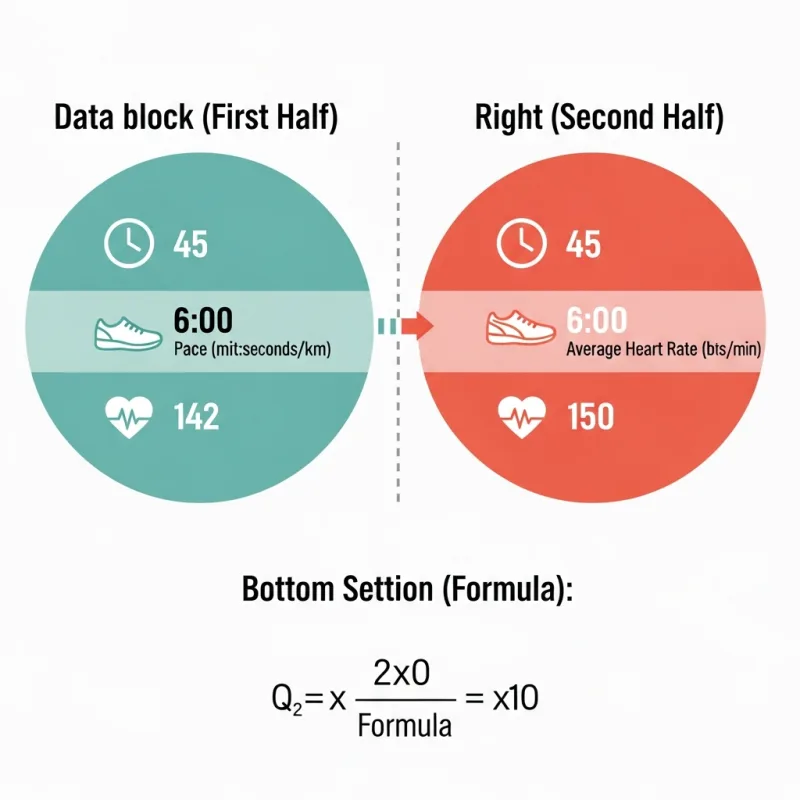
- Divide your session (the steady Zone 2 part, after the warm-up) into two equal halves. For example, for an 80-minute effort, you'll have two 40-minute blocks.
- For each half, note the average heart rate (HR) and the average pace (or average power). So you'll have: HR1 and Speed1 for the first half, and HR2 and Speed2 for the second.
- Calculate the "Speed/HR" ratio for each half. To simplify, we can invert and use "HR/Speed". Let's take this example:
- First half: HR1 = 140 bpm / Speed1 = 12 km/h. Ratio 1 = 140/12 = 11.67
- Second half: HR2 = 148 bpm / Speed2 = 12 km/h. Ratio 2 = 148/12 = 12.33
- Apply the decoupling formula:
Decoupling (%) = [ (Ratio 2 - Ratio 1) / Ratio 1 ] * 100
In our example: [ (12.33 - 11.67) / 11.67 ] * 100 = (0.66 / 11.67) * 100 = 5.65%.
This number is your endurance score!
Interpreting the Results: Your Endurance Report Card
Now that you have your number, what does it mean? This percentage is an excellent mirror of your aerobic fitness. Here's how to interpret it. Keep in mind that these values are general guidelines, and conditions (heat, humidity) can influence them.
Decoupling Below 5%: The Diesel Engine 🚜
Congratulations! This is the holy grail of endurance. Such low decoupling means your cardiovascular system is like a Swiss watch. You are incredibly economical and durable. Your body knows exactly how to use fats for fuel, you're resistant to fatigue, and ready to tackle very long distances. Keep up the good work; your base is solid as a rock.
Decoupling Between 5% and 8%: On the Right Track 👍
This is a very respectable score, typical for most regular, well-trained runners. Your endurance is good, but there's still a little room for improvement. You can perform well over many distances, but you might start to feel a drop-off on ultra formats or if you mismanage your initial effort. It's an excellent foundation to build upon.
Decoupling Between 8% and 11%: Orange Alert Zone 🟠
Here, we start to see a significant weakness in the aerobic system. Your body is still too dependent on sugars and fatigues relatively quickly. You are likely a better performer on short, intense formats than on long trail runs. This is a sign that it's time to seriously focus on developing your base endurance. Without this work, you risk plateauing and continuing to suffer at the end of your races.
Decoupling Above 11%: The Alarm Bell 🚨
Such a high score indicates a major aerobic deficiency. Your engine overheats very quickly. This is the typical symptom of the runner who does all their runs at a 'tempo' pace, without ever working at low intensities. There's a high chance you start your races too fast and pay the price in the second half. The good news? Your potential for improvement is huge! By following the advice below, you will see this number drop dramatically.
Your Action Plan: How to Smash Your Decoupling and Become an Endurance Monster
OK, that's all great, but how do I get from 12% to 5%? This is where the real work begins. But rest assured, it's not complicated. It just takes patience and discipline. Here are the 4 pillars for building bulletproof endurance.
1. The Reign of Zone 2: Slow Down to Get Faster
This is the most important piece of advice, and the hardest for many to apply. To improve your aerobic system, you have to spend time at low intensity. The vast majority of your training volume (about 80%) should be done in Zone 2, at total respiratory ease. It's at this pace that your body develops its endurance superpowers:
- It creates more mitochondria: These are the little power plants in your cells.
- It improves capillarization: It builds a denser blood vessel network to better oxygenate your muscles.
- It becomes a fat-burning machine: It learns to spare your precious glycogen stores for key moments.
Accept running slowly in training. Leave your ego in the locker room. This is the best-kept secret of the most durable athletes.
2. Long Runs, Your Best Friends
The weekly long run is non-negotiable. It's your dress rehearsal before race day. Gradually increase its duration, week after week. It's the perfect time to focus on maintaining a steady effort (and thus, low decoupling) and to test your nutrition and hydration strategy. A successful long run is one where you finish with the feeling that you could have kept going a bit longer.
⌚ EKOI Replica Team ORIGINE RACING DIVISION Long-Sleeved MTB Jersey
🧾 For those long outings in the forest or mountains, where the weather can change and you pass through areas of dense vegetation, a good long-sleeved jersey is a valuable ally. It protects from scratches, the sun, and provides slight thermal protection without causing overheating.
- Technical fabric: Micro-perforated polyester that wicks away sweat to keep you dry.
- Ergonomic cut: Designed for total freedom of movement, whether you're climbing or bombing down a hill.
🎯 Ideal for: Trail runners and mountain bikers who embark on long adventures and are looking for a versatile, protective, and breathable jersey.
🛒 Discover the EKOI Replica Team ORIGINE RACING DIVISION Long-Sleeved MTB Jersey on Ekoi3. Nutrition and Hydration: The Fuel for Performance
Never underestimate this point. You can have the best engine in the world, but without fuel, it won't take you anywhere. Start drinking and eating before you feel thirsty or hungry. On your runs longer than 90 minutes, practice consuming carbohydrates regularly (every 30-45 minutes). Test different products (gels, bars, purees) to see what your stomach tolerates. A good fueling strategy is the best insurance against skyrocketing decoupling.
4. Effort Management: The Art of Patience
Trail running is a sport of patience. Especially at the beginning. The temptation is strong to follow others' pace, to get fired up on the first climb. Fatal error! Learn to know yourself, to listen to your body, and to trust your heart rate monitor. Walk the steep inclines. It's often more energy-efficient and helps keep your heart rate under control. Remember: every beat you save in the first hour is energy you'll have for the last one.
Aerobic decoupling is much more than just a piece of data. It's your personal coach, your reliability indicator. By listening to it and working on it, you leave no room for chance. You build your performance on a solid foundation, brick by brick. You learn to become not the fastest, but the most durable, the most efficient. And in trail running, that often makes all the difference.
So, ready to analyze your next run?
It's your turn to play!
Answers to Your Questions About Aerobic Decoupling
Should I use pace or power to calculate decoupling in trail running?
Power is considered the gold standard because it measures the actual work produced, regardless of the gradient or wind. It is therefore the most reliable metric, especially on hilly terrain. However, a power meter is an investment. Pace remains an excellent and very effective starting point, provided you perform the test on the flattest, most consistent course possible to avoid skewing the data. If your course is very hilly, you can also simply monitor your HR drift while trying to maintain a constant perceived level of effort.
My decoupling is very high in the summer. Is this normal?
Yes, this is completely normal and expected. Heat and humidity place additional stress on the body. To maintain its core temperature, the body will increase blood flow to the skin (for sweating), and the heart will have to beat faster to compensate. This thermal stress naturally causes heart rate to rise for the same effort. The important thing is to compare apples to apples: analyze your trends by season. An 8% decoupling in the middle of summer might be a better sign of fitness than a 6% in ideal conditions.
How often should I test my aerobic decoupling?
It's not necessary to perform a formal test every week; that could even become counterproductive. The ideal approach is to conduct a protocol-based test (on the same course, in similar conditions) every 4 to 6 weeks within a training block. This will give you a clear view of your progress. In parallel, you can certainly glance at the decoupling from your weekly long runs to monitor the general trend without making it an official "test" every time.
Is 0% decoupling possible or desirable?
Achieving 0% decoupling is extremely rare and is not an end goal in itself. It's theoretically possible for an elite athlete over a relatively short effort in perfect conditions. You might even sometimes observe negative decoupling on short runs, where cardiovascular efficiency increases after the initial warm-up phase. For the vast majority of athletes, aiming for a stable decoupling below the 5% mark is already a sign of very high-level endurance and a much more realistic and relevant target.