Power in Trail Running: The New Metric to Dominate Climbs
By Sarah — translated from an article by Charly Caubaut Published on 20/10/2026 at 08h30 Reading time : 7 minutes
Hey there, trail enthusiast!
You know the feeling, right? That sensation of burning thighs on an endless climb, of your breath getting short, and that little voice asking, "Am I pushing too hard? Not hard enough?". For years, like many, I relied on my heart rate or my pace to manage my trail runs. On flat ground, it works. But as soon as the trail rears up, these indicators become as reliable as mountain weather. Pace becomes meaningless, and the heart takes forever to react. We're flying blind.
As a former triathlete, I spent thousands of hours with my nose glued to my cycling power meter. Watts were my compass, my absolute truth about the effort I was producing. It was clear, clean, instantaneous. So, when I saw this technology arrive in the world of trail running, I immediately understood it was going to be a game-changer. Imagine being able to quantify your effort with the same precision in the middle of a mountain pass as when pedaling on an indoor trainer. That's exactly what running power offers us. A true revolution for anyone who wants to understand their body, structure their training, and, above all, better manage their races to finish stronger. So, are you ready to break down this new way of looking at training together? Hold on tight, we're off to discover the world of watts!
Trail Running Power: But What Are We Really Talking About?
Before diving into sensors and training zones, let's take a moment to understand what this is all about. The word "power" might seem intimidating, reserved for pro cyclists or physicists. In reality, it's an ultra-simple concept and, most importantly, incredibly relevant for us trail runners.
From Cycling Watts to Running Watts
Power is the amount of work you do per unit of time. It's measured in Watts (W). Simply put, it's the energy you expend to move. On a bike, it's easy to measure: you place a sensor in the crankset or pedals and measure the direct force you apply. It's a purely mechanical measurement.
In running, it's a bit more complex. We can't directly measure the pushing force of your legs. Power is therefore *estimated* from motion data captured by accelerometers, gyroscopes, and barometric altimeters. These little technological gems, placed in your watch or a sensor on your shoe, analyze how fast you're moving your body mass, both horizontally (to move forward) and vertically (to climb). By combining this information, an algorithm calculates the power you're generating in real time. It's an estimate, yes, but modern sensors have become incredibly consistent and reliable.
Why is Power the King of Metrics in Trail Running?
Okay, that's all well and good, but why complicate things with watts when we already have pace and heart rate (HR)? Because on our playgrounds, those two have serious limitations.
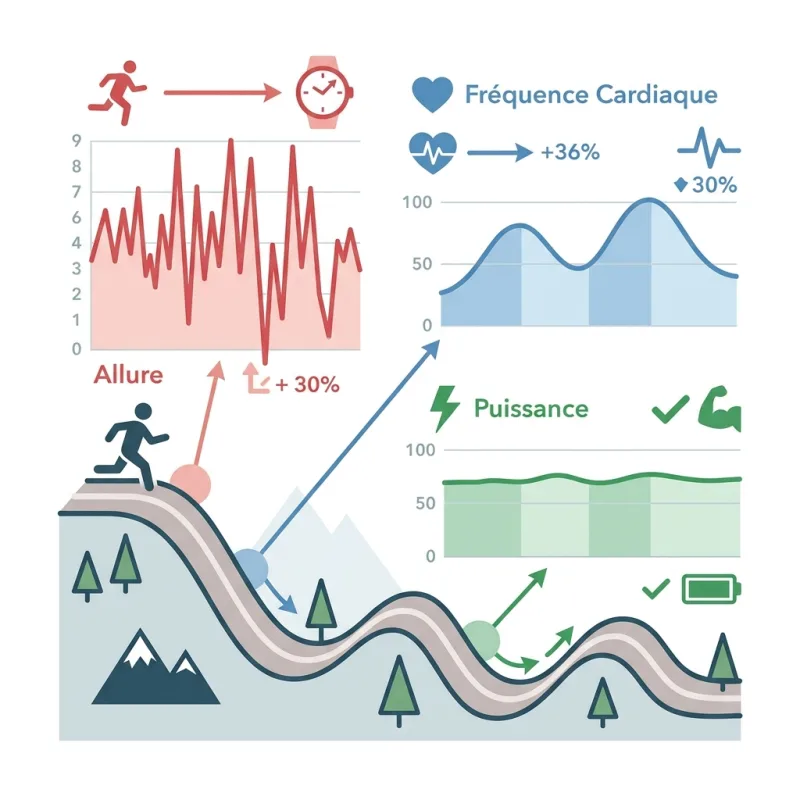
- Pace: The indicator that loses its bearings. Running at 6:00/km on a flat, smooth trail has absolutely nothing to do with running at 6:00/km on a 15% grade or in a technical rock field. The effort is radically different. Pace tells you nothing about the actual intensity of your run as soon as the terrain is no longer perfectly flat and smooth.
- Heart Rate: The delayed witness. HR is a measure of your body's *response* to an effort, not the effort itself. It takes time to rise at the start of a hill (you're already in the red while your HR monitor tells you everything is fine) and takes time to come down afterward. This is called cardiac drift. Furthermore, it's influenced by dozens of factors: heat, stress, fatigue, your morning coffee... It's a useful indicator, but not always reliable for managing a session to the second.
Power, on the other hand, is the measure of the *cause*. It's the raw, instantaneous effort. 300 watts is 300 watts, whether you're climbing, descending, or running on the flat. It's an objective value that doesn't lie. It allows you to compare incomparable efforts and manage your energy with surgical precision. That's the real strength of watts in trail running.
The Gear: How to Measure Your Power in Trail Running?
Convinced? Perfect! Now for the practical question: how do you get this famous data on your wrist? Several options are available, from the simplest to the most advanced. The market has evolved a lot, and measuring power has become much more accessible.
Power Meters: Your New Trail Companions
As I was saying, running power is a calculated estimate. The quality of this estimate depends on the tool you use. Here are the three main families of sensors:
- Footpods: The Gold Standard. These are small pods that you attach to your shoelaces. The most well-known is undoubtedly Stryd. Why is it the gold standard? Because being placed on the foot, it's closest to the action. It measures your foot's movement in three dimensions with formidable precision, and its integrated barometric altimeter reacts instantly to the slightest change in slope. Its strength is its consistency: the data is stable and reproducible, which is essential for reliable training tracking.
- GPS Watches with Native Power: The Integrated Solution. More and more brands are integrating power calculation directly into their high-end watches. Coros was a pioneer, closely followed by Polar and Garmin. The advantage is obvious: no need for an extra accessory. The watch uses its own wrist-based accelerometer and altimeter. It's super convenient, but the measurement can be a bit less precise than a footpod's, especially since arm movement isn't always a perfect reflection of leg drive (especially with poles!). However, for starting out and understanding the concept, it's an excellent entry point.
- Heart Rate Straps: The 2-in-1 Option. Some heart rate straps, like the Garmin HRM-Pro Plus, also integrate accelerometers to analyze your running dynamics and derive a power estimate from them. It's a good option if you want both an accurate HR measurement and an introduction to watts without multiplying devices.
Choosing Your Gear: The Right Question to Ask
So, what should you choose? The answer depends on your level of commitment. If you're curious and just want to start incorporating power into your thinking, your watch's native function (if it has one) is more than enough. You'll already learn a huge amount.
If, on the other hand, you want to base your entire training plan on this data, and you're looking for precision and reproducibility to measure your progress down to the watt, then investing in a footpod like Stryd makes perfect sense. The key is consistency: choose one system and stick with it so your data is comparable over time.
⌚ NOMAD GPS Watch for Outdoor Activities and Fishing - Brown
🧾 This Coros watch is an excellent example of all-in-one technology for the modern trail runner. In addition to all the GPS and health features, it integrates power measurement directly at the wrist, without needing an external sensor.
- Native power: No accessory needed, you get watts directly on your screen.
- Exceptional battery life: Essential for ultras and long mountain outings.
- Barometric altimeter: For precise elevation measurement, crucial for power calculation.
🎯 Ideal for: Trail runners of all levels who want a simple, integrated solution to discover and train with power.
🛒 Discover NOMAD GPS Watch on DecathlonFrom Data to Performance: How to Use Power to Improve?
Having a number on your watch is good. Knowing what to do with it is better! Power isn't just a gadget; it's a formidable tool for structuring your training and making it more effective. No more workouts based on "feel" where you don't know if you worked the right energy system. With watts, you know exactly what you're doing.
Step 1: Determine Your Critical Power (CP)
This is the starting point for everything. Critical Power (CP), or FTP (Functional Threshold Power) for cyclists, is the maximum power you can sustain for a long period (about 45-60 minutes). It's your anaerobic threshold, the line between a sustainable effort and an effort that puts you in the red. All your training zones will be based on this value.
How do you find it? The easiest way is to do a field test. No lab required!
- The protocol: After a good warm-up, find a stretch of terrain (a steady climb or a flat) where you can run without interruption for 30 minutes.
- The effort: Run these 30 minutes at the highest and most consistent intensity possible. It's hard; you should finish completely exhausted.
- The calculation: Once the test is over, look at your average power over those 30 minutes. Your Critical Power (CP) is estimated at 95% of this value. For example, if you held an average of 320W, your CP is 320 x 0.95 = 304W.
This number is YOUR benchmark. It's recommended to repeat this test every 6 to 8 weeks to adjust your zones according to your progress.
Step 2: Define Your Training Zones
Once you have your CP, you can define your training zones. This is one of those "practical gems" that will transform your sessions. Here is a classic 5-zone breakdown:
- Zone 1 (Recovery): < 80% of your CP. For very easy recovery jogs between big sessions.
- Zone 2 (Endurance): 80-90% of your CP. This is the intensity for your long runs. You should be able to hold a conversation. This is where you build your endurance.
- Zone 3 (Tempo / Aerobic Threshold): 90-100% of your CP. A sustained but controlled effort. Ideal for tempo runs or marathon/ultra pace work.
- Zone 4 (Anaerobic Threshold): 100-110% of your CP. This is where it starts to sting! These are for long interval sessions (5 to 15 minutes) to push your threshold.
- Zone 5 (VMA / Max Power): > 110% of your CP. Maximum effort for short interval sessions (30 seconds to 3 minutes).
Step 3: Structuring Your Workouts with Watts
Now, the fun begins! You can use these zones to build ultra-precise sessions.
- The long run: The goal is simple: stay in Zone 2. Thanks to power, you'll see that to maintain your 250W (for example), you'll have to slow down considerably on climbs and speed up on descents. No more long runs where you blow up on the first hill! You smooth out your effort and truly work on your endurance.
- The hill session: Instead of saying "run up the hill hard," your plan will say "6 x 3 minutes in Zone 4 uphill." It's much more precise. You learn to calibrate your effort on slopes, which is crucial in trail running. For more advanced tips on this type of session, I invite you to read this article on hill training to develop your trail running power.
- Threshold work: A classic session like 2 x 20 minutes in Zone 3. With power, you can do this exercise on a hilly course without your effort being skewed by the elevation changes. You just maintain your target power.
Power in Competition: The Art of Effort Management
While power is a great tool in training, it becomes your best ally on race day. No more starting too fast and paying for it later, no more blowing up two-thirds of the way through. With power, you can establish a race strategy and stick to it.
The Perfect Pacing to Finish Strong
The key to a successful trail race, especially over long distances, is management. Power allows for nearly perfect pacing.
Before the race: Based on the distance, elevation gain, and your time goal, you can define a target power. For example, on a 10-hour ultra, you know you can hold an average around 80-85% of your CP. You can even fine-tune it by planning for a slightly lower power at the beginning to save energy.
During the race: Your only job is to keep an eye on your watch and stay around that target power. It's counter-intuitive at first. On the first climb, everyone will pass you. Your instinct will tell you to speed up. But your watch will say, "Stay at 280W." Trust it. A few hours later, you'll be the one passing everyone who started too fast. You smooth your effort over the entire duration of the event, which is the most energetically efficient strategy.
Managing Climbs Like a Pro
Climbs are the make-or-break points in trail running. It's where you can lose considerable time and energy. Power gives you a crucial piece of information: efficiency. Sometimes, you might push yourself to run up a steep slope at 300W, completely in the red. By switching to a fast and efficient power hike with poles, you might realize you're moving almost as fast but only generating 260W. That 40W difference, multiplied by the number of climbs, represents a colossal energy saving over an ultra. Power helps you make the right decision, based on objective data and not on ego.
A 'Practical Gem': Normalized Power (NP)
For post-race analysis, take a look at your Normalized Power®. Unlike average power, NP accounts for variations in intensity. It gives a better picture of the actual physiological cost of your race. If your NP is very close to your average power, it means you paced your effort perfectly. If it's much higher, it means your race was made up of big surges and rest periods, which is more costly for the body. It's an excellent indicator of your management ability.
So, Ready to Switch to Watts?
As you've understood, power isn't just another number on your watch. It's a new philosophy of training and racing. It's a way to understand yourself better, to objectify your feelings, and to make smarter decisions on the trails. Of course, it doesn't replace experience, the pleasure of running in nature, and listening to your body. It's a tool, a guide, a co-pilot that gives you the most reliable information so you can focus on what's essential: enjoying the adventure.
Don't be afraid of the technology. Go for it, experiment. Start by just observing your power data without necessarily structuring your sessions around it, just to see how it varies. Then, do a CP test, define your zones, and try one or two workouts based on watts. You'll see, a world of precision and understanding will open up to you.
Now it's your turn!
Frequently Asked Questions about Power in Trail Running
Is wrist-based power from a watch reliable?
Yes, it's reliable enough to get started and train effectively. The key isn't the absolute accuracy of the number (which can vary from one brand to another), but its consistency. As long as you always use the same device, the data will be reproducible and will allow you to track your progress and structure your workouts. For maximum accuracy, a foot-based sensor (footpod) remains the gold standard.
Should I completely forget about heart rate if I use power?
No, absolutely not! Power and heart rate are two complementary metrics. Power measures what you produce (the output), while HR measures how your body responds to it (the input). Comparing the two is very insightful. For example, if for the same power output, your heart rate is higher than usual, it could be a sign of fatigue, dehydration, or heat.
Is power useful for managing descents?
That's an excellent question. On descents, the power generated is often very low, or even zero, because gravity does most of the work. Therefore, power is not the best indicator for managing your intensity downhill. This is one of the rare moments where other metrics, like vertical speed or simply your sensations, take over to assess engagement and muscular impact.
Is power in trail running also for beginners?
Yes, without a doubt! It's actually an excellent tool for a beginner. It helps you learn very quickly how to manage your effort, especially on climbs, and to avoid the classic mistake of starting too fast or going into the red on the first challenges. Using power to stay in the endurance zone (Zone 2) is one of the best ways to build a solid aerobic base without the risk of overtraining.