Spine Race 2026
The Spine Race: 268 miles (431 km) non-stop along the Pennine Way from Edale to Kirk Yetholm. 10,700m elevation. Britain's most brutal ultra-marathon.
Information
Contact
Social networks
Formats
Description
The Ultimate Test of Endurance on the Pennine Way
The Montane Spine Race stands as one of the most demanding ultra-marathons on the planet. Covering 268 miles (431 km) along the entire length of the Pennine Way — Britain’s oldest and most iconic national trail — this non-stop expedition-style race pushes runners from Edale in Derbyshire to Kirk Yetholm on the Scottish Borders. With over 10,700 metres of ascent and a relentless route through some of England’s wildest and most remote terrain, it has earned the reputation of being “Britain’s Most Brutal Race.”
First held in January 2012 as a winter-only event, the Spine Race was created to challenge runners against the full force of the British winter on exposed moorland, peat bogs, and mountain passes. A summer edition was introduced in 2017, offering longer daylight hours but no less of a physical and mental challenge. The event is organised by Spine Race Ltd and title-sponsored by Montane, the British outdoor clothing brand.
The Spine Race occupies a unique position in the global ultra-running calendar. Unlike most ultra-marathons, it is entirely self-navigated and non-stop, meaning runners must manage their own sleep, nutrition, and route-finding across seven days. There are no marked courses or pacers — just the Pennine Way trail and whatever the British weather throws at you.
Race Formats and Distances
The Spine (268 miles / 431 km)
The flagship event covers the entire Pennine Way from Edale to Kirk Yetholm. In winter, runners have 168 hours (7 days) to complete the course; in summer, the time limit is 156 hours (6.5 days). The route traverses the Peak District, Yorkshire Dales, North Pennines, Hadrian’s Wall, Northumberland National Park, and the Cheviot Hills. Total ascent is approximately 10,732 metres with 10,941 metres of descent. Five main checkpoints at Hebden Hey, Hardraw, Middleton-in-Teesdale, Alston, and Bellingham provide hot meals, drinks, medical support, and sleep areas.
Spine Challenger South (108 miles / 174 km)
Covering the southern half of the Pennine Way from Edale to Hardraw in the Yorkshire Dales, the Challenger South is the most popular entry point for runners new to the Spine series. The terrain includes the Peak District’s gritstone edges, the notoriously boggy Bleaklow and Black Hill plateaux, and the dramatic limestone country of the Dales.
Spine Challenger North (160 miles / 257 km)
Running from Hawes to Kirk Yetholm, the Challenger North takes on the more remote and exposed northern sections. Runners face Cross Fell (893m, the highest point on the Pennine Way), the wild moorland around Hadrian’s Wall, and the featureless Cheviot plateau. The time limit is 108 hours.
Spine Sprint South and Sprint North (46 miles each)
These shorter formats offer an accessible introduction to the Spine Race. The Sprint South runs from Edale to Hebden Hey, while the Sprint North covers from Bellingham to Kirk Yetholm. Both must be completed in around 36 hours.
Terrain and Difficulty
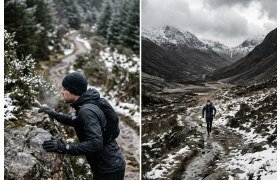
The Pennine Way is arguably the toughest national trail in Britain. The terrain is extraordinarily varied and consistently demanding: steep gritstone edges, vast peat bogs, exposed moorland plateaux, rocky mountain summits, river crossings, and remote valleys with limited escape routes. Notorious sections include the Black Hill and Bleaklow peat hags, the Sleightholme Moor bog (marked with stakes and tape), the exposed summit of Cross Fell, and the featureless Cheviot plateau where navigation in poor visibility is a serious challenge.
In winter, conditions are extreme. Temperatures regularly drop below -10°C with wind chill reaching -20°C. Gale-force winds, driving rain, sleet, snow, and whiteout conditions are common. Rivers can be in spate, and sections of trail may be under snow or ice. In summer, daytime temperatures range from 5°C to 25°C, but nights can still drop to freezing at altitude, and rain and wind remain ever-present threats.
The technical difficulty is compounded by the self-navigated format. Runners must carry and use a GPS device and map/compass. Route-finding errors in poor visibility, particularly on the featureless plateaux of Bleaklow, Cross Fell, and the Cheviots, are one of the most common reasons for retirement. Sleep deprivation after several days of continuous movement adds another layer of difficulty that few other races can match.
History and Notable Performances
The Spine Race was first held in January 2012, conceived as the ultimate test of endurance on the British hills. The race quickly gained a fearsome reputation, with early editions seeing finish rates well below 50%. The event has grown from a niche adventure race into one of the most prestigious ultra-endurance events in the world, attracting international fields of seasoned ultra-runners.
The men’s course record is held by Jack Scott (GBR), who completed the 2024 Winter Spine in an astonishing 72 hours 55 minutes and 5 seconds, slashing over 10 hours from the previous record. The women’s record belongs to Jasmin Paris (GBR), whose legendary 2019 run of 83 hours 12 minutes and 23 seconds was the overall course record at the time — she famously expressed breast milk at checkpoints during the race.
Other notable champions include Eoin Keith (Ireland), a three-time winner (2016, 2017, 2019), and Pavel Paloncy (Czech Republic), also a triple champion (2014, 2015, 2018). In 2024, Claire Bannwarth (France) became the first woman to win back-to-back Spine titles. The 2026 Winter edition was won by Sébastien Raichon (France) for the men and Anna Troup (GBR) for the women. The 2025 Winter edition saw Kim Collison and Lucy Gossage take the top honours.
Practical Information for Participants
- Qualification: Runners must be at least 21 years old and have completed an ultra-marathon of at least 80 miles or an equivalent mountain/moorland challenge.
- Entry fee: £995 for the full Spine (summer), payable in two instalments (£398 deposit + £597 balance due 100 days before the race). Winter Challenger North is £745, Challenger South £535, Sprint £165.
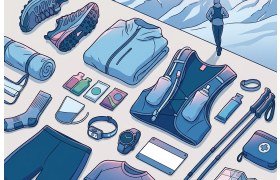
- Mandatory kit: The Spine Race has one of the most extensive mandatory kit lists in ultra-running. Key items include a sleeping bag (0°C comfort minimum for summer, lower for winter), bivvy bag, sleeping mat, GPS device, maps, compass, waterproof jacket and trousers, full spare clothing set, ice traction devices (Yaktrax/spikes for winter), head torch with spare batteries, first aid kit, rehydration salts, K-tape, and emergency foil blankets. Kit checks are conducted before the race, at checkpoints, and randomly on course. Missing items incur one-hour time penalties.
- Places: 150 runners for the full Spine (summer). The race regularly sells out; a waiting list is available.
- Checkpoints: Five staffed checkpoints provide hot food, drinks, sleep areas, medical support, and kit checks. Drop bags can be sent to checkpoints. Showers are available at selected locations.
- Accommodation and access: Edale is accessible by train from Manchester and Sheffield. Kirk Yetholm is a remote village in the Scottish Borders — transport should be arranged in advance for the finish.
What qualifications do I need to enter the Spine Race?
To enter the full Spine Race (268 miles), you must be at least 21 years old and have completed an ultra-marathon of 80 miles or more, or an equivalent mountain or moorland endurance challenge. The organisers review each application to ensure runners have sufficient experience for the demands of the Pennine Way in potentially extreme conditions.
What is the typical finish rate for the Spine Race?
The Spine Race has one of the lowest finish rates of any ultra-marathon in the world. In winter editions, the finish rate has historically been between 30% and 60%, depending on weather conditions. Summer editions generally see higher completion rates due to longer daylight hours and milder temperatures, but the distance and terrain remain a formidable challenge. Sleep deprivation, navigation errors, and weather are the most common reasons for retirement.
What mandatory equipment do I need to carry?
The Spine Race has one of the most comprehensive mandatory kit lists in ultra-running. Essential items include a sleeping bag rated to 0°C comfort (or lower for winter), a bivvy bag, a sleeping mat, a GPS device, maps and compass, waterproof clothing, a full set of spare clothes, head torches with spare batteries, ice traction devices (winter), rehydration salts, K-tape, and emergency foil blankets. All items must be carried at all times unless at a checkpoint. Kit checks occur before the race, at checkpoints, and randomly on course, with time penalties for missing items.
Share it with one of your triathlete friends. 🙏
Similar events
Discover other Trail events in the same region
Other Suggestions