Neuromuscular Fatigue: When the Brain Gives Up Before the Muscles in Trail Running
By Sarah — translated from an article by Charly Caubaut Published on 21/04/2026 at 08h30 Reading time : 9 minutes
Do you know that feeling? That precise moment, in the middle of an ultra or a long mountain run, when your legs still seem capable of carrying you, but a little voice in your head is screaming for you to stop. It's not just laziness, no. It's a brutal disconnection. The power has been cut. You can have the best shoes, a perfectly dialed-in nutrition plan, months of training in your legs... but your brain has hit the OFF switch. It's frustrating, confusing, and believe me, I've been there more than once on the trails and on my triathlon bike.
For a long time, it was believed that fatigue was purely a muscular issue: no more juice in the quads, cramps, the infamous lactic acid... But science and on-the-ground experience show us a much more complex and fascinating reality. Welcome to the world of neuromuscular fatigue, that invisible adversary that plays out not in your muscle fibers, but right between your ears. It's the conductor, your central nervous system, that decides to bring down the curtain to protect you. Understanding this phenomenon is one of the most powerful keys to unlocking your endurance potential. So, are you ready to dive behind the scenes of your own body? We're going to break it all down together, simply, so you can turn this weakness into a strength.
Understanding Neuromuscular Fatigue: More Than Just Heavy Legs
To really grasp what's at stake, you have to stop seeing fatigue as a simple gas tank that's emptying. Instead, imagine your body as a highly sophisticated race car. Your muscles are the engine, powerful and durable. But the driver is your brain. And this driver manages absolutely everything: acceleration, the fuel gauge, the oil temperature, the state of the tires... If a warning light comes on the dashboard, even if the engine can still run at full throttle, the driver will ease off the gas to avoid a breakdown. Neuromuscular fatigue is exactly that: your brain easing off the gas.
Fatigue, a Two-Faced Story: Central vs. Peripheral
To see things more clearly, scientists divide fatigue into two main categories. This is a handy little gem to know to better analyze your sensations.
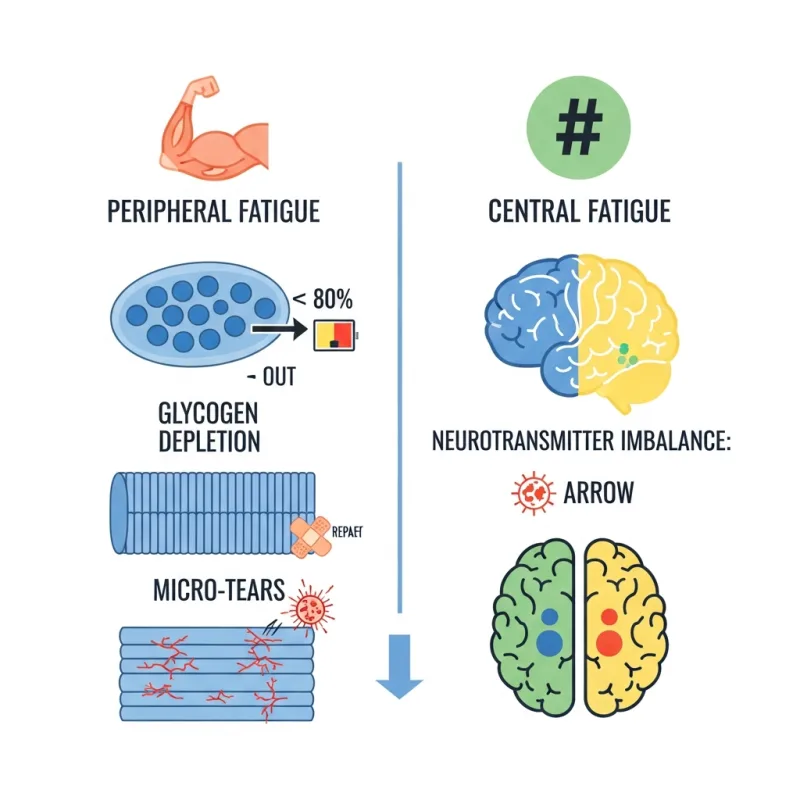
- Peripheral fatigue: This is the most well-known type, the one that happens directly in your muscles. It's the burning sensation, heavy legs, cramps... It's caused by local factors: the depletion of glycogen stores (your super-fuel), the accumulation of metabolic by-products (like H+ ions) that disrupt muscle contraction, or the micro-tears in fibers caused by repeated impact, especially on downhills. It's the engine overheating and running out of fuel.
- Central fatigue: This is the more insidious one. It originates in the brain and spinal cord, i.e., your central nervous system. Here, the muscles may still be able to contract, but the command no longer arrives, or it arrives much weaker. The brain voluntarily reduces the electrical signal sent to the muscles. It's the driver deciding to switch to safety mode, even if the engine still has resources. It's this fatigue that makes you feel "mentally drained," unmotivated, and unable to concentrate.
In trail running, and especially in ultra-running, these two forms of fatigue are never isolated. They are in a constant dance. Peripheral fatigue sends distress signals to the brain (via sensory nerves), which in turn, accentuates central fatigue to force you to slow down. It's a vicious cycle that you have to learn to manage.
The Tired Conductor: How the Brain Says "Stop"
But then, why does our brain, our best ally, betray us like this? In reality, it doesn't betray us, it protects us. It's a survival mechanism inherited from our ancestors. The brain anticipates potential damage and prefers to stop you before you cause irreversible harm. Several factors explain this shutdown.
- Brain chemistry in turmoil: Prolonged effort disrupts the balance of our neurotransmitters, the chemical messengers in the brain. We particularly observe an increase in serotonin, often associated with lethargy and sleep, and a decrease in dopamine, the neurotransmitter of motivation and reward. The result: the desire to continue collapses, even if you physically still could.
- The cognitive load of the effort: Running on a technical trail is not an automatic act like running on a treadmill. Your brain is constantly calculating: where to place your foot, how to approach that root, what's the best line through this rock field, should I drink, eat... This mental load is enormous and exhausting over time. It's a real orienteering course for your prefrontal cortex!
- Permanent internal monitoring: The brain receives thousands of pieces of information per second from your entire body: hydration level, body temperature, blood sugar level, inflammation signals from the muscles... If it perceives a dangerous drift, like the beginning of hyperthermia or hypoglycemia, it pulls the handbrake preventively by reducing the motor command.
Understanding this is already a giant leap forward. You are not "mentally weak." Your body and brain simply function as an integrated and incredibly intelligent system. The aim of the game is not to fight against this system, but to learn to work with it.
The Early Warning Signs on the Trails: Learn to Listen to Yourself
Neuromuscular fatigue doesn't just appear out of nowhere. It sends signals, little yellow flags before raising the big red one. One of the biggest challenges for an endurance athlete is learning to read these signals to act before it's too late. It's a skill that develops with experience, by spending hours and hours on the field.
Subtle Physical Symptoms
Even before the feeling of total exhaustion, your body speaks to you. You just have to listen. Here are the tell-tale signs:
- Loss of coordination: You start stumbling over roots you would have stepped over without thinking an hour earlier. Your foot placement becomes less precise, you kick rocks more often. This is a sign that the communication between your brain and your muscles is becoming less fluid. The electrical signal is losing quality.
- Technique degradation: Your stride, once light and airy, becomes more of a shuffle. You're more hunched over, your arms swing less effectively. You feel like you're "enduring" the terrain rather than playing with it. This is your brain, in an effort to save energy, switching to a "degraded autopilot mode" and no longer activating the stabilizing muscles as finely.
- Increased perceived exertion (RPE): This is a golden indicator. For the same speed or heart rate, the effort feels much harder. You feel like you have to fight to maintain a pace that was comfortable at the beginning. This is the very signature of central fatigue: the brain has to send a stronger signal to get the same muscle contraction.
Mental and Emotional Symptoms
This is often where the real battle is fought. The body might still be able, but the mind is no longer in it. These signals are just as important, if not more so, than the physical ones.
- Brain fog: Thoughts become confused. Simple calculations, like estimating the time to the next aid station, become a headache. You forget to drink or eat at scheduled times. This decline in lucidity is a direct warning from your saturated brain.
- A drop in motivation: The will to fight disappears. Negative thoughts loop in your head: "I'll never make it," "What's the point?," "I just want to sit down." This is a direct reflection of the drop in dopamine in your brain.
- Irritability: The smallest problem becomes a mountain. A shoelace that comes undone, a gel that tastes bad... everything annoys you. This is a sign of intense neurological stress. Your brain no longer has the resources to manage emotions.
- Making poor decisions: This is the most dangerous consequence. You decide to skip an aid station, not to put on your jacket as the weather turns, or to follow another runner without checking your own route. This is a very close cousin to what I call decision fatigue in ultra-trail running, where every choice depletes your reserve of mental energy a little more.
Training Strategies to Push Back Neuromuscular Fatigue
The good news in all this? Resistance to neuromuscular fatigue can be trained! Like a muscle, the brain can be trained to better withstand the load of a long effort. It's not about foolishly exhausting yourself, but about integrating specific and intelligent sessions into your preparation. Here are some of my practical gems, tested and approved over the years.
1. Train the Brain as Much as the Legs: Smart Pre-Fatigue
The principle is simple: you need to get your nervous system used to continuing to function effectively even when the body is sending signals of fatigue. To do this, we're going to simulate end-of-race conditions in training.
- Training blocks: Chain together two or three big runs over a weekend. On Sunday morning, you go for a run on legs that are already tired from the day before. Your brain will have to learn to recruit muscle fibers differently and maintain its concentration despite the accumulated fatigue.
- Bike-run workouts: A classic in triathlon, but a formidable weapon for the trail runner. Do a long bike ride (2-3 hours) and then immediately follow it up with 1 to 1.5 hours of trail running. The muscular pre-fatigue generated by cycling will put your nervous system in conditions very similar to the second half of an ultra.
- Long runs with a fast finish: Do your 3 or 4-hour long run at an easy pace, but force yourself to finish the last 30 to 45 minutes at your race pace (or even a little faster). This is an excellent way to teach your brain to "re-accelerate" when it's already tired.
2. Strength Training: Your Anti-Breakdown Insurance
It can't be said enough: a strong trail runner is a durable trail runner. Strength training isn't just for getting nice quads; it's fundamental for running economy and fatigue resistance.
- Eccentric work: Downhills in trail running are destructive for muscle fibers. Eccentric work (braking the movement, like during the lowering phase of a squat) prepares your muscles to better handle these shocks. Less muscle damage = fewer inflammatory signals sent to the brain = less central fatigue.
- Plyometrics: Exercises like box jumps, bounding strides, or jump rope improve the elasticity of your muscles and tendons. Your stride becomes more efficient, more economical. You spend less energy to move forward, and thus you save both your physical and mental energy.
- Core and proprioception: A strong core (abs, lower back) is the foundation of good posture. Good posture means less energy spent on stabilization. Working on unstable surfaces (like a Bosu ball) improves your proprioception, which is your brain's ability to know where your limbs are in space. This makes your footfalls more secure and reduces the cognitive load needed to navigate trails.
3. Pace Management: The Art of Not Burning Your Matches
This is perhaps the most important advice. Most cases of blowing up are due to starting too fast. Starting fast creates a huge oxygen and metabolic debt that you will pay for in cash later. Your brain perceives this fast start as an aggression and will go into protection mode much earlier.
Get to know yourself. Use a heart rate monitor to stay in the right effort zones, especially at the beginning of a race. Even better, learn to run by feel, based on your RPE (perceived exertion). In trail running, with the elevation changes, speed means nothing. Effort, however, is a constant that you must learn to master. The goal in an ultra is not to start fast, but to finish strong. And for that, patience is your best ally.
In-Race Management: Keys to Endure When the Brain Falters
Even with the best training in the world, there will be difficult moments. Moments when the brain will want to take the nearest highway exit. This is where strategy and mental fortitude take over. Having a plan and tools to manage these crises is essential.
Nutrition and Hydration: Fuel for the Brain
Your brain weighs about 2% of your body weight, but it consumes nearly 20% of your energy at rest! During an effort, it's a real glutton. Neglecting it is a surefire way to hit the central fatigue wall.
- Carbohydrates are your best friends: The brain runs almost exclusively on glucose. A drop in blood sugar (hypoglycemia) immediately leads to a drop in concentration, motivation, and cognitive function. It is therefore VITAL to consume carbohydrates regularly, starting from the first hour of the race. Don't wait until you're hungry or feel weak. Aim for 60 to 90 grams of carbohydrates per hour on long efforts, varying the sources (gels, bars, drinks, purees...).
- Electrolytes for the connection: Sodium, potassium, magnesium... are not marketing gimmicks. They are the minerals that allow nerve impulses to be transmitted. Without them, the signal between the brain and the muscles degrades. A well-formulated sports drink or salt tabs are essential, especially when it's hot and you're sweating a lot.
- Caffeine, the strategic boost: Caffeine is one of the few... legal and scientifically proven performance-enhancing drugs. It acts directly on the central nervous system by blocking adenosine receptors (a molecule that promotes sleepiness) and stimulating the release of dopamine. The result: a reduced sensation of fatigue and increased alertness. Use it sparingly and strategically, for example to get over a slump or for the last part of the race. Be careful, test it well in training!
Mental Techniques: Hacking Your Own Brain
When brain chemistry is working against you, you can use cognitive techniques to regain some control. This is pure and simple mental preparation.
- Slice the elephant: Never think about the total distance you have left to cover. It's the best way to get demotivated. Break your race down into tiny, achievable goals. Your only goal is to reach the next aid station, or even the next tree, the next turn. Each small success releases a bit of dopamine and gives you the desire to continue.
- Positive self-talk: Banish negative thoughts. Replace "I suck, I can't do this" with "Come on, you've done harder things, every step is a victory." It may sound simplistic, but studies have shown that positive self-talk has a real impact on the perception of effort and performance. Be your own biggest supporter!
- Mindfulness of your stride: When the mind wanders, bring it back to the present moment. Focus on your physical sensations: the contact of your foot on the ground, the rhythm of your breathing, the swing of your arms. This technique, derived from meditation, helps to calm the nervous system and regain control when parasitic thoughts invade.
Comfortable Gear for a Serene Brain
We don't always think about it, but uncomfortable gear is a huge source of mental stress. Every little annoyance is another piece of negative information your brain has to process, which accelerates cognitive load and central fatigue. A scratching tag, a bouncing pack, a rubbing seam... these are all micro-aggressions that, over the duration of an ultra, become a real mental torture. Good gear is gear you forget about.
Thermoregulation is a perfect example. Being too hot or too cold is a major stress for the body, and your brain will spend a crazy amount of energy trying to regulate your temperature. Using modular and intelligent layers is a practical gem for saving this precious mental energy. Simple accessories like arm sleeves can make a huge difference. You can put them on or take them off in seconds to adapt to temperature changes between a shaded valley and a sunny ridge, without having to stop and open your pack. Less stress, less mental load, more energy to move forward.
⌚ EKOI Perf Seamless Arm Sleeves
🧾 A simple but incredibly effective accessory for managing your body temperature without stopping. They help prevent overheating on climbs and getting cold on descents, thus reducing physiological stress and mental load.
- Thermoregulation: Can be put on and taken off in seconds for instant adaptation.
- Comfort: Seamless design to prevent any chafing or irritation.
🎯 Ideal for: Trail runners and cyclists looking for a versatile solution to manage temperature variations during long runs and competitions.
🛒 Discover the EKOI Perf Seamless Arm Sleeves on EkoiRecovery: Recharging the Central and Peripheral Batteries
You've finished your race, congratulations! But the work isn't over. The way you recover will determine your future progress and your ability to handle heavier training loads. And recovery isn't just for the muscles; it's also, and especially, for the nervous system.
Sleep: The #1 Neurological Reset Tool
If you only remember one thing about recovery, let it be this: sleep is king. It's during the deep sleep phases that your brain cleans and repairs itself. The glymphatic system, a kind of cerebral waste management service, activates to eliminate metabolic waste accumulated during the day and effort. It's also during sleep that growth hormone is secreted in greater quantities, promoting the repair of muscle and nerve tissues. After a big effort, give yourself full nights of sleep, or even naps. Never sacrifice your sleep for anything else; it's the best thing you can do for your nervous system.
Active Recovery and Post-Workout Nutrition
The day after a big run or a race, don't just lie on the couch all day. Low-intensity active recovery (walking, easy cycling, swimming) will promote blood circulation and help eliminate metabolic waste from your muscles. On the nutrition side, the post-workout window is crucial. Provide your body with protein to rebuild damaged muscle fibers and carbohydrates to replenish your glycogen stores. This will help calm inflammation and reduce the stress signals sent to the brain, thus accelerating nervous system recovery.
There you have it, you now have a much clearer vision of what's going on in your body and head during an endurance effort. Neuromuscular fatigue is not inevitable; it's a parameter in the performance equation that you can influence through smart training, a thoughtful race strategy, and careful recovery. It's a fascinating game, a permanent dialogue with yourself. So the next time that little voice tells you to stop, you'll know how to listen to it, analyze it, and maybe even convince it to go on just a little longer.
Now it's your turn to play!
Frequently asked questions about neuromuscular fatigue in trail running
What is the difference between being tired and neuromuscular fatigue?
"Classic" fatigue is often associated with simple weariness or muscle exhaustion (peripheral fatigue). Neuromuscular fatigue is more complex: it involves the central nervous system (the brain) which reduces the command sent to the muscles, acting as a protective mechanism to prevent damage. You can therefore feel mentally "drained" even when your muscles still have reserves.
How do I know if my drop in performance is due to central fatigue or a lack of fuel?
It's sometimes difficult to distinguish because the two are related. However, if you have followed your nutrition and hydration plan well but feel a sharp drop in motivation, difficulty concentrating, and a loss of coordination, it is very likely that central fatigue is the dominant factor. A lack of fuel (hypoglycemia) is often accompanied by shaking, cold sweats, and an intense feeling of hunger.
Can overtraining cause chronic neuromuscular fatigue?
Absolutely. Overtraining is a state where the training load exceeds the body's ability to recover. One of the main symptoms is a chronic neuromuscular fatigue that sets in. The nervous system is constantly in a state of stress, which results in decreased performance, sleep disturbances, irritability, and a loss of motivation. It's a sign that you need to ease off significantly.
Do stretches after a long run help combat this type of fatigue?
Stretching right after an intense effort is a debated topic. They do not act directly on central fatigue. Their role is rather to restore flexibility to the muscles and promote relaxation. For neuromuscular recovery, sleep, post-workout nutrition, and gentle active recovery (like walking) the next day are much more effective. However, light and gentle stretches, done some time after the effort, can contribute to overall well-being.