The Ultra-Runner's Blues: Surviving the Post-Goal Psychological Void
By Sarah — translated from an article by Charly Caubaut Published on 04/08/2026 at 08h30 Reading time : 7 minutes
Hey trail friend! Charly here. If you're reading this, there's a good chance you've crossed a finish line that represented much more than just a race. Months, or even years, of sacrifices, early morning wake-ups, runs in the rain, doubts, and hopes, all for that magical moment. The euphoria, the tears of joy, the immense pride... You touched your dream. And then... silence. The return home, the medal placed on a piece of furniture, and that strange, nagging feeling. An emptiness. A kind of fog that settles in where the fire of the goal once burned. It's called the post-race blues, post-goal depression, or more informally, the warrior's slump. And let me tell you right away: it's normal. I've experienced it after my biggest triathlons, and I've seen dozens of athletes, from top champions to passionate amateurs, go through this turbulent zone. It's not a sign of weakness; it's the price of glory, the hidden side of total commitment. So, today, we're going to break down this phenomenon together, with no taboos, like a chat between buddies after a long run. I'm going to share my experience, my field-tested tips, so you can navigate these troubled waters and come out stronger. Ready? Let's go.
From Euphoria to the Crash: Decoding a Normal Phenomenon
Before looking for solutions, it's crucial to understand what's happening in your mind and body. It's not just "in your head"; it's a completely logical biochemical and psychological reaction. Imagine your body as a Formula 1 car for months: you pushed it to the limit, optimized every detail, and on D-Day, you gave it your all. Once you cross the finish line, the engine cuts out. And the silence that follows can be deafening.
The Great Hormonal Tumble: When Chemistry Gets Involved
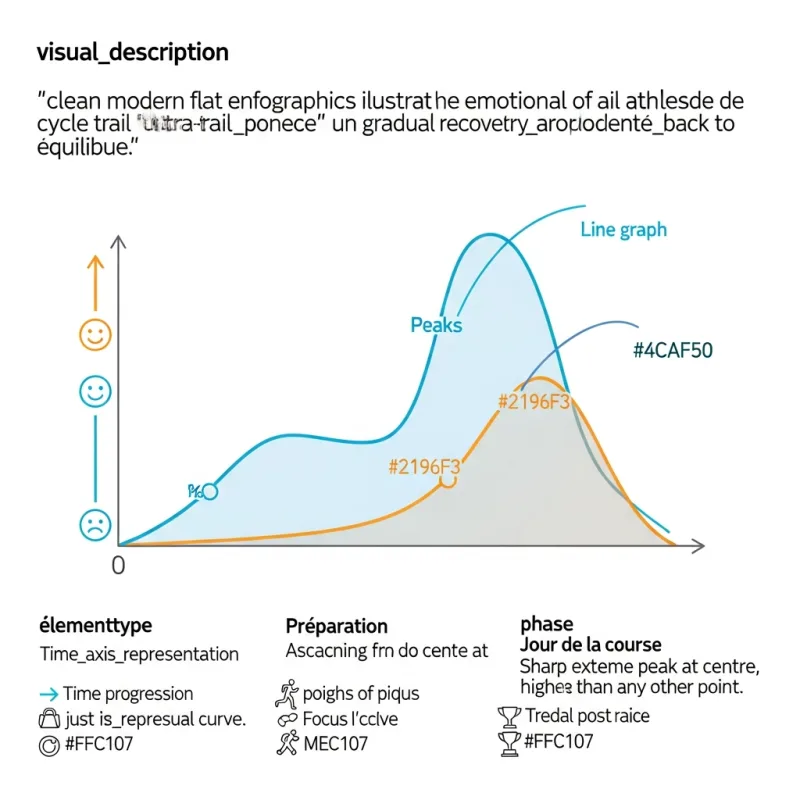
During your preparation and especially during the race, your body was running on all cylinders, powered by a potent hormonal cocktail. Adrenaline, cortisol (the stress hormone, but also a short-term performance booster), and above all, the famous endorphins, our natural opiates that provide that feeling of euphoria and invincibility, the famous "runner's high." This is what allows you to push through the pain and keep moving for hours. Once the race is over, your exhausted body abruptly stops this massive production. It's a free fall. Endorphin levels plummet, giving way to increased sensitivity to pain and a gloomy mood. Cortisol, after its peak, also drops, which can cause fatigue and irritability. It's a genuine physiological withdrawal. Your body and brain have to find a new balance, and this transition is rarely smooth.
The Psychological Black Hole: Losing Your North Star
Beyond the chemistry, the psychological aspect is just as powerful. Your ultra-trail wasn't just a race. It was your project, your north star. It structured your days, your weeks, your conversations, your food choices, your sleep schedule. Every decision was made through the prism of this goal. And suddenly, that star goes out. The framework that gave meaning and direction to your efforts disappears. You wake up on Monday morning, and the fateful question hits: "So, what do I do now?" This void can be terrifying. It's a sort of mini-identity crisis. For months, you were "the one preparing for UTMB®, the Diagonale des Fous, a 100-miler..." That validating and structuring label vanishes. You have to redefine yourself, find a new driving force, and that's not always easy. The social attention also fades. The encouragement, the questions about your training, the congratulations... all that support that carried you disappears. You go from being a hero to just a mortal who has to go back to work. This contrast can be brutal.
Identifying the Symptoms to Better Cope
Recognizing these blues is the first step to overcoming them. It's not just fatigue. Fatigue is physical. You sleep, you rest, and you're back on your feet. The blues, however, stick to you, even after a good night's sleep. Here are a few signs that should alert you:
- Total lack of motivation: The very idea of putting on your running shoes feels like an insurmountable mountain. You don't feel like doing anything, not running, not anything else.
- Irritability and mood swings: You're on edge. A small annoyance becomes a huge deal. You might be unpleasant with your loved ones without really understanding why.
- Feelings of sadness and emptiness: A persistent melancholy sets in. You might get teary-eyed for no apparent reason. The pride of finishing your race already feels distant, replaced by a sense of futility.
- Questioning your sport: "Why do I put myself through all this?", "It's pointless", "I'll never do a race like that again." The meaning behind your passion has evaporated.
- Sleep and appetite disturbances: You sleep poorly, wake up in the middle of the night, or conversely, you sleep 12 hours and still feel exhausted. Your appetite may disappear or, on the contrary, turn into uncontrollable cravings.
- Paralyzing nostalgia: You spend your time looking at race photos, reliving the highlights on a loop, unable to focus on the present or the future.
If you check several of these boxes, don't panic. You're right in the thick of it. The important thing is to put a name to what you're feeling and understand that it's a phase. A necessary transition phase for your body and mind to digest the monumental effort you've just accomplished.
Rebuilding Your Daily Life and Mindset: My Practical Gems
Okay, now that we've made a diagnosis, let's move on to the action plan. I've been through this, and over time, I've developed a sort of three-phase protocol to manage the post-race period. These are my little practical gems, tried and tested. Think of it as a new training plan, but this time, it's for mental recovery.
Phase 1: Acceptance and Absolute Rest (The First Week)
The golden rule for the first week post-ultra is simple: do nothing and accept it. Your body is a battlefield. Your muscles, tendons, and immune system are depleted. But so is your mind. Forcing anything at this stage is the worst mistake you can make.
- Completely disconnect: No running, no cycling, no swimming. Nothing. Walk a little if you feel like it, but with no time or distance goal. Just to loosen up your legs.
- Sleep, sleep, and sleep some more: Sleep is your best ally. Take naps, go to bed early. It's during sleep that your body regenerates and your brain processes the experience.
- Feed the machine: Don't start a restrictive diet to compensate for aid station indulgences. Your body needs quality nutrients to rebuild. Eat well, balanced meals, and treat yourself. A good recovery beer, a pizza... That's part of the reward too!
- Welcome your emotions: If you feel like crying, cry. If you feel empty, accept that feeling without judging yourself. It's normal. Trying to fight it will only make things worse. Talk about it with your loved ones, explain to them how you feel.
This first phase is about decompression. It's the airlock between the breath-hold of the race and returning to the surface. Whatever you do, don't skip it.
Phase 2: Gentle Reconnection (Weeks 2 to 4)
After a week of total rest, you can start moving again, but very gently. The goal isn't performance, but pleasure and reconnecting with your body and nature.
- Explore other playgrounds: This is the perfect time to try something new. If you're a runner, go for a swim or a leisurely bike ride. Do some yoga, climbing, or hiking. The idea is to break the routine and use your body differently.
- Leave the watch at home: Go on "pleasure" outings. Run in the forest with no pace or distance goal. Stop to take a photo, listen to the birds. Rediscover why you love being outdoors, away from the pressure of the clock.
- Spend time with your loved ones: You probably neglected them a bit during your training. Now's the time to make up for it. Organize a dinner, an outing, a weekend trip. Fill the void left by training with shared moments.
- Take care of yourself: A massage, a hot bath, a session with a physical therapist... Pamper the body that carried you so far. It's a way of thanking it and helping it recover faster.
It's during this phase that I just love to go hiking in the mountains. Not to gain elevation, just to be there. This is where simple, comforting gear makes all the difference. Feeling good, warm, without worrying about performance, is a form of active meditation.
⌚ Men's MT500 Padded Hiking Jacket -10°C - Brown
🧾 For these moments of gentle reconnection, there's nothing like gear that prioritizes comfort over pure performance. This padded jacket is perfect for a leisurely hike or simply for enjoying a mountain sunset after your effort.
- Warmth and lightness: Padded filling for good thermal insulation without the weight, ideal for not feeling weighed down.
- Compactness: It stores easily in its own pocket, perfect to have on hand in case the weather turns cooler.
🎯 Ideal for: The athlete in the recovery phase looking to reconnect with nature gently, for hikes or walks with no performance goals.
🛒 Discover the Men's MT500 Padded Hiking Jacket -10°C - Brown on FORCLAZPhase 3: Redefining the Horizon (After the First Month)
Normally, after a month, the worst of the blues should be behind you. You're starting to get your motivation back. It's time to look forward, but with intelligence and introspection.
- Take stock, calmly: Grab a notebook and a pen. What did you love about this adventure? What did you miss? What did you learn about yourself? This introspection is fundamental to give meaning to what you've accomplished and to guide your future choices.
- Set new goals, but not necessarily another race: Your next goal doesn't have to be an even longer, even harder ultra. It could be to improve your VMA, learn to swim better, go on a bike trip, or share your passion by volunteering at a race. Open up the possibilities!
- Reconnect with the community: Go for a run with friends, join a club, participate in group outings. Sharing is a powerful driver for regaining motivation. The energy of the group can pull you out of the isolation of the blues.
- Plan intelligently: If you decide to tackle another big goal, do it with the experience you've gained. Integrate rest periods, vary your activities, and above all, don't just dive in headfirst to fill the void. The choice must come from a deep desire, not a fear of nothingness.
Preparing for Post-Race: The Key to a Successful Transition
With experience, I've understood something essential: the post-race blues are largely managed... before the race. Anticipating this phase of emptiness is the best way to mitigate it. Here's how you can approach it.
The Importance of 'Why'
Before you even sign up, ask yourself: "Why do I want to do this race?" If the only answer is "to finish it" or "for the medal," you're a prime candidate for a major case of the blues. Your motivation must be deeper. Is it to push your limits? To discover incredible landscapes? To share an adventure with friends? To prove to yourself that you can overcome difficulties? This "why" will be your anchor. When the emptiness arrives, you can hold on to these values, which, unlike the finish line, don't disappear.
Integrating Recovery into Your Overall Plan
We spend months planning our training, our nutrition, our race strategy. But who plans their post-race month? Almost no one. That's a mistake! Integrate the three phases I described above into your annual schedule. Write in your calendar: "Week 1: total rest," "Week 2: pleasure bike ride," "Weekend 3: family hike." The simple act of having a structure for the aftermath will give you a framework and prevent you from feeling completely lost.
Cultivating a Secret Garden Outside of Sports
Ultra-running is an all-consuming passion, and that's what makes it so beautiful. But it shouldn't become your sole identity. Maintain other interests: music, reading, DIY projects, gardening, it doesn't matter. These activities are refuges. When the world of running feels empty, you'll have other universes where you can feel alive and fulfilled. It's a fundamental life balance. Be careful not to fall into excess, where the passion becomes an absolute necessity to feel good. As athlete Beñat Marmissolle explains very well, you have to know how to manage this intensity. To delve deeper into this topic, I invite you to read this fascinating article: Ultra-trail: when passion flirts with addiction, a warning from Beñat Marmissolle. It's a read that helps put things into perspective.
Knowing When to Ask for Help When the Fog Lingers
Sometimes, despite all efforts, the blues hang on. They turn into a thick fog that doesn't lift after a few weeks. If you feel that the sadness is constant, that you've lost interest in everything (not just sports), that it's impacting your professional or family life, you shouldn't be ashamed to ask for help.
Talk to your doctor. They can distinguish between a temporary slump and a genuine depression that requires specific support. A sports psychologist can also be a valuable ally. They understand the issues athletes face and can give you tools to get through this period. Never stay alone with your suffering. The world of trail and endurance sports is a big family. Reach out, and you'll be surprised how many people have been through it and are ready to listen without judgment.
This post-goal void is an integral part of the ultra adventure. Taming it is also part of growing as an athlete and as a person. It's learning that the value of our journey lies not only in the finish line but in the entire path taken, including this reconstruction phase. It's an opportunity to rediscover yourself, diversify your interests, and start again on a healthier, more solid foundation.
So don't see these blues as a failure, but as the final stage of your ultra. A quiet, introspective stage, but just as important as the last climb. Manage it well, and you'll be ready for new adventures, with renewed wisdom and strength.
Now it's your turn!
Answers to your questions about the post-ultra blues
What exactly are the ultra-runner's blues?
It's a state of psychological emptiness, demotivation, and sadness that occurs after achieving a major sporting goal like an ultra-trail. It's caused by a combination of physiological factors (a hormonal crash of endorphins and cortisol) and psychological factors (loss of the goal that structured your life, a return to routine, the end of social attention).
How long do these post-race blues last?
The duration varies greatly from one person to another. Generally, the most intense symptoms appear during the first two weeks. With good management (rest, gentle activities, introspection), most athletes find a good mental balance and new motivation after 4 to 6 weeks. If symptoms persist beyond that, it is advisable to speak with a professional.
Is it possible to completely avoid the post-race blues?
Avoiding it 100% is difficult because the hormonal drop is a natural reaction of the body. However, you can greatly reduce its intensity and duration by anticipating it. Having a plan for the post-race weeks, cultivating other interests, and working on your deep "why" are the best strategies for a much smoother transition.
What is the very first thing to do when you feel the emptiness setting in?
The very first thing is to accept what you're feeling without judging yourself. Don't fight against this feeling. Allow yourself to be tired, sad, and unmotivated. The absolute priority is complete rest: sleeping, eating well, and avoiding any demanding physical activity. By respecting this decompression phase, you give your body and mind the means to recover properly.