RED-S Syndrome in Trail Running: The Energy Deficiency Sabotaging Your Performance
By Sarah — translated from an article by Charly Caubaut Published on 22/09/2026 at 08h31 Reading time : 8 minutes
The Trail Runner's Invisible Wall: When the Engine is Running on Empty
Hey there, trail friend! Today, we're going to talk about a serious topic, something that can turn your passion for trail running into a real nightmare. Imagine: you train like a maniac, you lengthen your runs, you climb so much elevation you don't know what to do with it... and yet, your times stagnate. Worse, they're getting slower. You feel constantly drained, irritable, and the slightest little viral infection knocks you out for a week. You tell yourself it's just overtraining, that you need to "push" a little harder. What if I told you the problem isn't in your legs, but on your plate?
I've been there. That frustrating feeling of giving your all with no return on investment. You think you're a machine, you just forget to put in the right fuel, and above all... in sufficient quantity. This phenomenon has a name: RED-S syndrome, for Relative Energy Deficiency in Sport. It's the silent enemy that chips away at your performance and, more seriously, your health. So, put down your poles, grab a recovery drink, and let's break down this syndrome together so you can avoid it or get out of it. Let's go!
What Exactly Is This Famous RED-S Syndrome?
To put it simply, RED-S is when your body no longer has enough energy to manage everything. You ask it to run for hours in the mountains (a huge energy expenditure), but you don't give it enough calories in return to cover BOTH that effort AND its basic vital functions. It's a bit like asking your smartphone to run GPS, 4G, and a video game all day with only 10% battery. At first, it will hold on, then it will cut non-essentials, lower the brightness, and eventually turn off.
Your body is the same. When energy is lacking, it goes into "power-saving mode." It will start by sacrificing functions it deems non-essential for immediate survival: hormone production, bone building, reproduction, or even a top-form immune system. The problem is that these functions are absolutely crucial for your long-term health and... for your performance!
From the "Female Athlete Triad" to RED-S: A Broader Perspective
For a long time, the term used was the "female athlete triad." This concept described an unholy trinity in female athletes: disordered eating, amenorrhea (absence of menstrual periods), and osteoporosis (bone fragility). This was a significant step forward, but it was incomplete. Why? Because men are also affected, and because the consequences of energy deficiency are much more extensive!
In 2014, the International Olympic Committee therefore expanded this concept to create RED-S. This new definition includes male athletes and highlights a whole cascade of health problems: immune, cardiovascular, psychological, metabolic... In short, we realized that when you pull too hard on the energy rope, the entire body suffers.
Energy Availability: The Key Concept to Grasp
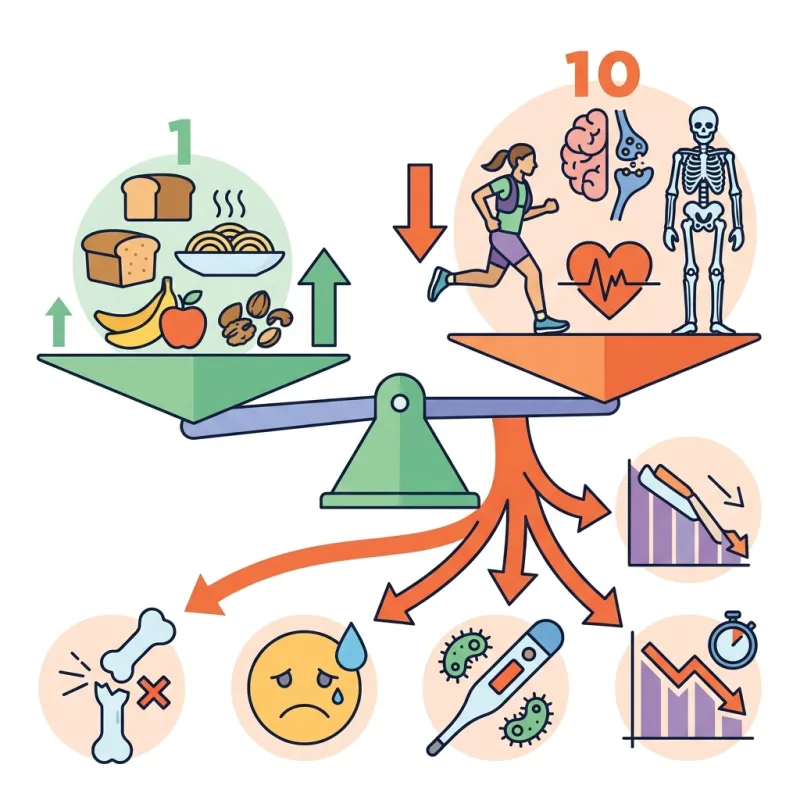
The technical term is "Low Energy Availability" or LEA. This is the heart of the matter. Energy availability is the energy left over for your body's basic functions AFTER subtracting the energy expended during training.
Simple calculation to visualize it: Energy Availability = (Dietary Energy Intake) - (Exercise Energy Expenditure).
If this result is too low over a prolonged period, your body enters survival mode. And that's where the trouble begins. The trap is that it doesn't happen overnight. It's an insidious process that sets in over weeks, or even months. You don't see it coming, until one day the wall is there, and it's very real.
The Warning Signs: How to Recognize Encroaching RED-S?
Your body sends you signals. The key is to know how to listen to them and not just write them off as a simple "slump." I've gathered the main symptoms for you. If you check several of these boxes, it might be time to ask yourself the right questions.
Signs Directly Impacting Your Performance
This is often what alerts us first, we enthusiasts who are glued to our GPS watches. It's the tip of the iceberg.
- Stagnation or regression: Despite training that seems consistent, or even more intense, you can no longer progress. Your times on benchmark segments are getting longer.
- Poor recovery: You need much more time to recover from a big outing. Your legs stay heavy, and fatigue persists for several days.
- Lack of "juice": You struggle to get up to speed, to maintain a high intensity. You feel empty, powerless.
- Recurring injuries: This is THE classic sign. Tendinitis that never ends, abnormal muscle pain, and, in the most severe cases, stress fractures. A stress fracture in the metatarsal or tibia is an unmistakable sign.
Physiological Signs: Your Body is Sounding the Alarm
Here, we get into the "practical gems" to watch for, as these are direct indicators that "power-saving mode" is activated. These signs are less obvious, but crucial.
- For female trail runners: The cessation or irregularity of menstrual cycles is the number one warning sign. No, it's NOT a sign that you're super fit! It's a sign that your body is putting its reproductive function on hold to save energy. It's a serious symptom that should never be ignored.
- For male trail runners: It's talked about less, but men are just as affected. The signs? A noticeable drop in libido, a decrease in morning erections... This often reflects a drop in testosterone levels, a key hormone for performance and health.
- For everyone:
- Chronic fatigue: A deep fatigue that doesn't disappear even after a good night's sleep or a rest day.
- Sleep disturbances: Difficulty falling asleep, waking up at night... even though you're exhausted. Paradoxical, isn't it?
- Digestive issues: Feeling bloated, constipation, slow digestion. Your digestive system is also running on slow mode.
- Feeling cold: You feel cold all the time, even when others are in t-shirts. This is a sign that your basal metabolism is slowing down to conserve energy.
- Weakened immunity: You catch every cold that goes around, and you take ages to recover from a minor sore throat.
Psychological Signs: When Your Mental Game Falters
The brain is a huge energy consumer. When it's in deficit, it inevitably affects your mood and cognitive abilities.
- Irritability and mood swings: You're on edge, you get angry over nothing. People around you notice you've changed.
- Difficulty concentrating: At work or in daily life, you struggle to stay focused, your memory plays tricks on you.
- Anxiety or depressive mood: Lack of energy can clearly affect your mental state, creating a vicious cycle where you feel bad, so you eat less or train more to compensate, which worsens the problem.
- Obsession with food and weight: You spend your time thinking about what you will (or won't) eat, weighing yourself several times a day. Food becomes a source of stress rather than a source of pleasure and energy.
The Causes of the Deficit: How Do We Get Trapped?
Falling into RED-S is very rarely a deliberate act. It's often an accumulation of small mistakes, lack of knowledge, and good intentions that end up creating a major imbalance. Understanding the causes is already halfway to avoiding it.
1. Increasing Training Load Too Quickly
This is the typical scenario of a trail runner preparing for their first ultra. You go from 50 km per week to 100 km, add in big weekends... but you forget to significantly increase your intake on the plate. Expenditure explodes, but intake stagnates. The equation no longer works, and the deficit deepens with every run.
2. The Quest for "Race Weight" and Restrictive Diets
Ah, the famous "race weight"! This often-fantasized idea that by losing 2 or 3 kilos, you'll fly on the trails. To achieve this, people embark on restrictive diets: cutting carbs (public enemy #1, wrongly so!), banning fats, eating salads without dressing... You intentionally create a calorie deficit to lose weight, forgetting that this deficit sabotages the energy available for vital functions. It's a direct path to RED-S.
The worst part is that it can work at first. You lose weight, you feel light... for a few weeks. Then, the machine breaks down. Fatigue sets in, performance drops, and you find yourself heavier and less efficient than before, with your health compromised as a bonus.
3. A Simple Lack of Awareness of One's Own Needs
Many athletes drastically underestimate the amount of energy they need. A long 4-hour trail run can easily burn between 2000 and 3000 calories, or even more! That's equivalent to a full day's intake for a sedentary person. If you don't compensate for this huge energy gap, a deficit is inevitable. And it's not just about the energy spent during exercise, but also the energy needed to rebuild muscle fibers, replenish glycogen stores, and keep the rest of your body running. To delve deeper into the subject, I've also prepared a complete guide for you on the fundamentals of nutrition in trail running, which will give you a solid foundation.
4. Stress and Lifestyle
Your body doesn't differentiate between the stress of a tough HIIT session and the stress of an intense workday or personal worries. Chronic stress increases the production of cortisol, a hormone that, in the long term, can disrupt appetite, sleep, and recovery. When you combine a high volume of training with a busy professional and personal life, your overall energy expenditure skyrockets. If your diet doesn't keep up, you're heading straight for RED-S.
Long-Term Consequences: Much More Than Just a Drop in Form
I have to be very direct with you: ignoring RED-S can have serious and sometimes irreversible consequences for your health. We're no longer talking about not beating your record in the next race; we're talking about your health for the next 30, 40, or 50 years.
- Bone health: This is probably the most serious risk. Energy deficiency, especially if it disrupts sex hormones (estrogen and testosterone), prevents proper bone mineralization. This leads to osteopenia, then osteoporosis. Your bones become as fragile as glass. The risk of stress fractures increases exponentially, and worse, the risk of a fracture from a simple impact does too. Some of the bone damage sustained at age 25 can be irreversible.
- Hormonal and reproductive health: In women, prolonged amenorrhea can lead to fertility problems. In men, a persistently low testosterone level impacts libido, muscle mass, bone density, and mood.
- Cardiovascular health: The body can develop severe bradycardia (an abnormally low resting heart rate) and hypotension. While a slow heart rate is often a sign of good training, a heart that is *too* slow can become dangerous.
- Metabolic health: The basal metabolic rate slows down so much that with the slightest increase in intake, the body stores everything as fat, fearing future scarcity. This explains why many athletes with RED-S end up gaining weight despite low intake.
- Mental health: The link between RED-S and depression is increasingly documented. Energy deficiency directly affects neurotransmitters in the brain.
The message is clear: playing with your energy availability is playing with fire.
The Exit Strategy: How to Refuel and Move Forward?
Okay, the picture is a bit bleak, I'll grant you that. But the good news is that you can recover from RED-S! It requires patience, humility, and often the help of professionals, but it is possible. Here is the roadmap I propose.
Step 1: Awareness and Consultation
This is the hardest but most important step. Admitting you have a problem. If you recognize yourself in the symptoms described, the first thing to do is to talk about it. To whom? Ideally, a multidisciplinary team:
- A sports medicine doctor: They can make a diagnosis, order a complete blood panel (hormone levels, iron, vitamins...) and check for complications (like a stress fracture via imaging).
- A dietitian-nutritionist specializing in sports: This is your best ally for reassessing your energy needs and creating a suitable eating plan, without judgment or frustration.
- A sports psychologist: If the problem is related to body image or disordered eating behaviors, their help can be invaluable in deconstructing false beliefs.
Step 2: Adapt (and Often Reduce) Training
Here's the hard pill to swallow: to get out of RED-S, you very often have to reduce your training load. It's counterintuitive, but it's the only way to reduce energy expenditure so that the body finally has enough "budget" to repair itself. This might mean less volume, less intensity, or even a complete break for a few weeks in the most severe cases. The goal is to restore the energy balance. This is the time to be smart and see rest not as a failure, but as an integral part of rebuilding.
⌚ NOMAD GPS Watch for Outdoor Activities and Fishing - Green
🧾 In a RED-S management phase, monitoring your training load and recovery becomes crucial. This watch is an excellent tool to objectify your sensations, track your sleep, and ensure you don't exceed the limits set with your coach or doctor.
- Feature 1: Precise GPS tracking to quantify the volume and intensity of your outings.
- Feature 2: Advanced sleep and heart rate analysis to assess your recovery.
🎯 Ideal for: Athletes looking to better understand their body's signals and manage their training more scientifically to avoid overtraining and energy deficiency.
🛒 Discover Montre GPS NOMAD Activités Outdoor et Pêche Verte on CorosStep 3: Increase Energy Intake, Without Fear
This is the central pillar of treatment. You have to eat more. Period. And eat a bit of everything. Your body needs all the macronutrients to rebuild itself:
- Carbohydrates: This is the main fuel for exercise and the brain. Whole wheat pasta, rice, potatoes, bread, fruits... We need to stop demonizing them.
- Proteins: Essential for repairing muscle fibers, but also for the immune and hormonal systems. Meat, fish, eggs, legumes...
- Lipids: Good fats (vegetable oils, nuts, oily fish, avocado) are fundamental for hormone production and the absorption of certain vitamins.
The practical advice? Never skip meals, especially after a workout. Add rich and dense snacks (a handful of almonds with a piece of fruit, Greek yogurt with honey...) between meals. The goal is to ensure a constant flow of energy throughout the day.
Step 4: Patience and Listening to Your Body
Recovering from RED-S takes time. Several months, sometimes more than a year for all systems (especially hormonal) to return to normal. There will be ups and downs. You have to accept not being at peak performance right away, perhaps gaining a little weight at first (your body is rebuilding its stores and protecting itself). Be kind to yourself. Learn to differentiate between the "good" fatigue of training and deep exhaustion. Learn to recognize hunger cues and respond to them without guilt.
This ordeal, if you navigate it intelligently, can become an incredible strength. You will learn to know your body like never before and you will build a healthier, more sustainable, and ultimately, more successful athletic career.
The message I want to get across is that nutrition is not the enemy of performance; it is its foundation. Eating enough is not a sign of weakness; it's a sign of intelligence and respect for the formidable machine that is your body. You ask it to perform feats, so give it the means to accomplish them.
Now it's up to you!
Answers to Your Questions About RED-S Syndrome
Does RED-S syndrome only affect elite athletes?
Absolutely not! That's a very common misconception. RED-S can affect any athlete, regardless of their level. An amateur athlete who suddenly increases their training volume to prepare for a first marathon or ultra-trail, while also watching their weight, is a perfect target. The risk comes from the imbalance between intake and expenditure, not from the performance level.
How can you tell the difference between simple training-related fatigue and RED-S?
"Normal" training fatigue is acute and disappears with one or two days of rest and proper nutrition. The fatigue of RED-S is chronic, deep, and persistent, even after rest. Most importantly, it is accompanied by other symptoms: sleep disturbances, irritability, frequent injuries, and especially hormonal signs like the cessation of periods in women or a drop in libido. It's this collection of symptoms that should be an alert.
Will I gain a lot of weight if I increase my energy intake to recover from RED-S?
This is a common fear that often prevents recovery. Initially, a slight weight gain is possible and even healthy. Your body needs to replenish its reserves (body fat, glycogen) and repair tissues. However, at the same time, your basal metabolic rate will increase again, and your body will relearn how to use energy efficiently. In the long term, by finding the right balance, you will stabilize your weight at a healthy level for your body type, while regaining energy and performance.
How long does it take to fully recover from RED-S?
There is no single answer, as it depends on the severity and duration of the energy deficit. Recovery can take from a few months to over a year, or even longer. The return of energy and improvement in performance can be quite rapid once the energy balance is restored. However, the normalization of hormonal functions (return of menstrual cycles, for example) and the rebuilding of bone density are much slower processes that require patience and regular medical monitoring.