The Lingual Reflex: The Secret to Breathing Better and Running More Stably
By Sarah — translated from an article by Charly Caubaut Published on 21/07/2026 at 08h30 Reading time : 7 minutes
Hey there, effort enthusiasts!
You and I, we spend hours optimizing our gear, dissecting our training plans, searching for any marginal gain to go faster, farther. We invest in carbon shoes, aero bikes, super-powered GPS watches... What if I told you that one of the most stunning improvements for your performance costs nothing, weighs nothing, and is located... right there, in your mouth? 🤔
It might sound crazy, but today, we're going to talk about a well-kept secret, a kind of biomechanical "hack" that many athletes are unaware of: the lingual reflex. Forget the complicated jargon. Just imagine that the position of your tongue, that small muscle you use to talk and eat, has a direct and massive impact on your breathing, your posture, and even your stability during exertion. I've spent hundreds of hours in the saddle and on the trails testing, feeling the differences, and I can tell you: it's a small revolution. So, ready to discover this practical gem that could very well change the way you move? Come on, follow me, let's dive right in!
So what is this famous lingual reflex?
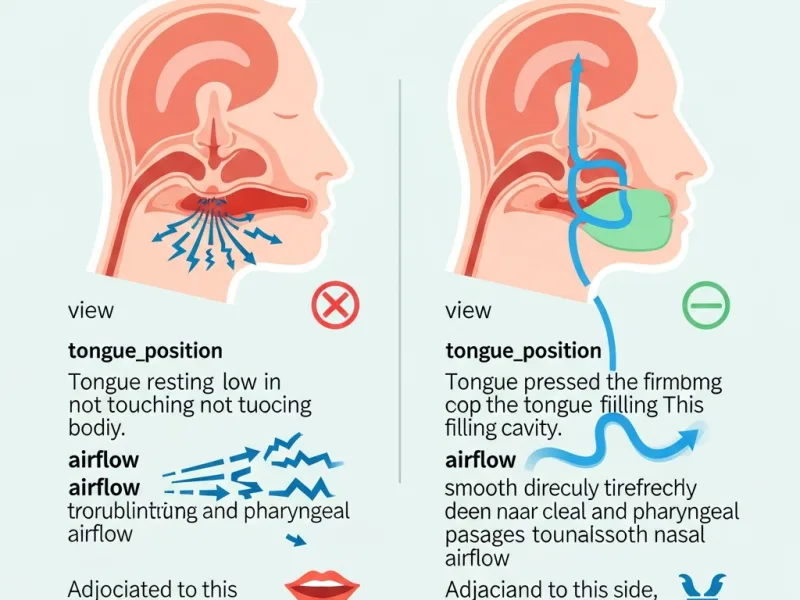
Let's keep it simple. The lingual reflex, or more precisely, correct tongue posture, is the natural position your tongue should adopt at rest. And that position isn't at the back of your mouth, slumped on the floor of your mouth. No, not at all! The ideal physiological position is when your entire tongue (the tip, middle, and back) is gently "stuck" or "suctioned" against your palate.
To be very precise:
- The tip of the tongue is placed just behind the upper incisors, on a small rough area called the incisive papilla, without touching the teeth.
- The rest of the tongue spreads out over the entire width and length of the palate.
- The teeth are slightly apart, not in contact.
- The lips are closed, without tension.
It's not an effort, not a contraction. It's a resting position, a posture. Think of a slight suction effect, as if your tongue were a magnet drawn to your palate. For many of us, due to stress, bad postural habits, or chronic mouth breathing, the tongue is positioned incorrectly: low, between the teeth, or pushing against them. And that's where the trouble begins, because this low position has a cascading effect on your entire body mechanics, especially during exertion.
The direct link between your tongue and your breathing: the game-changing gem
This is where it gets exciting for us endurance athletes. Your tongue's position is the keystone of your breathing. When your tongue is properly placed against the palate, it acts like a switch that promotes nasal breathing.
The magic of nasal breathing during exertion
Breathing through your nose isn't just an alternative to using your mouth. It's a much more advanced and beneficial function, especially when you're pushing the machine. Here's why:
- Filtration and regulation: Your nose is an incredible filter. It purifies the air of dust and allergens, humidifies it, and warms it before it reaches your lungs. The result: less irritation, less exercise-induced asthma, and better long-term respiratory health.
- Diaphragm activation: Nasal breathing creates a slight resistance that forces a deeper, more efficient recruitment of your diaphragm, the main muscle of respiration. Better diaphragm activation means fuller, more stable breathing and less stress on the accessory muscles of the neck and shoulders (those side stitches and tight traps at the end of a long outing, sound familiar?).
- The nitric oxide (NO) gem: This is THE superpower of nasal breathing. Your sinuses produce a gas called nitric oxide. When you breathe through your nose, you carry this gas down to your lungs. NO is a powerful vasodilator: it increases the diameter of your blood vessels and your bronchial tubes. In practical terms, this means more oxygen reaches your muscles for the same amount of effort! It's a pure efficiency gain.
By adopting the correct tongue posture, you naturally encourage this breathing mode. Your mouth stays closed, and your body learns to use the royal road for oxygen. It's a fundamental change that can radically improve your endurance and comfort. To dig even deeper into this topic, I recommend you check out my guide on the secrets of breathing in trail running to boost your endurance, where we explore these mechanics in detail.
More than just breathing: the impact on your stability and posture
If improved breathing is already a golden argument, that's only half the story. The positioning of your tongue has a direct effect on your entire postural chain. This is perhaps the most surprising and powerful benefit.
The tongue: the first link in core engagement
Imagine a chain that starts from the top of your skull and goes down to your feet. Your tongue is connected, via a complex network of muscles and fascia (the connective tissues that envelop our entire body), to the deep muscles of your neck (the hyoid muscles). These neck muscles are themselves the starting point of the anterior postural chain that controls the position of your head and shoulders.
When your tongue is low, it literally pulls your head forward and down. To compensate and keep looking straight ahead, you contract the muscles in your neck and upper back. This creates unnecessary tension, a slouched posture, and an overall imbalance. On a bike, this translates to a neck on fire after 2 hours. In running, it means shoulders that ride up and a deteriorating stride.
Now, reverse the situation. By pressing your tongue to the palate, you activate the deep neck muscles. This engagement creates a "tensegrity" effect: your head straightens and naturally aligns with your spine. It's like you're activating an internal core engagement that starts from the top. This alignment propagates: your shoulders relax, your chest opens up (which further helps breathing!), and your pelvis stabilizes more easily.
In the field, the effects are stunning:
- In running: You feel taller, lighter. Parasitic oscillations of your torso decrease. Each stride is more efficient because energy is no longer wasted compensating for imbalances. On technical trail descents, you gain proprioception and balance, as if your center of gravity is better locked in.
- In cycling: The infamous neck and between-the-shoulder-blades pain fades away. Your position on the bike is more stable, especially in an aerodynamic position. You transfer power to the pedals better because your core is more solid.
- In swimming: Better head and neck alignment facilitates hydrodynamics and body rotation.
It's a true optimization of your running economy. Less energy spent on stabilization means more energy available to move forward. Simple, right?
In practice, how do you get started? Your step-by-step guide
Okay, theory is all well and good. But how do we turn this into an automatic habit? As with everything in sports, the key is progression and repetition. The goal is to reprogram your brain so that this position becomes the new norm, without even thinking about it.
Step 1: Awareness at rest
Before you try to sprint with your tongue on the palate, you first need to master the action in a calm state. The objective is to create new neural connections.
The basic exercise: Several times a day, stop for a minute and ask yourself: "Where is my tongue?". If it's down, correct the position. Close your mouth, swallow your saliva. The moment you swallow, your tongue naturally presses against the palate. Hold that position. Feel the slight suction. Your teeth are not touching. You are breathing calmly through your nose. Do it at the office, in the car, while reading... Set reminders on your phone if needed! This is the foundation of everything.
Step 2: Integrate it into low-intensity activities
Once the position feels more familiar at rest, it's time to integrate it into movement. Start with activities where you're minimally out of breath.
- While walking: Focus on your tongue posture when you go grocery shopping or for a stroll. Synchronize your nasal breathing with your steps.
- During your warm-ups: This is the ideal time. During your easy jog, drills, or joint mobilizations, make your tongue position your number one priority.
- During stretching or yoga: These practices are centered on body awareness. It's an excellent opportunity to reinforce the reflex.
Step 3: The exertion test: progress is everything
This is the moment of truth! But don't go all out. Your respiratory system needs time to adapt.
Start with base endurance (Zone 2) outings, where you are in total respiratory comfort. The goal is to keep your tongue on the palate and breathe exclusively through your nose. At first, you might feel like you're short of air. That's normal! It's your body panicking a bit in response to this change. Slow down your pace, even walk a bit if you have to, until your breathing calms down. Week after week, you'll see that you're able to maintain a faster pace while still breathing nasally.
For threshold or VO2 max sessions, be realistic. It will become very difficult, if not impossible, to breathe only through your nose. But all is not lost! Try to keep your tongue on the palate for as long as possible, even if you have to open your mouth to supplement your oxygen intake. The mere position of the tongue will continue to provide the benefits of stability and open airways. One technique is to inhale through the nose and exhale through the mouth, keeping the tongue as high as possible.
Practical Tip: The "Click" Exercise
To really feel the activation of the entire tongue, a great exercise is to do a swallowing "click." Press your tongue to your palate and snap it down hard. You should hear a sharp, loud sound. This helps you become aware of and strengthen the muscles that press the back of the tongue against the soft palate, the most important and hardest part to control.
Mistakes to avoid and common misconceptions
As with any new technique, there are pitfalls to avoid. Keep these in mind for a smooth transition.
- Mistake #1: Forcing and clenching your jaw. The position should be relaxed. If you clench your teeth or feel tension in your jaw, you're forcing it too much. The tongue should be resting, not crushed. It's a posture, not a maximal contraction.
- Misconception: "I'll suffocate or run out of air." Initially, the feeling of "air hunger" is a reaction from your brain, which isn't used to the slight increase in CO2 in your blood (which, paradoxically, improves oxygen release to the muscles - this is the Bohr effect). Trust the process, be progressive, and your body will adapt in a few weeks.
- Mistake #2: Wanting to change everything overnight. Don't pressure yourself to hold the position for your entire Ironman right from the start. Integrate it in small increments. 10 minutes during your jog, then 15, then 30. It's a marathon, not a sprint.
- Misconception: "It's useless at high intensity." False. Even if you open your mouth to ventilate maximally, keeping your tongue as close to the palate as possible helps maintain head alignment and a relaxed neck. It prevents you from finishing an interval session with your head dropping and shoulders up to your ears. Every little detail counts!
Testimonials from the field: when friends get on board
I'm not the only one who's been blown away. I've shared this tip with training partners, and the feedback is unanimous. It's the kind of detail that makes a real difference.
Marc, a cyclist and avid rouleur: "Charly, your tongue trick is magic. My neck and traps were always solid as a rock after 100km. I started focusing on it, especially in the aero position. The first few rides were weird, I was thinking about it all the time. But now, it's automatic. No more pain, and I feel more stable, more engaged, especially when I'm accelerating out of the saddle. It's like my whole body is better connected."
Sophie, a passionate trail runner: "In trail running, lucidity and stability are everything. Especially after several hours of running. I tried the lingual reflex. On climbs, nasal breathing helps me keep my heart rate lower and manage my effort better. But the real revelation is on the descents. By pressing my tongue up, I feel much more 'grounded.' My footing is more secure, I anticipate better, my upper body is calmer. It's like I've activated an internal gyroscope. I couldn't do without it now."
There you have it. You now hold a simple, free, and incredibly effective key to unlocking new potential. This isn't a gadget; it's a return to the fundamentals of our physiology. It requires a bit of patience and body awareness, but the benefits are well worth the investment. Whether it's to gain comfort, endurance, or stability, the lingual reflex is one of those gems that remind you that performance is often hidden in the most unexpected details.
So, the next time you lace up your sneakers or hop on your bike, think about that little muscle in your mouth. It might just become your best ally.
Now it's your turn to play!
Your questions about the lingual reflex
Is the lingual reflex difficult to learn?
No, it's not difficult, but it requires consistency. The hardest part is unlearning a bad habit that has been ingrained for years. The key is conscious repetition at rest (at the office, in the car, etc.) so that the position becomes automatic. At first, you'll have to think about it actively, but after a few weeks, it will become your new default position.
Can I really breathe only through my nose during intense exercise?
For most athletes, breathing exclusively through the nose during maximal efforts (like a sprint or a VO2 max session) is very difficult, if not impossible. The goal is to use nasal breathing for as long as possible, especially during base endurance and threshold efforts. At very high intensity, you'll likely need to open your mouth, but try to keep your tongue on the palate to maintain the benefits for posture and stability.
How long does it take to see the first benefits?
Postural benefits, like reduced neck tension, can be felt quite quickly, sometimes even on the first few outings if you concentrate well. For the respiratory benefits and adaptation to exercising with nasal breathing, it usually takes between 4 and 8 weeks of regular training for your body to adapt and for you to start seeing a real improvement in your comfort and endurance at a given pace.
Are there any contraindications or risks?
There are no contraindications to adopting a correct tongue posture, as it is the natural physiological position. The only risk is trying to go too fast and creating tension by forcing it (jaw clenching, headaches). The approach should be relaxed and progressive. If you suffer from jaw problems (TMD) or a severe nasal deviation, seeking advice from a doctor or an osteopath may be helpful to guide you.