The Ultimate Guide to Triathlon Penalty Cards: Rules, Sanctions, and Avoidance Strategies
By Sarah — translated from an article by Anthony Anne Published on 14/03/2026 at 07h30 Reading time : 3 minutes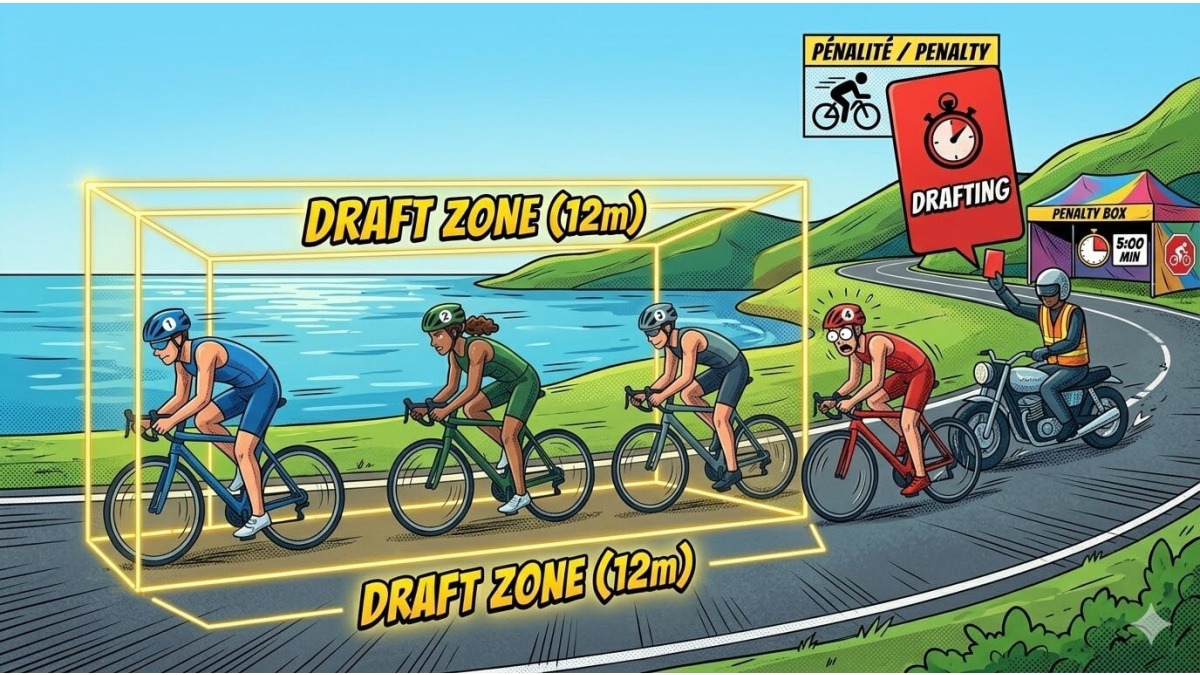
Triathlon is a demanding discipline where physical performance isn't everything. It's a sport of rules, governed by national federations (like FFTRI in France) and international ones (World Triathlon). For any athlete, whether they're in their first XS race or an IRONMAN®, ignorance of the rules can turn months of preparation into bitter disappointment. The card system isn't there to punish arbitrarily but to ensure fairness, participant safety, and respect for the environment. In this comprehensive guide, we will break down each card color, explain the "Penalty Box" procedures, and analyze the most common fouls like drafting or littering. Understanding the sanctions is key to crossing the finish line with a smile and without any added time. In triathlon, the referee (often called an "Official") is a race facilitator. Unlike in soccer, the referee is often mobile, on a motorcycle or on foot in the transition zones. An infraction is defined as any undue advantage gained by an athlete or any action that endangers others. There are three critical phases where penalties are most frequently given: The yellow card is the most common penalty. It is generally given for minor or technical fouls that can be corrected immediately. The reasons vary, but common ones include: The referee blows their whistle, shows the yellow card, and calls out your race number. In a short-distance race (S, M), the penalty is often a "Stop & Go": you must stop, listen to the referee's instructions, and can start again once the correction is made. For long-distance races, this can lead to a 30-second to 1-minute stop in the Penalty Box. The blue card is specific to non-drafting (Draft-Illegal) races. It's the nightmare of every long-distance triathlete. Drafting involves riding too close to the competitor in front to take advantage of their slipstream and save energy (up to 20-30% power savings). The standard World Triathlon rule specifies a draft zone of 12 meters long (measured from front wheel to front wheel) and 1.5 meters wide. The time spent in the "Tent" or "Penalty Box" depends on the race distance: ⚠️ Warning: In many events, accumulating two or three blue cards results in immediate disqualification (DSQ). The red card means the end of your race. It is a rare but final penalty that sanctions serious misconduct. An interesting study conducted by Bentley et al. (2002) in the journal "Sports Medicine" titled "The Physical Demands of Combined Endurance Sports" highlights the psychological impact of penalties. According to the research, a forced stop in the Penalty Box causes a drop in muscle temperature and a disruption of heart rhythm, which can increase the rating of perceived exertion (RPE) by 15% upon resuming. From a strategic standpoint, G. Millet's thesis on the physiology of long-distance triathlon shows that the stress generated by a penalty can induce an increased release of cortisol, accelerating glycogen depletion. In short, a penalty costs much more than just the minutes on the stopwatch. If you see a card being pointed at you: Respecting the rules is an essential component of the triathlon ethos. A complete athlete is an informed athlete. By mastering the subtleties of the yellow, blue, and red cards, you optimize your chances of success and contribute to the longevity of our sport. Remember: "Race hard, but race fair". Would you like me to create a specific training plan to improve your transitions and avoid yellow cards?Introduction: Why Master the Refereeing Color Code?
1. The Basics: Definitions and Refereeing Philosophy
🔍 What is an infraction in triathlon?
2. The Yellow Card 🟨: The Warning and Compliance Check
When do you receive a yellow card?
The Penalty Procedure
3. The Blue Card 🟦: The Scourge of Drafting
What is Drafting?
Time Penalty
Race Format
Bike Distance
Penalty Duration
M Distance (Olympic)
40 km
2 minutes
L Distance (Half-Ironman)
90 km
5 minutes
XXL Distance (Ironman)
180 km
5 minutes
4. The Red Card 🟥: Disqualification (DSQ)
Reasons for disqualification:
5. Scientific Analysis and Performance Data
6. How to React Correctly to a Referee?
Conclusion
🧠 FAQ - Everything About Triathlon Penalties
❓ Can I appeal a card after the race?
Yes, it's possible to file a protest with the race jury within 15 to 30 minutes of your finish, often requiring a financial deposit. However, referees' judgment calls (like drafting) are rarely overturned without irrefutable video evidence.
❓ Does the black card still exist?
In the regulations of the International Federation (World Triathlon), the blue card has replaced the black card for drafting penalties to better distinguish them visually.
❓ What happens if I throw my bottle on the ground?
"Littering" is being punished more and more severely. Depending on the race, it can range from a blue card (time penalty) to a direct red card (disqualification), especially in IRONMAN® branded events.
❓ Are headphones allowed?
No, headphones, earbuds, and phones are strictly forbidden for safety reasons. Using them generally leads to immediate disqualification.
❓ How long does a stop-and-go last?
A stop-and-go lasts as long as it takes to correct the foul (e.g., fastening your helmet) and for the referee to record it. It's a matter of seconds, but it completely breaks your rhythm.
❓ How many meters is the draft zone?
In most long-distance races, the zone is 12 meters. In some specific formats or regional races, it might be reduced to 7 or 10 meters. Always check the race briefing.