White Noise: How Mental Silence Can Boost Your Endurance in Trail Running
By Sarah — translated from an article by Pedro Published on 04/04/2026 at 08h30 Reading time : 7 minutes
The Deafening Silence of the Long-Distance Runner
You know that moment? You're deep into an ultra, hours into your run. Your legs start to feel heavy, your breath is short, and suddenly, a little voice pops into your head. Then another. And another. "Why am I doing this?", "I'll never make it", "I hurt all over", "I should have trained more on hills." It's a real racket, a ceaseless noise that saps your energy far more effectively than the steepest of climbs. For me, a former triathlete turned ultra-trail runner, this internal battle was long my greatest adversary. Far more than the miles or the elevation gain.
Then, over the course of races, failures, and small victories, I learned to cultivate something precious, a secret weapon I call "mental white noise." No, I'm not talking about putting on headphones with the sound of a waterfall in the middle of the forest! I'm talking about that state of inner calm, that silence where parasitic thoughts quiet down to make way for pure, total, almost meditative concentration. A state where body and mind become one with the trail. It's in this silence that an unsuspected reserve of endurance is hidden. That's where the magic happens. Ready to take on the challenge? Then follow me, I'll take you on the paths of your own silence.
Understanding Mental "White Noise" in Trail Running
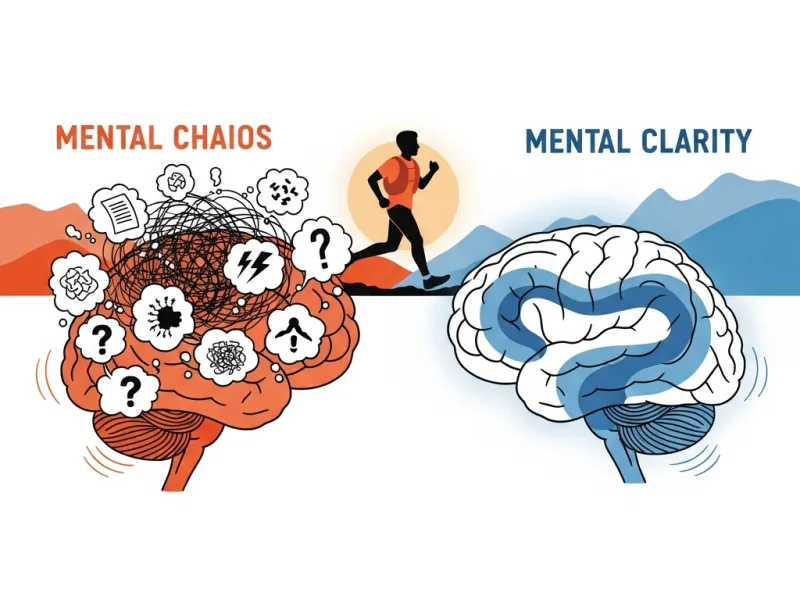
Before trying to achieve it, it's crucial to understand what this famous "mental white noise" is. The image is quite telling. In acoustics, white noise is a sound that contains all audible frequencies at equal intensity. The result? It has the ability to mask other sounds. A distant conversation, the ticking of a clock... everything is drowned out in this constant hum. The analogy for our mind is perfect: mental white noise is not the absence of thought, but a state of concentration so intense on the present moment that it "masks" the flow of useless and negative thoughts.
More Than an Absence of Thoughts, a State of Pure Concentration
Don't get me wrong. The goal is not to empty your mind. Trying to think of nothing is the best way to think of everything! It's a losing battle. Mental white noise is the opposite. It's about filling your mind, but with one single, chosen, and controlled thing. It's a state of hyper-presence. Your thoughts are no longer scattered between the past (your pacing mistakes) and the future (the distance left), they are anchored here and now: in the rhythm of your breathing, in the sensation of your feet hitting the ground, in the precise vision of the rock to avoid in three meters. The internal dialogue falls silent, not because we force it into silence, but because it no longer has room to exist. All your attention is requisitioned by the action.
The Inner Noise: Our Worst Enemy in Ultras
I have a painful memory of one of my first 100km races. Around the 70th kilometer, in the middle of the night, a pain in my knee flared up. Physically, it was manageable. But mentally, it was the beginning of the end. My brain went into overdrive: "What if it's serious?", "I'm going to have to drop out", "All this training for nothing", "The others are going to pass me." Every thought was a stab to my morale. I started running tensed up, which worsened the pain, which in turn fed my negative thoughts... a vicious cycle. I finished, but in terrible psychological suffering. It wasn't the pain that almost made me quit, it was the noise my mind made around that pain. This noise is what consumes your glucose, creates unnecessary muscle tension, and makes you make bad decisions (forgetting to eat, starting too fast...). It is your true adversary.
The Concrete Benefits of Mental Silence on the Trails
Learning to calm this noise isn't just about psychological comfort. It's an extraordinary performance lever. In the field, nothing replaces experience, and mine, as well as that of many athletes I coach, confirms that the benefits are tangible, measurable, and sometimes spectacular.
Better Management of Pain and Discomfort
Ultra-trail running is a test of endurance against pain. That's a fact. But there's signal-pain (an injury) and sensation-pain (muscle fatigue, discomfort). Mental noise has a nasty habit of turning the latter into the former. It tells a story around the sensation: "This cramp is the beginning of the end," "This fatigue is not normal." By cultivating mental silence, you learn to dissociate the sensation from the story. The pain becomes mere information. "Oh, my left quad is tight. That's normal after 8 hours of effort. I'll adjust my stride on the downhill and remember to hydrate well at the next aid station." You switch from panic mode to management mode. The difference is colossal. You are no longer a victim; you are in control.
Optimization of Running Economy
Stress and negative thoughts have a direct physiological cost. High shoulders, clenched jaw, jerky breathing... All these parasitic tensions burn precious energy. When your mind is calm and focused on the essential, your body follows. Your stride becomes smoother, more relaxed. Your breathing naturally synchronizes with your effort. You no longer waste energy fighting against yourself. Every movement is more efficient. This is what we call running economy: producing the same effort with less energy expenditure. And on an ultra, every calorie saved is a victory that will carry you miles further.
The Gateway to the State of Flow
This is the Holy Grail for any endurance athlete. That state of grace where everything seems easy, fluid, effortless. The effort is intense but doesn't feel costly. Time becomes distorted. You are completely immersed in the action. Well, mental white noise is the threshold to this state. It's impossible to enter the zone if your mind is a battlefield. By quieting the internal dialogue, you create the necessary conditions for flow to emerge. Silence is not the destination, but it is the gateway. To delve deeper into this fascinating subject, I recommend reading my complete guide on how to achieve a state of flow in triathlon and trail running. It's a perfect complement to understand how to transform this silence into pure performance.
Improved Decision-Making and Increased Lucidity
An ultra is a series of micro-decisions: When to drink? Which gel to take? Should I attack this climb or manage it? Should I put on my headlamp now or wait another 15 minutes? A mind cluttered with fear or doubt makes emotional, often poor, decisions. A clear, calm mind is much more connected to the body's signals and the environment. It analyzes information objectively. The decision to eat doesn't come from a panicked "I'm going to bonk," but from a fine-tuned listening to your body's real needs. This lucidity, maintained for hours, is what differentiates a race you endure from a race you master.
My Personal Techniques for Cultivating White Noise While Running
Alright, Pedro, that's all well and good in theory, but practically, on the trails, how do we do it? I'm getting to that! There's no "off" switch for the brain. However, there are simple and powerful techniques, real mental training exercises to practice while running. Here are the ones that have saved me an countless number of times. To each their own adventure, so test them and adopt the ones that speak to you the most.
1. Rhythmic Breathing: Your Anchor in the Present
This is the foundation of everything. When your mind starts racing, always come back to your breath. It's your most reliable anchor. My favorite technique is to synchronize it with my steps. It's simple and incredibly effective.
- On flat or gentle uphill sections: I inhale through my nose for three steps, then exhale through my mouth for three steps. This 3:3 rhythm is very calming.
- On steep climbs: I switch to a 2:2 rhythm. Inhale for two steps, exhale for two steps. This forces me to match my pace to my breath and not the other way around, preventing me from going into the red.
- On downhills: I practice a long, controlled exhalation to release tension. Inhale for 2 steps, exhale for 4 or 5 steps.
The important thing is to focus 100% of your attention on counting and the sensation of the air coming in and out. While you're doing this, the inner noise can't shout as loudly.
2. The Moving Body Scan
This technique, borrowed from mindfulness meditation, is incredibly effective for reconnecting with your sensations and releasing unnecessary tension. While running, bring your attention to each part of your body in succession.
- Start with your feet: Feel the contact with the ground, the roll of your stride.
- Move up to your calves, your thighs: Are they tense? Can you release a little tension there?
- Move to your pelvis, your core: Is your posture good? Is your core engaged but flexible?
- Shoulders and neck: This is often where stress lodges. Consciously lower your shoulders. Relax them.
- Arms and hands: Are your fists clenched? Open your hands, let your arms swing freely.
- Face: Unclench your jaw, smooth your forehead. A relaxed face leads to a relaxed body.
This scan takes only 30 seconds, but it instantly brings you back into your body, into the present moment.
3. Hyper-Focus on One Sense: Hearing or Sight
The brain has trouble concentrating on multiple things at once. Let's use this "weakness" to our advantage! Choose just one of your senses and immerse yourself in it.
- Hearing: Focus exclusively on the sounds around you. The crunch of your shoes on the gravel, a bird's song, the sound of the wind in the leaves, the gurgle of a stream. Try to distinguish each sound, to identify it. Don't judge them, don't analyze them, just listen.
- Sight: Focus your gaze and attention on a specific point. Not the distant landscape, but the trail right in front of you. Observe every detail: the color of the dirt, the shape of a root, the texture of a dead leaf, the play of light through the trees. Become an expert of the square meter passing under your feet.
By immersing yourself in one of these senses, you occupy your attentional channel and leave less room for parasitic thoughts.
4. The Mantra: A Simple Phrase to Occupy the Mind
A mantra isn't about self-deception. It's not about foolishly convincing yourself that everything is fine. It's a tool to replace a negative broken record with a neutral or positive loop. The mantra should be short, simple, and personal. It must resonate with you. Here are some examples:
- "Smooth and light": Ideal for downhills or moments when you feel heavy.
- "One step at a time": Perfect when the remaining distance seems insurmountable.
- "Strong and calm": To tackle a long climb without getting carried away.
- "Here and now": The ultimate mindfulness mantra.
Repeat it over and over, in rhythm with your breathing or your steps. The sound and vibration of these words in your mind will gradually take the place of the inner critic. In the field, nothing replaces experience, and I can tell you that my mantra has pulled me out of more than one mental dark place.
5. Accepting Thoughts Without Clinging to Them
This is perhaps the most subtle, but most liberating, technique. Sometimes, despite all your efforts, a negative thought will arise. "I'm in pain," "I'm tired." The worst thing to do is to fight it. If you tell yourself "I must not think that I'm tired," you only reinforce that thought. The trick is to observe it, acknowledge it, and let it pass. Imagine your thoughts as clouds in the sky. You are the sky, not the clouds. A dark cloud (a negative thought) arrives. You see it, you identify it ("Ah, there's the thought 'I'm tired'"), but you don't cling to it. You don't judge it. And you watch it drift away, carried by the wind, making way for a patch of blue sky. This attitude of non-judgment and detachment is a skill that develops with practice and changes absolutely everything.
Integrating the Practice Beyond the Trails
The ability to find mental silence in the midst of effort isn't something you can improvise on race day. It's a muscle that needs to be trained daily. If you wait until you're at the 80th kilometer to try to meditate, you're likely to be disappointed. The key is to integrate short practices into your everyday life to lower your baseline level of mental "noise."
Mindfulness Meditation: The Basic Training
No need to become a Buddhist monk. Start simple: 5 to 10 minutes each day. Sit quietly, close your eyes, and focus your attention on your breath. That's it. When your mind wanders (and it will, that's its job!), gently and without judgment, bring your attention back to your breath. Every time you do this, you strengthen your "attention muscle." This is the exact same mechanism you'll use during a race to return to your sensations or your mantra. Apps like Petit BamBou or Headspace are great for getting started.
Digital Detox and Exposure to Nature
We live in a world of constant stimulation. Notifications, emails, social media... Our brain is constantly solicited, which increases our general level of mental noise. Impose moments of disconnection on yourself. Leave your phone at home for a short run, go for a walk in the forest without music or podcasts. Re-accustom your mind to quiet, to a slower pace. Exposure to nature has also been proven to be an excellent way to reduce stress and mental rumination. Take advantage of it, it's our playground!
Conclusion: To Each Their Own... Inner Adventure
As you've understood, the next frontier in your trail running progress may not be in a new pair of shoes or a tougher training plan. It's likely right there, between your two ears. Learning to cultivate mental white noise, this active and focused silence, is giving yourself the means to unlock your true physical potential. It's transforming suffering into information, doubt into concentration, and effort into fluidity.
This won't happen overnight. It will be a journey, with ups and downs. There will be runs where the noise wins, and others where you'll get a glimpse of that magical silence. Be patient and kind to yourself. Experiment with the techniques I've shared, adapt them, invent your own. To each their own adventure, and this one, the inner adventure, is undoubtedly the most exciting of all.
So, the next time you lace up your shoes, remember to train not only your legs, but also your mind. Ready to take on the challenge and listen to the silence?
Frequently Asked Questions about Mental Silence in Trail Running
Is mental "white noise" the same as thinking about nothing?
No, absolutely not. Trying to think about nothing is often counterproductive. Mental white noise is a state of intense concentration on a single point (breath, sensations, a mantra), which has the effect of "masking" the flow of parasitic thoughts. It is not an empty mind, but a focused and disciplined mind.
How long does it take to master these techniques?
There's no set rule, as it's a continuous training process, just like physical training. Some will feel benefits from the very first runs by applying them, especially with breathing techniques. To achieve a stable state of silence, it requires regular practice, both during runs and through short daily meditation sessions. The key is consistency, not intensity.
Can listening to music or podcasts help achieve this mental silence?
It's a complex topic. For some, music can help occupy the mind and avoid negative thoughts, acting as a sort of "external white noise." However, it can also disconnect you from your bodily sensations and the environment, which is crucial in trail running. My advice is to use it sparingly, perhaps to get through a low point, but to first and foremost learn to find calm without external aids.
Is this approach useful for short trail runs or only for ultras?
It's useful for all distances! On a short trail run (20-40 km), the intensity is higher, and the ability to stay focused and manage pain is a major performance factor. Mental silence allows you to push your limits and maintain an effective running technique all the way to the finish line. In an ultra, it's a matter of mental survival, but the benefits are universal.