The Caffeine Protocol: Taper Off to Supercharge Your Ultra-Trail Performance
By Sarah — translated from an article by Clara Atem Published on 29/09/2026 at 08h31 Reading time : 9 minutes
The morning ritual, that sacred act before lacing up your shoes...
You and I, we know this moment well. The alarm goes off long before the sun, the house is silent. The first thought, even before picturing the day's vertical gain, is that steaming cup. The smell of coffee spreading through the kitchen is like the first comfort, the first victory of the day. For many of us, endurance athletes, coffee isn't just a drink; it's a companion on the road, a true ritual that gets the engine started.
And yet, for a few years now, we've been hearing more and more in the running packs about this famous "caffeine protocol" or "caffeine taper." The idea? To give up our hallowed coffee for a few days or weeks before a major goal, like an ultra-trail. Sacrilege, you think? I admit, the first time I heard about it, I rolled my eyes. Me, Clara, giving up my morning espresso before a big race prep? Unthinkable.
But curiosity, and especially the desire to squeeze out a few extra percentage points of performance, pushed me to dig deeper. Out in the field, I tested, I fumbled, I experienced the withdrawal headaches and the euphoria of rediscovering that "kick" mid-race. And today, I can tell you: when done right, this protocol is not a gimmick. It's a formidable strategic weapon for tackling the long hours and sleepless nights of an ultra. So, are you ready to put your body in "reset" mode to unleash its full potential? Follow me, I'll explain everything, without jargon, and with real-world experience. Pure and simple.
Why Caffeine is Our Best Friend (Most of the Time)
Before we talk about giving it up, we need to understand why we love it so much. Caffeine isn't just a psychological placebo; it's one of the most studied and scientifically validated ergogenic aids (meaning it improves performance). For us trail runners, its benefits are numerous and particularly interesting.
Caffeine's Superpowers for the Endurance Athlete
When you down a caffeinated gel or your coffee, several mechanisms kick into gear in your body. Without drowning you in biochemistry, here are the concrete effects you feel:
- Reduced Perception of Effort: This is perhaps its most magical effect. Caffeine acts on the central nervous system and, by blocking adenosine receptors (the molecule that signals fatigue), it makes the effort feel less difficult. The same climb will seem a little less grueling, the same pace a little easier to maintain. In an ultra, this feeling can make a huge difference to your morale.
- Improved Alertness and Concentration: After 15 or 20 hours of running, in the middle of the night, lucidity is not our strong suit. Roots become traps, and calculating arrival times at the next aid station becomes as complex as a high school math problem. Caffeine stimulates the brain, helping you stay alert, focused on your stride, your nutrition, and your navigation. It's a real safety asset.
- Optimized Fat Utilization: Caffeine promotes lipolysis, which is the breakdown of fats to produce energy. By using more of your lipid reserves (which are nearly inexhaustible, even in the leanest among us), you spare your muscle glycogen stores, our "premium" fuel for intense efforts. The result: you push back the infamous "wall."
On the Ultra-Trail Course: An Indispensable Ally
Picture this. It's 2 a.m., and you're in the heart of the Beaufortain massif. The beam of your headlamp dances on the damp trails, and the cold is starting to bite. Sleep is creeping in, every step an effort of will. This is where your caffeinated gel comes into play. Thirty minutes later, the mental fog lifts, your legs respond a little better, and you have the strength to push on to the next aid station. That's the effect of caffeine in an ultra. It's not a jolt that makes you sprint, but a precious aid that allows you to keep moving forward, to manage, to stay in your race.
I have a very clear memory from the TDS®. I was in a state of extreme, almost nauseous fatigue after a difficult night. At the Bourg-Saint-Maurice aid station, I almost dropped out. A volunteer simply handed me a cup of Coke. I drank a few sips without much conviction. Twenty minutes later, as I started the climb towards Passeur de Pralognan, I felt like I was coming back to life. The combined effect of the sugar and caffeine had restarted the engine. It's in moments like these that you understand its power.
The Caffeine Paradox: When Habit Cancels Out the Benefit
If caffeine is so great, why on earth would you want to give it up? This is where the concept of tolerance comes in. Your body is an incredibly intelligent machine that is constantly seeking balance. And when you give it caffeine every day, it adapts.
Tolerance: How Your Body Becomes "Desensitized"
To put it simply, caffeine works by binding to adenosine receptors in your brain. Adenosine is the molecule that accumulates throughout the day and tells you, "Hey, it's time to sleep." By blocking its spot, caffeine prevents this message from getting through, and you feel more awake.
But here's the catch: if you drink coffee every day, your brain says, "Okay, there's an intruder blocking my receptors. To compensate, I'll just create new ones!" It's a defense mechanism. The result? You need more and more caffeine to get the same stimulating effect. Your morning coffee no longer gives you a boost; it just allows you to feel "normal" and avoid a headache.
On race day, when you take your caffeinated gel, the effect will be greatly diminished. You'll still get the benefits for fat utilization, but the mental boost and the reduced perception of effort will be almost non-existent. You lose the main advantage of the substance. A pity, isn't it?
The Side Effects We Too Often Forget
Chronic high caffeine consumption is not without consequences, especially for an athlete whose recovery is key to progression:
- Decreased Sleep Quality: Even if you feel like you're sleeping well, caffeine (especially when consumed in the afternoon) can disrupt deep sleep cycles, the most restorative phase. Poor recovery hinders your training adaptations.
- Stress and Anxiety: Caffeine stimulates the production of cortisol, the stress hormone. During periods of heavy training load, when the body is already under pressure, adding another layer can be counterproductive.
- Masking Real Fatigue: The biggest trap! Drinking coffee to "get through" a workday after a tough session the day before prevents you from listening to your body's signals. You're pushing your limits, and that's an open door to overtraining or injury.
The Taper Protocol: Resetting Your Body for Maximum Effect
This is where our famous protocol comes into play. The idea is brilliantly simple: by temporarily stopping all caffeine consumption, you force your brain to clean house. It will gradually reduce the number of adenosine receptors to return to its baseline state. You will, in a sense, "re-sensitize" your body.
The Goal: A Multiplied Effect on Race Day
Imagine the difference. After 10 to 15 days without a drop of caffeine, your receptors have become ultra-sensitive again. On the day of the ultra, when you take your first dose, the effect will be immediate and powerful. It's like going from a small, dim bulb to a full-power spotlight. That "boost" you haven't felt in years will be back, right when you need it most. It's a significant competitive advantage, but above all, an incomparable comfort during the race.
Perfect Timing: When and For How Long?
The tricky question: how long do you have to suffer? There's no absolute rule set in stone, but science and field experience give us some good pointers.
- The Short Taper (5-7 days): This is the bare minimum. It already allows for good re-sensitization. The advantage is that the withdrawal symptoms are shorter. It's a good option if you are very dependent and the idea of a long taper paralyzes you.
- The Standard Taper (10-14 days): For me, this is the ideal sweet spot. It's the duration that seems to offer the best benefit-to-drawback ratio. In two weeks, your body really has time to "cleanse" itself. This period often coincides with the pre-race taper phase, where training volume decreases, making the withdrawal fatigue more manageable.
- The Long Taper (21 days or more): Some athletes go for up to 3 or 4 weeks. Honestly, studies don't show a significantly greater benefit after 14 days. The main risk is suffering the negative effects of withdrawal (fatigue, irritability) for too long, which can impact the end of your preparation.
My advice? Aim for 10 to 14 days before your goal race. That's more than enough to get an explosive effect on race day.
My Practical Guide: Implementing Your Taper Step by Step
Okay, theory is all well and good. But how do you do it in practice? I'll guide you step by step. The idea is to go gently so that it doesn't become an additional source of stress.
Step 1: Inventory the (Hidden) Enemy
The first thing to do is list ALL sources of caffeine in your diet. We often think of coffee, but it hides everywhere:
- Coffee: Espresso (about 60-80 mg), filter coffee (up to 150 mg), instant coffee...
- Tea: Especially black and green tea (30-50 mg per cup).
- Sodas: Most colas contain between 30 and 40 mg per can.
- Energy drinks: Be careful, they are highly concentrated (80 mg and up).
- Dark chocolate: The higher the cocoa content, the more caffeine it contains (up to 30 mg for 40g of 70% chocolate).
- Certain supplements or medications: Read the labels on painkillers or pre-workout boosters carefully.
During your taper, all of this must be eliminated or drastically reduced.
Step 2: Choose Your Method: Cold Turkey or Gradual?
There are two schools of thought. It's up to you to see which one best suits your temperament.
- The "Cold Turkey" Method (abrupt stop): From one day to the next, you cut everything out. It's fast, direct. The upside is that the most difficult phase of withdrawal symptoms (the first 2-3 days) is intense but short. The downside... is that it's very intense. Severe headaches, extreme fatigue, irritability... If you have a demanding job or young children, it can be difficult to manage.
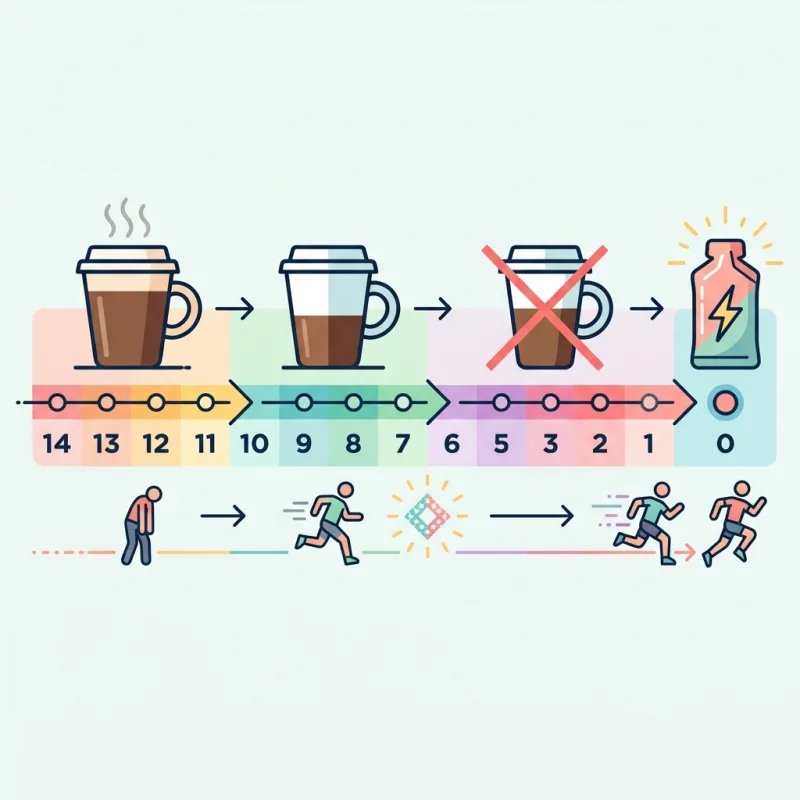
- The Gradual Method (my favorite): This is the gentlest and, in my opinion, the smartest approach for an athlete. The idea is to reduce gradually over several days. For example, for a 14-day taper:
- From D-14 to D-11: Cut your usual consumption in half. If you drank 2 coffees, switch to just one.
- From D-10 to D-7: Switch to decaf (which still contains a tiny amount of caffeine, perfect for the transition) or a very light tea in the morning.
- From D-6 to Race Day: Zero caffeine. The final stop will be much less abrupt.
Step 3: Manage Side Effects Like a Pro
Let's not kid ourselves, there will be tough moments. But with a few tricks, it's quite manageable.
- For headaches: This is the number one symptom. The key is HYDRATION. Drink plenty of water throughout the day. Peppermint tea can also help. If the pain is too strong, don't hesitate to take a paracetamol; there's no shame in it.
- For fatigue: Accept it. Your body is rebalancing. Take advantage of the taper phase to take naps. Go to bed earlier. The first training sessions of the withdrawal week may feel laborious. That's normal! Don't panic, your fitness hasn't disappeared; it's just the withdrawal speaking.
- Finding substitutes for the ritual: Often, it's the habit we miss. Replace your coffee with an herbal tea, a ginger infusion, chicory, or simply a large glass of lemon water. The important thing is to keep that little moment for yourself.
Race Day: How and When to Reintroduce Caffeine for the Knockout Punch
The taper is over. You're on the starting line. Now is when the effort pays off. But be careful, reintroducing caffeine must be as strategic as stopping it.
Timing the First Dose: Don't Rush It!
The classic mistake is to take a caffeinated gel just before the start or in the first hour. It's useless! At the beginning of an ultra, the adrenaline and excitement of the race are more than enough of a stimulant. Save that bullet for later.
My advice: Wait for the first signs of mental or physical fatigue. Usually, this happens after 3 to 5 hours of racing, or just before tackling a section you know is difficult (a long climb, the start of the night). That's when the effect will be most beneficial.
What Form and What Dosage? Precision is Key
During the race, you should opt for forms that are easy to digest and have a precise dosage:
- Caffeinated gels, chews, or sports drinks: These are ideal. Absorption is fast, and you know exactly how many mg you are ingesting. Most gels contain between 30 and 75 mg of caffeine.
- Caffeine pills: Very effective and concentrated (often 100 mg). Use with caution and only if you have tested them before. The effect is powerful.
- Coffee or cola from aid stations: This is more random. The dosage is imprecise, and the acidity of coffee can sometimes be hard on a stomach weakened by effort. It's more of a comfort treat than a fine-tuned nutritional strategy. Save it for moments when your morale really needs a boost.
Regarding the total dosage, the scientific recommendation is between 3 and 6 mg of caffeine per kilogram of body weight, spread throughout the race. For a 70 kg person, this represents between 210 and 420 mg. Be careful not to exceed 400-500 mg over 24h, as this could lead to significant side effects (tachycardia, anxiety, digestive issues).
My Proposed Strategy for an Ultra
Here is an example of an intake plan, to be adapted, of course, to how you feel and your own tolerance:
- Hour 4: First dose, 50 mg (e.g., one gel). To get the engine started gently.
- Hour 8 (before nightfall): 75 mg. To prepare the body and mind for the long watch.
- Hour 12 (middle of the night): 50-75 mg. To fight the major fatigue slump around 2-3 a.m.
- Hour 16 (daybreak): 50 mg. To accompany the return of daylight and get a fresh start.
- Hour 20 (final phase): 50 mg. The last bullet to finish strong.
The idea is to smooth out the intake, with a dose every 3 to 4 hours, to avoid energy spikes and crashes.
Mistakes to Avoid: My Lessons Learned the Hard Way
This protocol is powerful, but it can also backfire if executed poorly. Here are the traps to avoid, take it from my experience.
Mistake #1: Starting Without a Prior Test
NEVER do a taper for the first time before your goal race of the year. Test it beforehand, during a prep race or a big training weekend. This will allow you to see how your body reacts to the withdrawal and, more importantly, to the reintroduction of a caffeine dose during exertion.
Mistake #2: Overdosing on Race Day Thinking "More is Better"
Since your body is re-sensitized, a normal dose will already have a powerful effect. If you overdose, you risk a disaster scenario: palpitations, tremors, heightened anxiety, and especially, digestive issues that could force you to drop out. Stick to your plan and listen to your body.
Mistake #3: Forgetting That Caffeine is No Substitute for Sleep or Training
It's a tool, not a magic potion. It won't turn a shaky preparation into a podium finish. The foundation remains solid training, good sleep management, and impeccable overall nutrition. Caffeine is the icing on the cake. A well-prepared mind is just as, if not more, crucial. You have to learn to play with your thoughts, and on that point, I invite you to read my article on neuro-nutrition, a formidable weapon against the desire to quit.
Conclusion: Become the Strategist of Your Own Energy
As you've understood, the caffeine taper protocol is much more than a simple trick. It's a true strategic approach that invites you to better understand how your body works and to no longer be a victim of your consumption, but to use it intelligently. Yes, it requires a little effort and a few less pleasant days. But the reward on race day is well worth it.
Rediscovering that feeling of clarity and energy in the middle of the night, just when everything seems to be shutting down, is an invaluable aid. It's a powerful tool for pushing your limits, but never forget the essentials: performance in ultra-running is a complex alchemy of the physical, the mental, and nutrition. And in the midst of it all, there's the most important thing: the adventure, the landscapes, and surpassing yourself. So, be strategic, be attentive, but never forget to have fun above all.
Frequently Asked Questions about the Caffeine Protocol
Is a caffeine taper really essential to succeed in an ultra-trail?
No, it's not essential. Many athletes achieve great performances without ever doing a taper. However, it is a strategic tool to maximize the ergogenic effects of caffeine on race day. If you are a regular consumer, the taper will allow you to rediscover a "boost effect" that you had probably lost due to tolerance.
What are the worst withdrawal symptoms and how can they be effectively relieved?
The most common and unpleasant symptom is a headache, which can be quite intense for the first 2-3 days. To relieve it, hydrate abundantly (at least 2L of water per day) and don't hesitate to take a simple painkiller like paracetamol. Fatigue and irritability are also common. The best solution is to anticipate this by lightening your schedule and allowing yourself to take naps.
Can I drink decaffeinated coffee during the withdrawal period?
Yes, it's actually an excellent trick, especially if you're following a gradual withdrawal method. Decaffeinated coffee still contains a very small amount of caffeine (2-5 mg per cup), which helps to lessen withdrawal symptoms without preventing the re-sensitization of receptors. It's ideal for the transition and for keeping the pleasure of the ritual.
I'm starting my taper 10 days before the race. If I take caffeine on race day, won't it upset my stomach?
That's a legitimate concern, but generally, it's not an issue if you follow two golden rules. First, use forms of caffeine that you have already tested in training (gels, drinks...). Never test a new product on race day. Second, start with moderate doses (30-50 mg) and space out your intake. The risk of gastric distress is more related to an overdose than to the reintroduction itself.