Exogenous Ketones in Ultra-Trail: The Miracle Fuel to Finish Your Races?
By Sarah — translated from an article by Clara Atem Published on 31/03/2026 at 08h31 Reading time : 8 minutes
Exogenous Ketones: The Buzz Shaking Up the Endurance World
Hey there, fellow trail and long-distance challenge enthusiast! Clara here. If you follow the world of endurance sports, you couldn't have missed it. We see them in the bottles of Tour de France cyclists, we hear about them in the paddocks of triathletes in Hawaii, and now, they're showing up in our ultra-trail packs. I'm talking, of course, about exogenous ketones. These little vials, priced like a fine wine, promise the world: inexhaustible energy, unwavering mental clarity, accelerated recovery... In short, the panacea for us, the folks crazy about elevation gain and infinite distances.
But as a former athlete and an eternally curious person, my "snake oil" radar goes off pretty quickly. Is this a real metabolic revolution or just a very well-orchestrated marketing stunt? Is the promise too good to be true? So I decided to dig into the subject, to break down the science, but above all, to do what I love most: test it. In the field. Because that's where, and only where, you can truly judge the effectiveness of a nutritional strategy. Far from labs and charts, with mud under your shoes and lactic acid burning in your thighs.
In this article, I'm going to share my entire journey with you: from understanding what a ketone is to my full-scale test during a long mountain run. We're going to weigh the pros and cons, no holds barred. My goal? To give you all the information you need to form your own informed opinion. So, lace up your shoes, we're heading out on a long exploration into the heart of our energy cells. I promise, we'll try to make this as digestible as possible. Plain and simple.
What Exactly Are Ketones? A Guide for Non-Chemists
Before grabbing the first vial you see, let's take a moment to understand what we're talking about. Don't worry, I promise not to drown you in impenetrable scientific terms. The idea is to grasp the concept, because that's the foundation of everything.
Endogenous vs. Exogenous: A Fundamental Difference
Originally, ketone bodies are molecules that our body produces naturally. These are called endogenous ketones (endo = inside). This process, ketogenesis, kicks in when we lack carbohydrates, our main fuel. Imagine a situation of prolonged fasting or a very low-sugar diet (the famous "keto" diet). Your glycogen reserves (the storage form of sugar in the muscles and liver) are at rock bottom. To keep functioning, and especially to fuel our brain, which is a huge energy consumer, our body is a formidable machine: it starts to break down fats on a massive scale. This breakdown produces ketone bodies, mainly beta-hydroxybutyrate (BHB), which can then be used as an alternative energy source.
Exogenous ketones (exo = outside) are something else entirely. These are the ones found in dietary supplements. By drinking them, you're directly supplying your body with ketones, without needing to fast for days or follow a drastic diet. So, in theory, you can benefit from this energy source while continuing to consume carbohydrates. And that's where it becomes potentially very interesting for us endurance athletes.
The "Fourth Fuel": The New Piece of the Energy Puzzle?
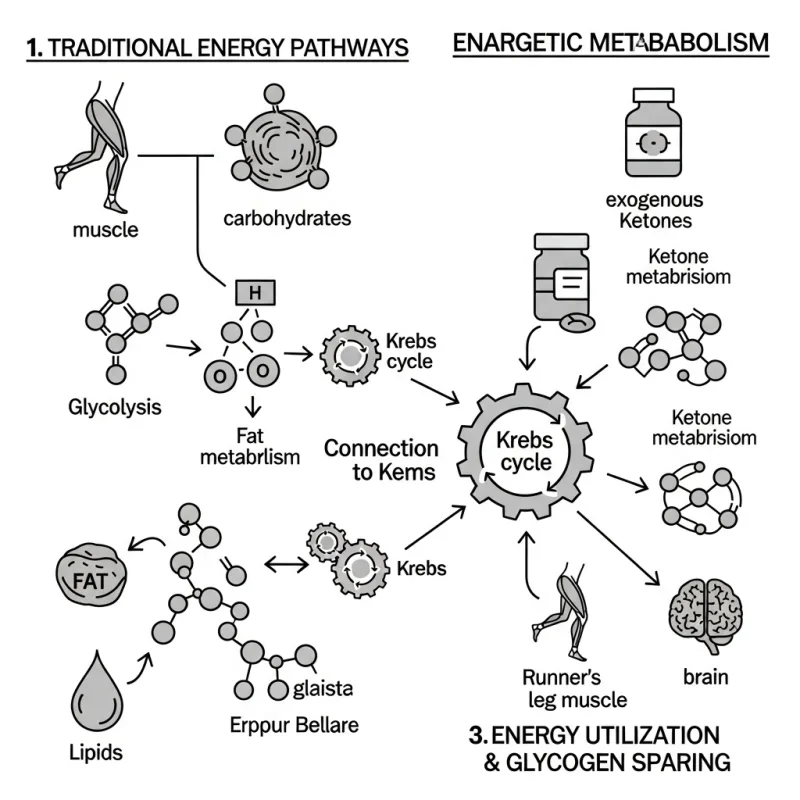
We've always been taught that our muscles run on three energy sources:
Exogenous ketones present themselves as a fourth fuel. An energy source that doesn't directly compete with other metabolic pathways. The idea isn't to replace carbohydrates, but to work in parallel. This is the "dual fuel" paradigm. Imagine your body as a hybrid engine: it can run on gasoline (carbohydrates) and electricity (ketones) at the same time. This ability to use both carbohydrates and ketones simultaneously could offer a unique metabolic advantage, especially as the race hours pile up.
The Science Behind the Vial: What Does the Research Say?
Okay, the concept is appealing on paper. But what about the scientific evidence? Because we're all familiar with marketing promises. What we're interested in are the facts. Research on exogenous ketones in sport is relatively new but very active, primarily driven by teams of renowned researchers.
Glycogen Sparing: The Ultimate Promise
The most exciting theory for ultra-endurance is that of glycogen sparing. The dreaded "wall" that every runner fears is often the result of an almost complete depletion of our glycogen stores. If ketones can provide some of the energy needed for the effort, then, logically, we should draw less on our precious sugar reserves. These would then be preserved for later, for the end of the race, for that final climb where everything is on the line.
This is exactly what was highlighted in a pivotal study published in 2016 in the prestigious journal Cell Metabolism by Professor Peter Hespel's team at the University of Leuven (KU Leuven). In this study on trained cyclists, consuming ketone esters during exercise reduced the use of muscle glycogen. The athletes using ketones showed their bodies preferred this new fuel, leaving the glycogen aside. On paper, this is the Holy Grail for an ultra-trail runner. Keeping your reserves intact for longer means pushing back failure.
Mental Clarity and Reduced Central Fatigue
Beyond the legs, an ultra is also won in the head. Who hasn't experienced that "brain fog" after 15 hours of racing? The difficulty in calculating a split time, deciding whether to put on a jacket or not, or even following the course markers. This is called "central" fatigue; it comes from the brain.
And the brain loves ketones. It's even its preferred fuel when glucose is scarce. The hypothesis is that providing exogenous ketones during a prolonged effort could help maintain optimal cognitive function. Less perceived fatigue, better concentration, more lucid decisions... These are significant assets when you have to navigate a technical trail at 3 a.m. with a flickering headlamp. Some athletes report a feeling of "calm" and "focus" after taking them, which could be linked to this effect on the central nervous system.
And What About Recovery?
The promise of ketones doesn't end at the finish line. Several studies suggest they could also play a crucial role in recovery. How? By accelerating post-exercise glycogen resynthesis. After a race, it's vital to replenish our sugar stores as quickly as possible. Taking ketones along with a recovery drink rich in carbohydrates and protein seems to amplify this restocking process.
Furthermore, ketones are thought to have anti-inflammatory and anti-catabolic (limiting muscle breakdown) properties. In practical terms, this could mean less muscle soreness, faster repair of damaged muscle fibers, and therefore a smoother return to training. We all know what it's like to finish an ultra walking like a cowboy. If a small vial can reduce that period of suffering, the idea is certainly tempting.
My 'In the Field' Experience: A Full-Scale Test in the Alps
Theory is all well and good. But as I told you, nothing beats experience. So I ordered a starter pack from one of the most reputable brands of ketone esters. My wallet cried a little, but my curiosity was too strong. My goal: to see for myself, without any preconceptions, what it was like in a format that speaks to me.
The Test Protocol: A Demanding Long Run
I chose a 55 km loop with 3500m of elevation gain around Chamonix as my playground. It's a route I know well, demanding, with long climbs and technical descents. A kind of concentrated ultra, perfect for pushing the body. The estimated time: between 8 and 9 hours.
My protocol was simple:
- Base Nutrition: My usual strategy. Gels, bars, fruit pouches, and some salty snacks. About 60g of carbs per hour. I changed nothing about my habits to isolate the effect of the ketones as much as possible.
- Ketone Intake: The most common protocol suggests one dose (about 25g of esters) every 3-4 hours. So I planned for one vial at the start, one after 3 hours of effort, and a final one after 6 hours.
First Impressions: An... Unforgettable Taste! 🤢
I mentioned it, and I have to be honest: the first sip is a shock. Imagine a mix of paint thinner, jet fuel, and bitter berries. It's absolutely vile. You have to be really motivated to swallow it. I chased it down with a good gulp of water and a fruit pouch, but the acrid aftertaste lingered for a while. This is a point not to be overlooked: if you have a sensitive stomach, it could be a deal-breaker.
After that difficult moment, I didn't feel any immediate effect, no sudden boost, no nausea. Just the feeling of having ingested a chemical. I started my first climb, focused on my sensations.
In the Thick of It: Surprising Stability
It was after about 4-5 hours that I started to notice a difference. Usually, that's when I start to feel the first signs of fatigue, when I have to be very vigilant about my nutrition to avoid bonking. This time, I felt a surprising energy stability. No euphoric peak after a gel, but no dip either. It was a linear, constant energy. A bit like my engine was running at a very efficient cruising speed, without ever racing or sputtering.
I continued to take my gels and bars, but more out of habit and automation than a real feeling of hunger or need. It's a difficult sensation to describe, a feeling of quiet strength. On the last big climb, after 7 hours of effort, where my mind usually starts to waver, I was still surprisingly lucid. Focused on my stride, able to enjoy the scenery. That was probably the most striking effect.
The Post-Effort Verdict: Less Pronounced Muscle Soreness
Back at the car, I was tired, of course, but not wiped out as I might have been after such an effort. I took one last half-dose of ketones with my recovery drink. The next day and the day after, the surprise continued. The muscle soreness was there, but much less debilitating than usual. I felt like I had recovered from a 5-hour run, not an 8.5-hour one. The feeling of heaviness and inflammation was significantly reduced.
Pros and Cons: The Balance for the Ultra-Trail Runner
After this test and my research, it's time to lay things out. Exogenous ketones are a complex tool, with real advantages but also major drawbacks that you absolutely must know before diving in.
The Real Potential Upsides:
- Energy Stability: For me, this is the most tangible benefit. Less of a glycemic roller coaster, which allows for a calmer effort management.
- Glycogen Sparing: Science confirms it and my experience suggests it. Keeping some gas in the tank for the end is a huge strategic advantage in an ultra.
- Mental Clarity: The nootropic effect is real. Staying lucid to manage your race, your nutrition, and unforeseen events is a key factor for success.
- Improved Recovery: Less muscle damage and faster rebuilding promises a better ability to string together training sessions or a more pleasant post-race experience.
The Drawbacks and Dangers to Be Aware Of:
- The COST 💰: This is the main obstacle. We're talking 30 to 40 euros per 25g vial. For an ultra like the UTMB®, where you might need 6 to 10, the budget can exceed 300 euros. It's a colossal investment, reserved for an elite or very wealthy enthusiasts.
- The TASTE: As I said, it's terrible. The risk of nausea or gastrointestinal issues is very real. If your stomach says no at the 80th kilometer, your race is over. It's a risky bet.
- INDIVIDUAL RESPONSE: We are all different. My positive experience doesn't guarantee you'll have the same. Some athletes feel no effect, while others simply can't tolerate them. The only way to know is to test.
- LACK OF LONG-TERM DATA: Studies often focus on 2-3 hour efforts, on highly trained male cyclists. What about efforts of 20, 30, 40 hours? What about for women? For mid-pack runners? There are still many gray areas.
Practical Guide: Whether (or Not) to Integrate Ketones into Your Strategy
Are you intrigued and wondering if you should give it a try? Here are a few pointers to help you decide and, if you do, to do it smartly.
For Whom and When? The Right User Profile
Let's be clear: ketones are not for everyone. If you're new to ultras, if you haven't yet optimized your training, sleep, and basic nutrition, forget it. You'd be throwing money down the drain. Ketones are about optimization, about the famous "marginal gains."
They are better suited for the experienced athlete who knows their body perfectly, who already has a solid nutrition strategy, and who is looking to take it to the next level on very long distances (100 km and over). It's a tool to consider for a major goal of your season, not for the local village race on Sunday.
My Recommended Testing Protocol (If You Want to Give It a Go)
If you decide to take the plunge, the golden rule is: NEVER, EVER, TEST IT DURING A RACE! That's the best way to ruin everything.
- Start small: Buy one or two vials to see if you can handle the taste and if there are any digestive side effects. Try a half dose during a normal run.
- Simulate the race: If the first test goes well, organize a long run that mimics the conditions of your goal race (duration, elevation gain, intensity). Apply the protocol you're considering for your race (e.g., 1 dose every 3-4 hours).
- Don't change anything else: Keep the exact same nutrition plan you usually use. Ketones are an addition, not a replacement. They work TOGETHER with carbohydrates. Trying to eliminate gels would be a serious mistake. This is actually an interesting angle for those who, like me, sometimes struggle with sugar fatigue in ultra-trails, as they might allow for a slight reduction in carb load without a performance drop.
- Analyze your sensations: Take notes. How do you feel? Your energy level? Your concentration? Your digestion? Be honest with yourself.
Salts or Esters: What's the Difference?
You'll find two main families of exogenous ketones on the market: ketone salts and ketone esters. Without getting into overly technical details, remember this:
- Ketone salts: BHB is bound to a mineral (sodium, potassium...). They are a bit more affordable, their taste is often masked and more tolerable. However, they are less effective at quickly raising blood ketone levels and can add a significant salt load, which can be problematic in an ultra.
- Ketone esters: BHB is bound to an alcohol molecule. These are the ones used in most of the convincing scientific studies. They are much more potent, act faster, but they are also the most expensive and have the most atrocious taste.
For performance use, esters are currently considered the gold standard, despite their drawbacks.
So, Miracle or Mirage? My Verdict as a Trail Runner
So, should you empty your savings account for this space-age fuel? My answer is nuanced. No, exogenous ketones are not the miracle fuel that will get you through an ultra without training. They will never replace months of serious preparation, good race management, and solid base nutrition.
However, I don't think it's just a mirage either. It's a cutting-edge tool, a fascinating biochemical advancement that, when used intelligently by the right athlete at the right time, can genuinely offer an advantage. More stable energy, a clearer mind, better recovery... these are concrete benefits that I was able to feel.
The real barrier today remains their prohibitive cost and foul taste, which reserve them for a small fraction of the running field. But technology is evolving quickly. Perhaps in a few years, more affordable and palatable versions will be available for everyone.
In the meantime, my advice remains the same: focus on the fundamentals. Training, enjoyment, listening to your body. If, and only if, you feel you've optimized everything else and your curiosity is itching, then you can consider experimenting, with caution and a methodical approach. But never forget the most important thing: enjoying yourself above all. That’s the most powerful and sustainable fuel you’ll ever find. It’s as simple as that.
Frequently Asked Questions about Exogenous Ketones in Trail Running
Do exogenous ketones make you lose weight?
No, this is a very common misconception. The state of nutritional ketosis (achieved through a very low-carbohydrate diet) can lead to weight loss. However, exogenous ketones are a source of calories (about 4 kcal per gram). Consuming them in addition to your regular diet will not cause any weight loss. Their purpose in a sports context is performance, not weight loss.
Is it considered doping?
Currently, no. Exogenous ketones are not on the World Anti-Doping Agency (WADA) list of prohibited substances. They are considered a nutritional supplement, just like energy gels or protein powders. Their use is therefore completely legal in competition.
What is the budget for using ketones in an ultra?
The budget is very substantial and is the main obstacle. A single dose (one vial) typically costs between 30 and 40 euros. For a 100-mile ultra (about 24 to 48 hours of racing), an effective protocol might require a dose every 3 to 4 hours, which means between 6 and 12 doses. The budget for a single race can therefore easily range from 200 to over 400 euros.
Can I replace all my gels with ketones?
Absolutely not, and it would even be counterproductive. Research shows that ketones are most effective when consumed WITH carbohydrates. The body then uses both energy sources in parallel (the "dual fuel" model). Cutting out your carbohydrate intake during an ultra would lead you straight to failure. Ketones should be seen as a supplement to your usual nutritional strategy, not a substitute.